
Car allowance
A car allowance is a fixed amount an employer pays each month to an employee who uses their own car for work, to cover fuel, insurance, maintenance and wear. It is simple to run, but in the US it is usually taxed as wages unless it is paid under an accountable plan.
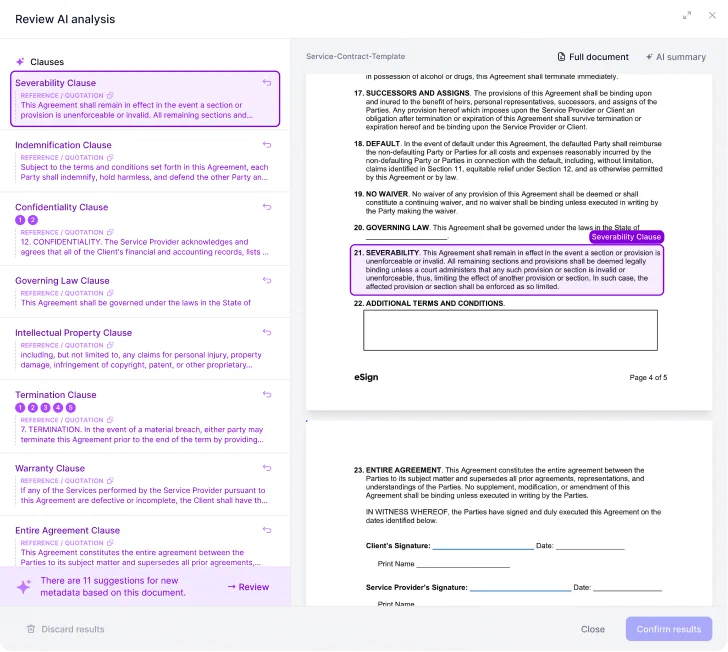
Analyze your contracts. Extract important clauses.
Try our AI contract analysis and extract important clauses and information from existing contracts.
Save your favourite clauses
Insert directly with a single click
Upload preferred precedents
Sample Car allowance clauses
(4) Includes (a) $13,200 of 401(k) contributions and $29,755 of health insurance premiums paid on behalf of Mr. Cowart, and $9,000 of car allowance paid to Mr. Cowart (2023); and (b) $11,634 of 401(k) contributions and $28,168 of health insurance premiums paid on behalf of Mr. Cowart, and $7,350 of car allowance paid to Mr. Cowart (2022).
Amounts reported in the “All Other Compensation” column include company contributions to the Named Executive Officers’ 401(k) plan retirement accounts, car allowance amounts, and employer-paid life insurance premiums, as reflected below.
Mr. Quinn commenced employment with the Company on September 1, 2019 and was not eligible to receive any Company 401(k) plan contributions or a car allowance during 2019. In 2020, Mr. Quinn is eligible to receive Company 401(k) plan contributions and is receiving a car allowance.
Under the terms of the Current Powell Agreement, Mr. Powell (i) receives an annualized base salary of $330,000; (ii) is eligible to receive an annual bonus with a target opportunity of 50% of his then-current base salary, with the actual amount to be determined based on financial metrics to be decided by the Board; (iii) is eligible to receive annual equity grants pursuant to the Company’s long-term incentive plan; and (iv) is entitled to a monthly car allowance of $1,400.
You will receive a car allowance of $9,600 per annum (less the required withholding taxes and other statutory deductions) on a monthly basis. The car allowance is payable on the first pay period of each month. The car allowance will be treated as taxable income.
Amount represents a one-time vacation payout of $274,665 due to a change in the Company’s vacation policy during 2020, a Company match of $13,386 under the 401(k) plan, $10,809 of life insurance premiums paid by the Company for which Mr. Whang’s spouse is the beneficiary, a car allowance and a discretionary contribution to his health reimbursement account. We consider the cost of the car allowance, which did not exceed $10,000, and life insurance premiums to be perquisites. The car allowance was discontinued in 2020.
Amount represents a car allowance of $18,000, $10,809 of life insurance premiums paid by the Company for which Mr. Whang’s spouse is the beneficiary, a Company match of $15,455 under the 401(k) plan and a discretionary contribution to his health reimbursement account. We consider the cost of the car allowance and life insurance premiums to be perquisites.
Amount represents a car allowance of $32,951, Company contribution under the 2017 Netherlands pension plan of $16,689, value received for spousal travel expenses and Company-paid tax preparation fees. We consider the cost of the car allowance, value received for spousal travel expenses and Company-paid tax preparation fees to be perquisites.
Source
Majesco“4.6 Car Allowance. As of the Amendment Effective Date, Employee shall be provided a car allowance of $600 per month payable on the fifteenth (15th) day of each month. During the Term of this Agreement, Employee shall also be provided a lease deposit of $5,000 every thirty six (36) months from the date hereof with the first such lease deposit being paid to Employee within thirty (30) days of the Amendment Effective Date.
Source
TSR INC3.6 Car Allowance. The Company will provide Employee with a monthly car allowance of $800.00 (“Car Allowance”) until June 30, 2024.
3.5 Car Allowance /Leased Car
During the term of your employment, you shall be entitled to car allowance or a leased car, at your discretion, in accordance with the terms set forth in Annex A.
Car Allowance / Leased Car
At your discretion, the Company shall either:
(i) pay you a monthly car allowance in the amount of NIS 4,500 per month (gross) (the “Car Allowance”).
The Car Allowance shall not constitute part of the Salary for any purpose whatsoever, including for purpose of calculating your social benefits.
In addition and for the avoidance of doubt, it is hereby clarified that the Car Allowance shall be provided in lieu of any payment in respect of commuting expenses.
Source
AuraSource, Inc. (ARAO)Additionally, Mr. Stoppenhagen will receive a car allowance of $250 per month and an office allowance of $250 per month. The term of the contract is from January 1, 2020 to December 31, 2025. A copy of the Employment Agreement is attached to this Form 8-K as Exhibit 99.2 and is incorporated herein by reference.
What is a car allowance?
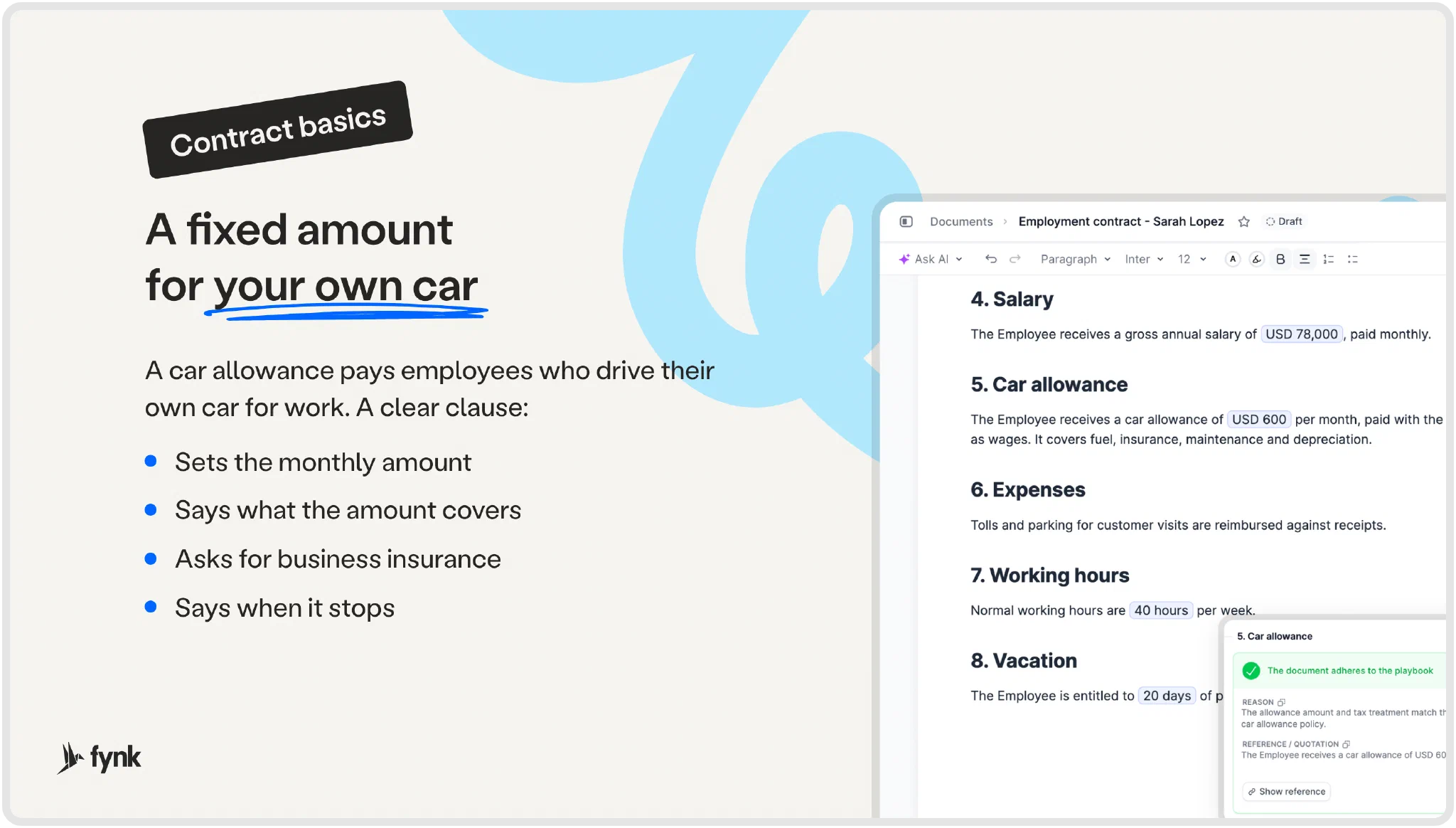
A car allowance is a fixed amount an employer pays an employee, usually every month with the salary, for using their own car for work. It is meant to cover the business share of fuel, insurance, maintenance, tires and depreciation. The employee chooses, owns and pays for the car.
Example: a field sales rep receives USD 600 a month on top of their salary to drive their own car to customer visits.
How does a car allowance work?
- The amount is set in the employment contract or a car allowance policy, for example per role or per region.
- It is paid with the salary, the same amount every month, no matter how many miles the employee drives.
- The employee covers all car costs, including the insurance the policy requires for business use.
- It usually stops when the employee changes to a role without driving, goes on long leave, or leaves the company.
Because the amount is fixed, it can be too much for someone who rarely drives and too little for someone who drives every day. That is the main reason some companies switch to mileage reimbursement.
Is a car allowance taxable?
In the US, usually yes. A flat car allowance paid without mileage records counts as a non-accountable plan, so the IRS treats it as wages: income tax, Social Security and Medicare are withheld, which reduces what the employee keeps. It is tax-free only under an accountable plan, where the employee logs business miles and returns any excess, or under a FAVR (fixed and variable rate) plan that meets IRS rules. In California, Labor Code § 2802 also requires employers to reimburse necessary business expenses in full, so an allowance that falls short of the employee’s actual costs can lead to claims.
In Germany, a car allowance is taxable salary too, while a company car used privately is taxed at 1% of its gross list price per month (0.25% for many electric cars).
Car allowance vs mileage reimbursement vs company car
| Car allowance | Mileage reimbursement | Company car | |
|---|---|---|---|
| How it works | Fixed monthly amount | Business miles times a rate per mile, such as the IRS standard rate | The employer provides the car |
| Taxed in the US? | Yes, as wages, unless under an accountable or FAVR plan | No, up to the IRS rate, with a mileage log | Personal use is a taxable fringe benefit |
| Best for | Predictable driving, simple payroll | Varying or occasional driving | Heavy driving, brand image |
| Admin | Low | Mileage logs every month | Fleet, insurance and maintenance |
Car allowance clause example
Sample clause: Car allowance
Add this clause to a contract, send it and get it signed in fynk.
Use it in fynk for freeWhat should a car allowance policy include?
- Who qualifies: the roles or minimum business miles that earn an allowance.
- The amount: per month, per role or region, and when it is reviewed.
- What it covers: fuel, insurance, maintenance, depreciation, and whether tolls and parking are paid separately.
- Car and insurance requirements: age or condition of the car, minimum liability coverage, a valid license.
- Tax treatment: that the allowance is taxed as wages, or how mileage is logged under an accountable plan.
- When it stops or changes: role changes, leave, a lost license, the end of employment.
Car allowances usually sit in employment contracts and offer letters, so the amounts drift from one hire to the next. In fynk, you can keep the clause in your employment template with the amount as a field, and record the allowance as metadata on each contract, so HR can see who gets how much without opening every PDF.
Which documents contain a car allowance?
Employment contracts and offer letters for sales, field service and management roles, and a company’s car allowance policy. None of these free templates has a car allowance clause yet, but each has the right place for one:
Free templates to add this clause to
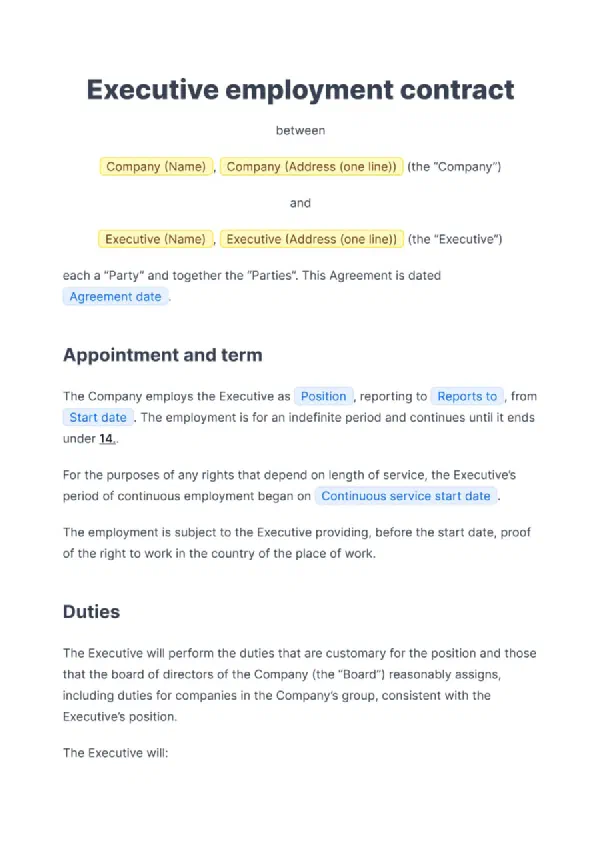 Executive employment agreement template
The benefits section lists what the executive is entitled to, which is where a car allowance usually goes.
Use the free template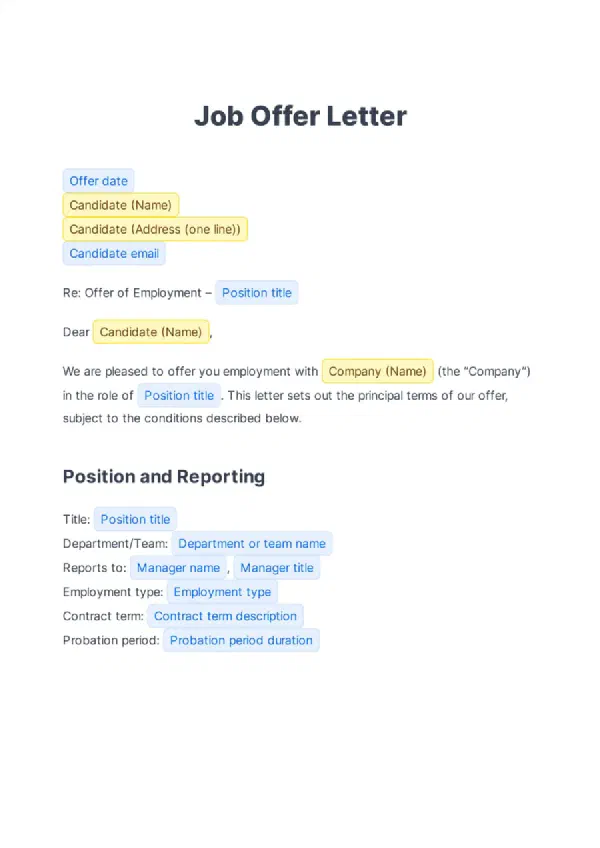 Job offer letter template (with sample)
Has a field for other benefits and perquisites, so the allowance is agreed before the employee starts.
Use the free template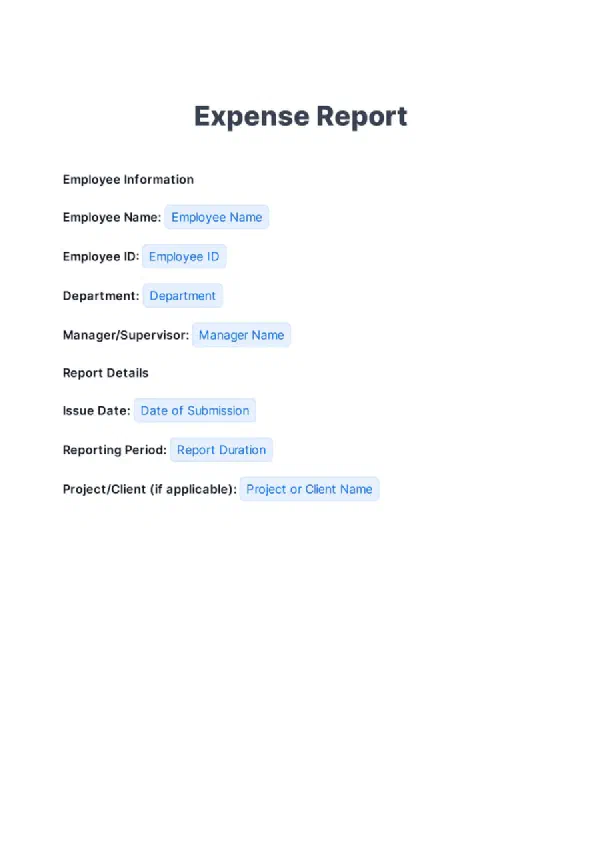 Simple expense report template
For companies that reimburse business miles from a log instead of paying a fixed allowance.
Use the free template
Related clauses
- Reimbursement of expenses The reimbursement of expenses clause outlines the conditions under which one party will repay the other for costs incurred while performing contractual obligations, typically requiring the expenses to be deemed reasonable and necessary. This clause often specifies the process for submitting expense claims, documentation requirements, and any limits or exclusions regarding which expenses are eligible for reimbursement.
- Compensation The compensation clause outlines the payment terms agreed upon between the parties involved in a contract, specifying the amount, schedule, and method of payment for services rendered or work completed. It ensures transparency and sets expectations regarding financial responsibilities and obligations.
- Fees And Expenses The "Fees And Expenses" clause outlines the obligations of each party regarding the payment of fees and expenses incurred during the execution of a contract. It typically specifies what costs will be covered, who is responsible for them, and the timelines for payment.
- Tuition reimbursement The tuition reimbursement clause mandates that an employer will cover the costs of an employee’s educational courses, subject to specific conditions such as the employee earning a passing grade or the course being relevant to their job role. This clause aims to encourage professional development while also enhancing the employee's skills and contributions to the organization.
Frequently asked questions
There is no standard amount. It depends on the role, the region and how much the job requires driving. A good check is to multiply the expected business miles by the IRS standard mileage rate and compare the result with the allowance after tax.
It means your employer pays you a fixed amount, usually every month, to use your own car for work. You choose and pay for the car, its insurance and its running costs.
Another name for a car allowance, also called an auto allowance. It can also cover vans or trucks that employees use for work.
A flat allowance without mileage records is taxable wages. To be tax-free, it must be paid under an accountable plan, where the employee substantiates business miles and returns any excess, or under a fixed and variable rate (FAVR) plan that meets IRS requirements.
More clauses from the library
See allCC&Rs
The "CCRs or "CC&Rs" refers to Covenants, Conditions, and Restrictions, which are rules and guidelines set by a homeowners' association (HOA) or a property developer that dictate how properties within a particular community can be used and what homeowners can and cannot do with their properties. These contractual obligations are designed to maintain the aesthetic and functional harmony of the community, ensuring that all residents adhere to agreed-upon standards to preserve property values and neighborhood appeal.
18 example clauses
Certified rent roll
A certified rent roll is a documented summary of rental income, tenant details, and lease terms for a property or portfolio, usually verified by an accountant or property manager. It serves as an essential tool for property owners and investors, providing an accurate representation of income streams and tenant occupancy.
7 example clauses
Chairman emeritus
The Chairman Emeritus clause designates a former chairman, who has retired from active duty, with an honorary title in recognition of their valuable service and contributions. While they no longer hold executive power or responsibilities, they may still act as an advisor or consultant to the board or company.
14 example clauses
Analyze your contracts. Extract important clauses.
Try our AI contract analysis and extract important clauses and information from existing contracts.
Save your favourite clauses
Insert directly with a single click
Upload preferred precedents