

How a four-person team runs the paperwork of seven companies from one Claude chat
- 20–30 min
saved per drawdown
- 7
legal entities in two countries
- 3 of 4
team members use the skill

"It's basically just opening up a new chat in Claude. We say company A requires 100 euros from company B, we add the skill, press enter, and all of it is performed automatically."
CoastCap connected Claude to fynk. Now one line in a chat drafts the loan document, gets it signed, files it and updates the loan ledger.
Disclosure: CoastCap is an investor in fynk, and Clemens Gaugusch sits on fynk’s advisory board.
At a glance
- Who: CoastCap, a Vienna-based single family office. A team of four, seven legal entities across Austria and Germany.
- Use case: intragroup loan documentation, from drawdown notice to signature, filing and ledger update
- Stack: Claude with a shared team skill, fynk via MCP, Google Sheets, Google Drive
- Result: 20–30 minutes saved per drawdown, at least once a week and up to 30 documents a month at peak
“It’s basically just opening up a new chat in Claude. We say company A requires 100 euros from company B, we add the skill, press enter, and all of it is performed automatically.”
That’s how Clemens Gaugusch, Managing Director at CoastCap, describes the way his team now documents loans between its own companies.
As an investor, CoastCap backs companies that automate processes nobody automated before. Now it is applying the same thinking to its own back office.
Small team, a lot of paperwork
CoastCap is a single family office: a team of four managing one person’s private wealth, spread across seven legal entities in Austria and Germany. The entities lend money to one another and provide management services across the group. Every loan facility, every drawdown and even every call held as part of those services gets documented. Until recently, that meant manual ledgers and a lot of folders.
“Even though it’s just internal, one would argue we don’t need to document it. But we take that documentation requirement very seriously,” Clemens says.
What finally pushed CoastCap to automate was volume. So many documents came into the inbox, from existing portfolio companies and fund managers to new investment opportunities, that just going through them, deciding what to do and saving them took real time. As Clemens puts it: “It’s not very appealing to be employed at a company just simply to manage an inbox.”
Drawing the line
A few weeks before our interview, the team ran a workshop. They wrote down every task the family office performs and sorted each one: automate, or keep human. For each task, they also mapped where the data comes from, how it’s processed and where it ends up.
The line between the two is thin, Clemens says, but it follows a clear rule. Relationships with banks, portfolio companies and funds run on trust, and agents can’t replace that.
Everything that is internal can be much more automated. In everything that is commercial (terms, duration, investment proposals), we want to still be in the driver's seat.

Intragroup loan documentation landed firmly on the automate side.

Before: five manual steps per drawdown
When one entity was short on liquidity, the team decided together whether a sister or parent company should lend the money. Then the paperwork began: someone filled out the drawdown notice from a fynk template, sent it for signature, saved the signed document, updated the drawdowns and outstanding facility in an Excel ledger, and calculated the interest by hand.
Now: one chat
The decision still sits with the team. Everything after it runs through Claude.
CoastCap connected Claude to fynk’s MCP server, which lets Claude create documents and send them for signature in fynk directly. The team then wrote a skill for the process: a short markdown file with instructions, shared with everyone at CoastCap.
Claude fills in the drawdown notice from the fynk template and sends it to the managing director of the borrowing entity, who gets the signature link by email. Once it’s signed, the document is saved and the loan ledger is updated, including interest. Each signature request also carries an internal code, so the recipient can check it really came from the team.
Three of the four team members now use the skill, and none of them has to open fynk for it.

Why fynk is the layer that matters
Clemens’s answer to what fynk does in this chain that the other tools don’t is the record. “It’s kind of bulletproof,” he says. “Once the document is established in fynk and signed, it provides sufficient evidence for our system of record, and there is no way to alter it later on.”
The templates matter just as much. Claude only fills in the dynamic fields, so the wording itself never changes. “By having predefined templates and only changing dynamic fields, we can be sure that those contracts comply with our own standards. That is a very comfortable feeling.”

More than time
Each document saves 20–30 minutes. They happen at least weekly, and at peak up to 30 a month. But Clemens is quick to add: “It’s not only the time saving. We know for sure that no mistake has been done.” It also keeps CoastCap compliant, and gives tax advisors and the people preparing financial statements one source of truth to work from.

A lawyer’s view on AI
Before CoastCap, Clemens worked as a transaction lawyer in Vienna and New York. Asked what makes him comfortable letting AI work with contracts, he draws on that experience.
I have seen many transactions get into very difficult situations because of documents being missed, wrong versions being sent out, track changes not being visible. All of this is typically human error. It's not only a time-saving argument, it's an argument for safety.

What he tells founders
Clemens sees the same problem in the startups CoastCap backs. “A lot of builders are held back by internal processes and bureaucracy. As much as they can automate (contracts, documentation, accounting), they should do it, so they have more time for the things that matter.”

For CoastCap, the goal is to spend that time with founders: strategy, workshops and product work with the portfolio companies. And the workshop list still has plenty of internal processes left to work through.
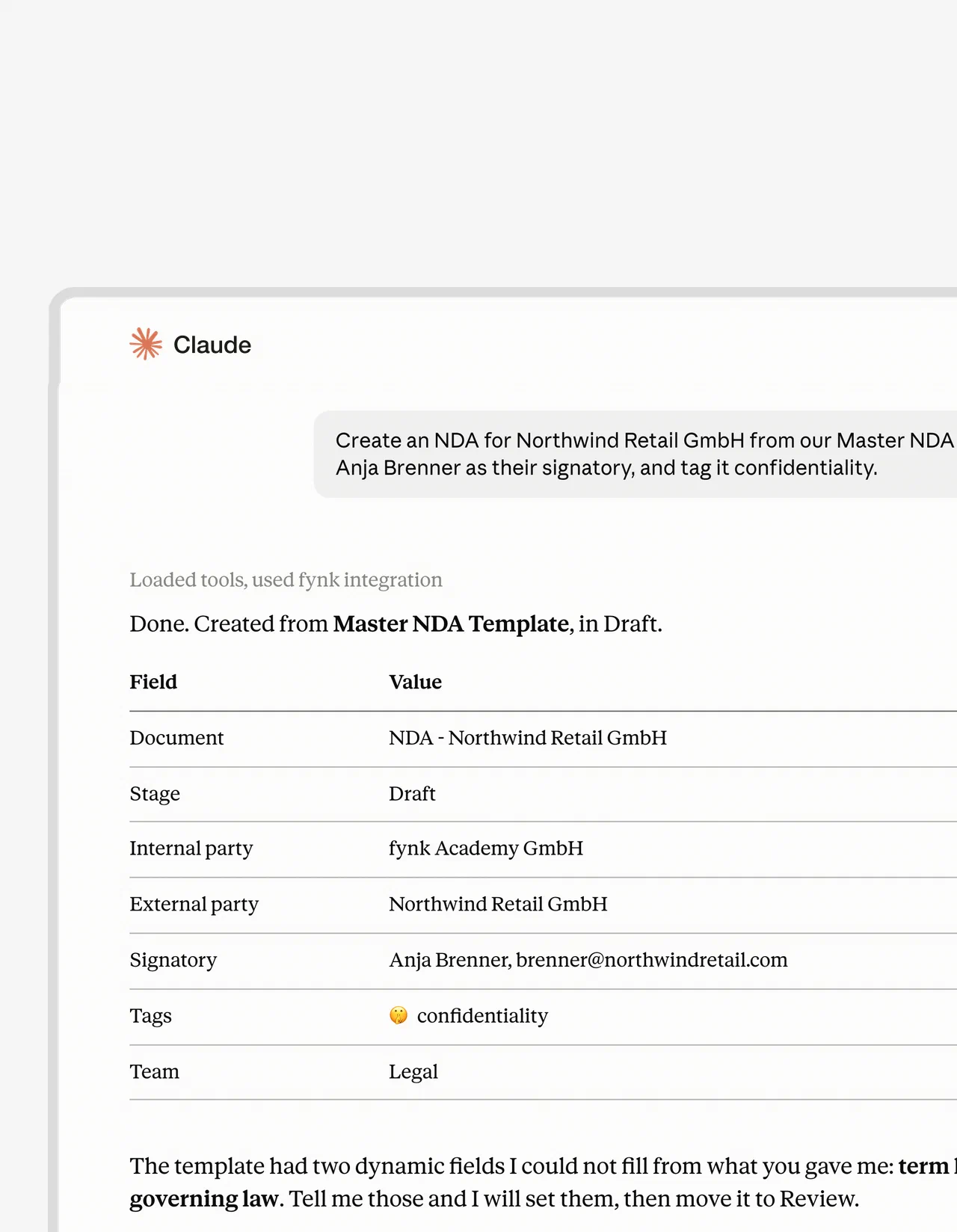


Claude creates the document from a fynk template and fills in the details.




Take control of your agreements. Move your business forward.
Run agreements the way they should run: fast, clear, and on your terms.
No setup headaches
Go live in days, not quarters
No lock-in
Full export anytime
No hidden fees
Signatures included, no envelope fee