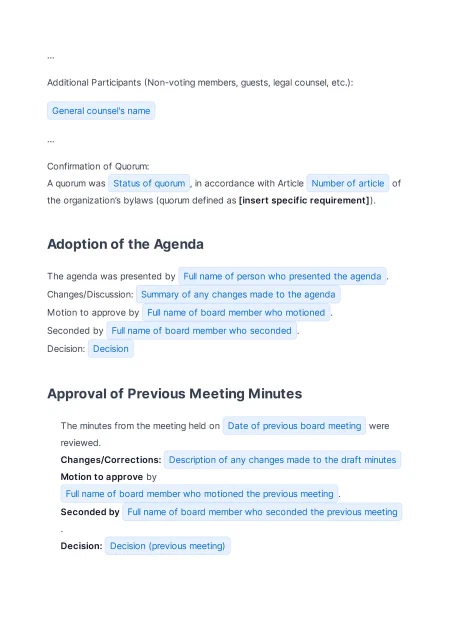
Confirmation of Quorum: A quorum was Status of quorum, in accordance with Article Number of article of the organization’s bylaws (quorum defined as [insert specific requirement]).
Adoption of the Agenda
The agenda was presented by Full name of person who presented the agenda. Changes/Discussion: Summary of any changes made to the agenda Motion to approve by Full name of board member who motioned. Seconded by Full name of board member who seconded. Decision: Decision
Approval of Previous Meeting Minutes
The minutes from the meeting held on Date of previous board meeting were reviewed. Changes/Corrections:Description of any changes made to the draft minutes Motion to approve by Full name of board member who motioned the previous meeting. Seconded byFull name of board member who seconded the previous meeting. Decision:Decision (previous meeting)
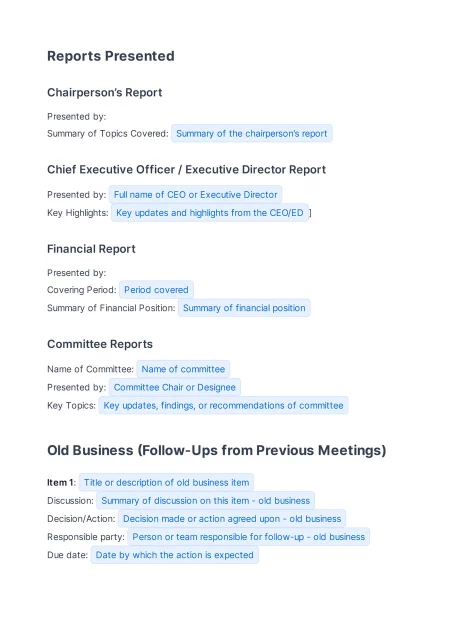
Reports Presented
Chairperson’s Report
Presented by: Summary of Topics Covered: Summary of the chairperson’s report
Chief Executive Officer / Executive Director Report
Presented by: Full name of CEO or Executive Director Key Highlights: Key updates and highlights from the CEO/ED]
Financial Report
Presented by: Covering Period: Period covered Summary of Financial Position: Summary of financial position
Committee Reports
Name of Committee: Name of committee Presented by: Committee Chair or Designee Key Topics: Key updates, findings, or recommendations of committee
Old Business (Follow-Ups from Previous Meetings)
Item 1: Title or description of old business item Discussion: Summary of discussion on this item - old business Decision/Action: Decision made or action agreed upon - old business Responsible party: Person or team responsible for follow-up - old business Due date: Date by which the action is expected
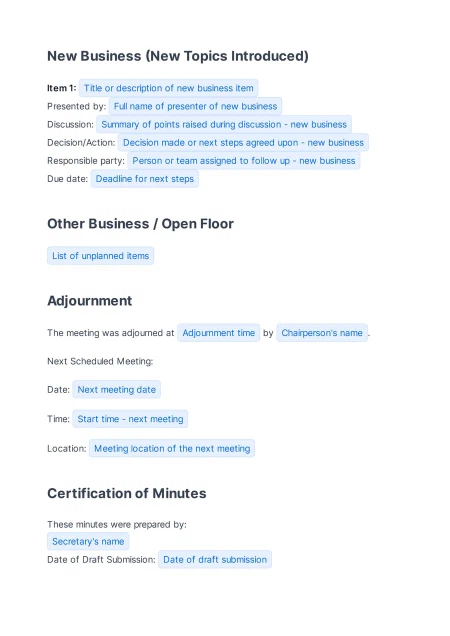
New Business (New Topics Introduced)
Item 1:Title or description of new business item Presented by: Full name of presenter of new business Discussion: Summary of points raised during discussion - new business Decision/Action: Decision made or next steps agreed upon - new business Responsible party: Person or team assigned to follow up - new business Due date: Deadline for next steps
Other Business / Open Floor
List of unplanned items
Adjournment
The meeting was adjourned at Adjournment time by Chairperson's name.
Next Scheduled Meeting:
Date: Next meeting date
Time: Start time - next meeting
Location: Meeting location of the next meeting
Certification of Minutes
These minutes were prepared by: Secretary's name Date of Draft Submission: Date of draft submission
I certify that the above minutes accurately reflect the discussions and decisions made by the Board of Directors of Company (Name) on Date of approval by the board.
Pending
Pending
Disclaimer: The original creator, the author of this template, and fynk GmbH are not responsible for any damages or liabilities that may result from using this template. This template should not be considered a substitute for legal advice, and consulting with a legal professional is recommended before use. fynk GmbH, the original creator, and the author do not provide legal advice and will not be held accountable for any legal consequences arising from its use.
More than
3,000 teams
chose fynk to outgrow legal chaos.
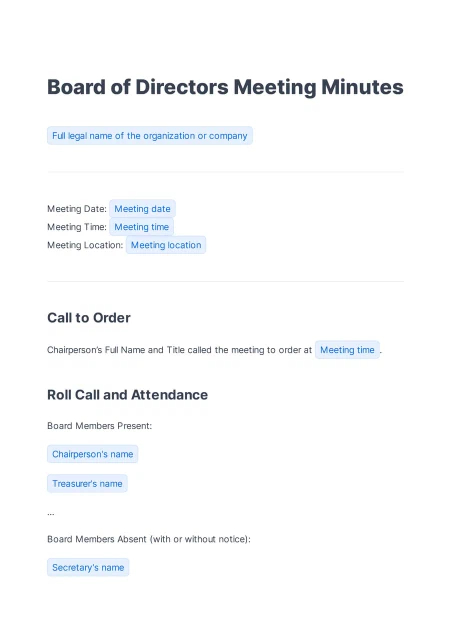
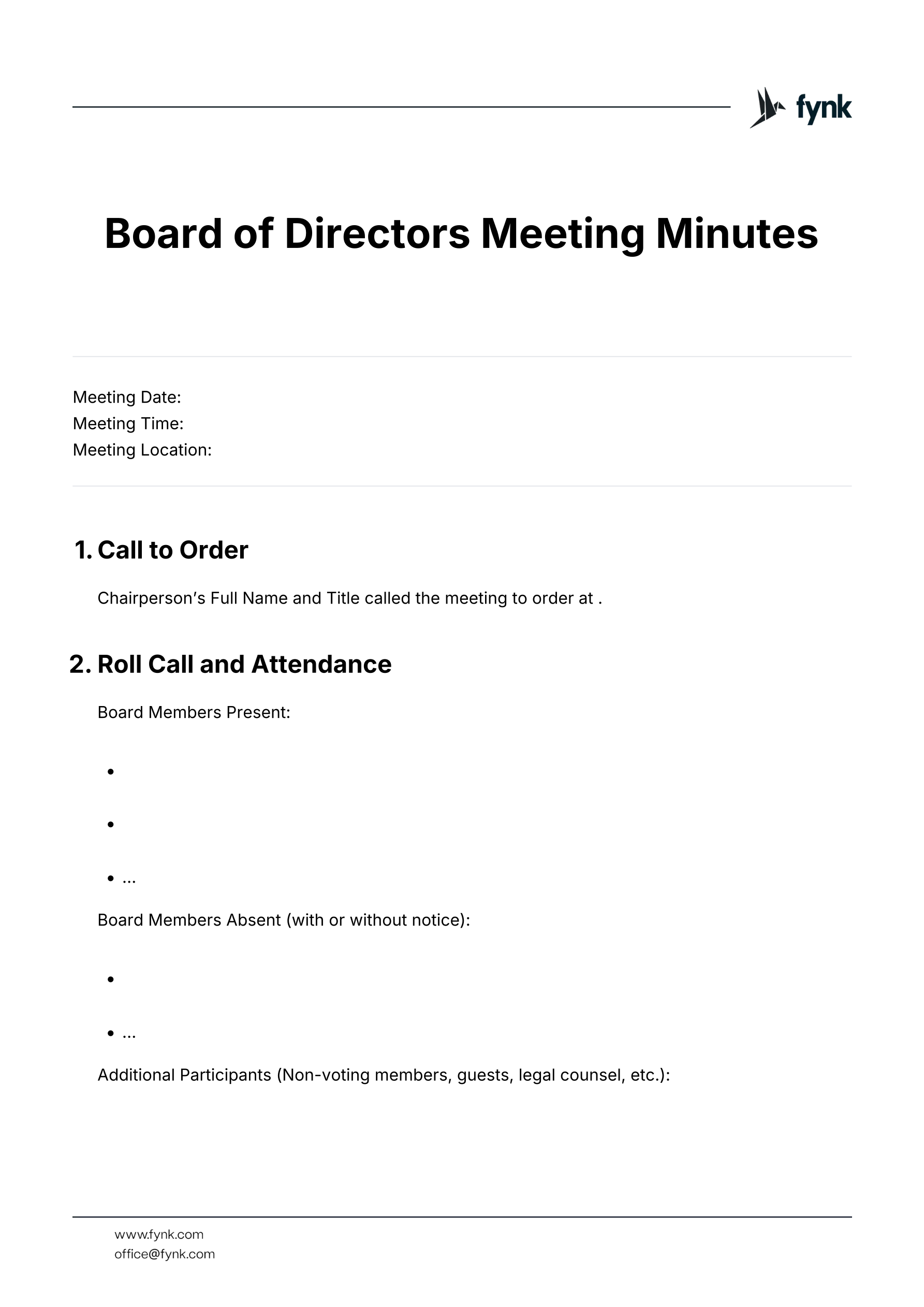
A board minutes template that follows the meeting: call to order, attendance and quorum, agenda, previous minutes, reports, old and new business, adjournment and certification.
The short answer
Board meeting minutes are the official written record of a board of directors meeting. They are a summary, not a transcript: they record what the board decided, not everything that was said.
Good minutes always include:
The organisation, date, time, place or video link, and type of meeting
Who was present, absent and attending as a guest, and confirmation of a quorum
Each motion, who moved and seconded it, and the result of the vote
Action items with an owner and a due date
Adjournment time and the next meeting
The signature of the secretary and, once approved, the chair
What to include in board meeting minutes
Each row is a section of this template, in meeting order.
Section
What to record
Header
Full legal name of the organisation, meeting date, time and location (or video link)
Call to order
Who opened the meeting and at what time
Roll call and attendance
Directors present, directors absent (with or without notice), non-voting participants such as counsel or guests
Quorum
Whether a quorum was present, with a reference to the bylaw article that defines it
Adoption of the agenda
Who presented it, any changes, motion, second and decision
Approval of previous minutes
Date of the meeting, corrections, motion, second and decision
Reports
Chair’s report, CEO or executive director report, financial report (period covered, financial position), committee reports
Old business
Follow-ups from earlier meetings: discussion summary, decision, responsible person, due date
New business
New topics: presenter, discussion summary, decision or next step, responsible person, deadline
Other business
Items raised that were not on the agenda
Adjournment
Time, who adjourned, date, time and place of the next meeting
Certification
Who prepared the minutes, draft date, the certification statement and signatures
What to leave out: verbatim quotes, personal opinions, side conversations and detailed debate. Record conflicts of interest and recusals, though: if a director left the room for a vote, the minutes should say so.
How to write board meeting minutes, step by step
Prepare before the meeting. Read the agenda and the last minutes. Fill in the header, the expected attendees and the agenda items in the template so you only add outcomes on the day.
Record attendance and quorum first. Note arrivals and departures with times. If a director leaves and the quorum is lost, decisions taken after that point may be invalid.
Capture each motion exactly. Write the motion word for word, who moved and seconded it, and the result (carried or failed, with the vote count if the bylaws require it). Note abstentions and recusals.
Summarise discussion in one or two sentences. Enough for an absent director to understand why the board decided what it did.
Write down every action item. Owner and due date, every time. The template has a “responsible party” and “due date” line under each business item.
Attach, don’t retype. Reference reports and presentations and attach them, instead of copying their content into the minutes.
Draft within a few days. Memory fades fast. Send the draft to the chair for review.
Approve at the next meeting. The board votes on the draft (or accepts it by general consent), corrections are recorded, and the approved version is signed.
Board meeting minutes example
A short, filled-in example based on the template. All names are placeholders.
Board of Directors meeting minutes, Riverside Community Trust Date: 12 February 2027. Time: 18:00. Location: Main office, Room 2, and video call.
Call to order. Dana Brooks, Chair, called the meeting to order at 18:04.
Attendance. Present: Dana Brooks (Chair), Lee Park (Treasurer), Morgan Ellis, Priya Shah. Absent with notice: Chris Novak (Secretary). Also present: Taylor Reed, Executive Director; Jo Martin, minute-taker.
Quorum. A quorum was present under Article 7 of the bylaws (a majority of the five directors).
Agenda. Adopted without changes. Moved by Lee Park, seconded by Priya Shah. Carried unanimously.
Previous minutes. The minutes of 13 November 2026 were approved with one correction to the date of the next audit. Moved by Morgan Ellis, seconded by Lee Park. Carried unanimously.
Financial report. Lee Park presented the Q4 2026 accounts (attached). Income was in line with budget; reserves cover five months of operating costs.
New business: lease for a second site. Taylor Reed presented a five-year lease proposal (attached). Motion to authorise the Executive Director to sign the lease on the terms presented, up to an annual rent of $48,000. Moved by Priya Shah, seconded by Morgan Ellis. Carried, 3 in favour, none against. Lee Park declared a conflict of interest, left the room and did not vote. Action: Taylor Reed to sign and circulate the lease by 1 March 2027.
Adjournment. The Chair adjourned the meeting at 19:12. Next meeting: 14 May 2027, 18:00, Main office.
Certification. Prepared by Jo Martin, draft submitted 15 February 2027. Approved by the board on 14 May 2027. Signed: Chair, Secretary.
Minutes become official once the board approves them, usually as the first item of the next meeting. The secretary (or whoever took the minutes) signs to certify they are accurate, and many organisations also have the chair sign. The template ends with a certification statement and two signature blocks for this.
Some rules worth knowing:
UK companies. Under the Companies Act 2006, every company must record minutes of all directors’ meetings (section 248), and minutes signed by the chair of that meeting or the next one are evidence of the proceedings (section 249).
US corporations. In Delaware, one officer must have the duty to record the proceedings of directors’ and stockholders’ meetings (DGCL § 142(a)), and the corporate records may be kept electronically (§ 224). Most other states have similar rules.
Nonprofits. IRS Form 990 asks whether the organisation contemporaneously documented the meetings and written actions of its board and committees, so minutes matter for tax-exempt status reporting as well.
Electronic signatures work for minutes. In the US, the ESIGN Act and UETA give electronic signatures legal effect. In the EU, eIDAS says an electronic signature cannot be denied legal effect just because it is electronic. Check your bylaws or articles in case they require a particular form. With fynk you can send the approved minutes to the secretary and chair for e-signature in a set signing order, and the audit trail records who signed and when.
Decisions without a meeting
If the board needs a decision between meetings, many laws allow a written resolution instead of a meeting. In Delaware, for example, the board can act by unanimous written consent (DGCL § 141(f)). In German-speaking countries this is called a circular resolution (Umlaufbeschluss). See the guide to circular resolutions. With fynk’s resolution voting, stakeholders can vote and sign in the same document.
How long to keep board minutes
Jurisdiction or type
Retention rule
UK companies
At least 10 years from the date of the meeting (Companies Act 2006, section 248)
US corporations
No single federal period; most keep minutes permanently as part of the corporate record book
Nonprofits
Keep permanently. They show governance decisions to auditors, grantors and the IRS
Keep the signed minutes together with their attachments (reports, financial statements, contracts approved) in one place. Auditors, investors in due diligence and courts will ask for the whole package, not only the minutes. A central document hub keeps them searchable years later.
Robert’s Rules and meeting minutes
Many boards, especially nonprofits, follow Robert’s Rules of Order. Its core principle for minutes: record what was done, not what was said. In practice that means:
Every main motion as adopted or rejected, who made it, and the result
Points of order and appeals, and how the chair ruled
Guest speakers by name and topic, without a summary of the talk
The time of adjournment
The secretary’s signature
When the minutes are approved, the chair can ask for corrections and, if there are none, declare them approved without a formal vote. The secretary marks them “Approved” with the date.
FAQ
The organisation’s name, date, time and place; who attended and whether a quorum was present; each motion with who moved and seconded it and the vote result; summaries of reports; action items with owners and due dates; the adjournment time; and the signature of the secretary and, once approved, the chair.
Usually the corporate or board secretary. In small companies and startups it can be a director, an assistant or legal counsel. Whoever takes them should not be heavily involved in the debate, so they can record it accurately.
The secretary signs to certify the minutes are accurate, and the chair often signs once the board has approved them. In UK companies, minutes signed by the chair of the meeting or of the next meeting are evidence of the proceedings.
For companies in most jurisdictions, yes. UK companies must record minutes of all directors’ meetings under the Companies Act 2006. US state corporate laws require corporations to keep records of board proceedings. Nonprofits are expected to keep them as part of good governance.
Detailed enough to show what was decided and why, but not a transcript. Record motions, votes, conflicts of interest and action items in full. Summarise discussion in a sentence or two and attach the reports the board relied on.
Yes, in most jurisdictions. Electronic signatures have legal effect under the ESIGN Act and UETA in the US and under eIDAS in the EU. Check that your bylaws or articles do not require a specific form.
UK companies must keep them for at least 10 years. Most US corporations and nonprofits keep board minutes permanently, because they are the primary evidence of corporate decisions.