
Disclosure statement
A disclosure statement is a written statement that gives the other party the material facts it needs before it signs, such as known defects in a house, the true cost of a loan or the risks of an investment. Many disclosure statements are required by law, and leaving out a material fact can make the seller or lender liable.
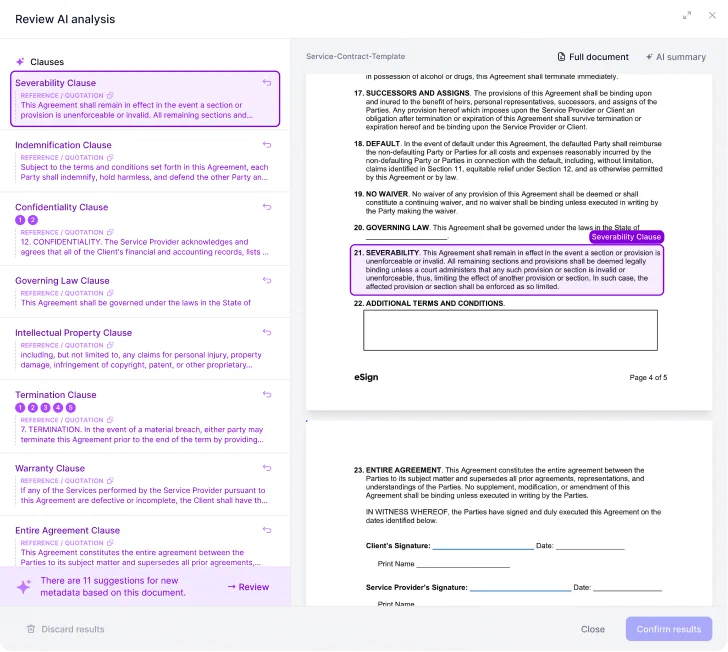
Analyze your contracts. Extract important clauses.
Try our AI contract analysis and extract important clauses and information from existing contracts.
Save your favourite clauses
Insert directly with a single click
Upload preferred precedents
Sample Disclosure statement clauses
Source
Near Intelligence, Inc.Adequacy of Disclosures in the Combined Disclosure Statement and Plan. The Combined Disclosure Statement and Plan contains adequate and extensive material information regarding the Debtors and the Combined Disclosure Statement and Plan (and the transactions contemplated thereby) so that the parties entitled to vote on the Combined Disclosure Statement and Plan could make informed decisions regarding the Combined Disclosure Statement and Plan. The Combined Disclosure Statement and Plan contains “adequate information” as that term is defined in section 1125(a) of the Bankruptcy Code and complies with any applicable additional requirements of the Bankruptcy Code and Bankruptcy Rules.
Source
Near Intelligence, Inc.Implementation of the Combined Disclosure Statement and Plan (11 U.S.C. § 1123(a)(5)). The Combined Disclosure Statement and Plan, including the provisions governing the Litigation Trust, provides adequate and proper means for the Combined Disclosure Statement and Plan’s implementation. Thus, section 1123(a)(5) of the Bankruptcy Code is satisfied.
Source
Legacy EJY, Inc.Information contained in the Combined Disclosure Statement and Plan is proposed and subject to change, whether as a result of amendments or supplements, third-party actions, or otherwise, and should not be relied upon by any party. A copy of the Combined Disclosure Statement and Plan is furnished as Exhibit 99.1 and is incorporated herein by reference. The above description of the Combined Disclosure Statement and Plan is a summary only and is qualified in its entirety by reference to the full text of the Combined Disclosure Statement and Plan.
Source
Legacy EJY, Inc.THIS COMBINED DISCLOSURE STATEMENT AND PLAN CONTAINS CERTAIN STATUTORY PROVISIONS AND DESCRIBES CERTAIN EVENTS IN THESE CHAPTER 11 CASES AND CERTAIN DOCUMENTS RELATED TO THE COMBINED DISCLOSURE STATEMENT AND PLAN THAT MAY BE ATTACHED AND ARE INCORPORATED BY REFERENCE. ALTHOUGH THE DEBTORS BELIEVE THAT THIS INFORMATION IS FAIR AND ACCURATE, THIS INFORMATION IS QUALIFIED IN ITS ENTIRETY TO THE EXTENT THAT IT DOES NOT SET FORTH THE ENTIRE TEXT OF SUCH DOCUMENTS OR STATUTORY PROVISIONS OR EVERY DETAIL OF SUCH EVENTS.
Source
Legacy EJY, Inc.THE INFORMATION CONTAINED HEREIN OR ATTACHED HERETO IS MADE ONLY AS OF THE DATE OF THIS COMBINED DISCLOSURE STATEMENT AND PLAN, UNLESS ANOTHER TIME IS SPECIFIED. THIS COMBINED DISCLOSURE STATEMENT AND PLAN WAS COMPILED FROM INFORMATION OBTAINED FROM NUMEROUS SOURCES BELIEVED TO BE ACCURATE TO THE BEST OF THE DEBTORS’ KNOWLEDGE, INFORMATION AND BELIEF. THERE CAN BE NO ASSURANCES THAT THE STATEMENTS CONTAINED HEREIN WILL BE CORRECT AT ANY TIME AFTER THIS DATE.
NO REPRESENTATIONS OR WARRANTIES ARE MADE AS TO THE ACCURACY OF THE FINANCIAL INFORMATION CONTAINED HEREIN OR ASSUMPTIONS REGARDING THE DEBTORS’ BUSINESS. EXCEPT WHERE SPECIFICALLY NOTED, THE FINANCIAL INFORMATION CONTAINED IN THIS COMBINED DISCLOSURE STATEMENT AND PLAN AND IN THE RELATED EXHIBITS HAS NOT BEEN AUDITED BY A CERTIFIED PUBLIC ACCOUNTANT AND HAS NOT BEEN PREPARED IN ACCORDANCE WITH GENERALLY ACCEPTED ACCOUNTING PRINCIPLES IN THE UNITED STATES OR ANY OTHER JURISDICTION.
THIS DISCLOSURE STATEMENT AND PLAN HAS BEEN PREPARED IN ACCORDANCE WITH SECTIONS 1123 AND 1125 OF THE BANKRUPTCY CODE AND BANKRUPTCY RULE 3016 AND NOT NECESSARILY IN ACCORDANCE WITH FEDERAL OR STATE SECURITIES LAWS OR OTHER NON-BANKRUPTCY LAWS. THIS COMBINED DISCLOSURE STATEMENT AND PLAN HAS NOT BEEN APPROVED OR DISAPPROVED BY THE UNITED STATES SECURITIES AND EXCHANGE COMMISSION (THE “SEC”), ANY STATE SECURITIES COMMISSION OR ANY SECURITIES EXCHANGE OR ASSOCIATION, NOR HAS THE SEC, ANY STATE SECURITIES COMMISSION OR ANY SECURITIES EXCHANGE OR ASSOCIATION PASSED UPON THE ACCURACY OR ADEQUACY OF THE STATEMENTS CONTAINED HEREIN. NO OTHER GOVERNMENTAL OR OTHER REGULATORY AUTHORITY HAS PASSED ON, CONFIRMED OR DETERMINED THE ACCURACY OR ADEQUACY OF THE INFORMATION CONTAINED HEREIN.
Source
Legacy IMBDS, Inc.The Proposed Disclosure Statement was submitted to the Bankruptcy Court for interim approval, and on November 2, 2023, the Bankruptcy Court entered the Order (I) Granting Interim Approval of the Disclosures in the Combined Plan and Disclosure Statement; (II) Scheduling a Combined Confirmation Hearing and Setting Deadlines Related thereto; (III) Approving Solicitation Packages and Procedures; (IV) Approving the Forms of Ballots; and (V) Granting Related Relief [Docket No. 701] (the “Solicitation Procedures Order”). Accordingly, the Debtors have commenced solicitation of votes to accept or reject the Proposed Plan in accordance with the terms of the Solicitation Procedures Order. A confirmation hearing to consider final approval of the Proposed Disclosure Statement and the Proposed Plan is expected to be held in the Bankruptcy Court on January 8, 2024.
Source
A. M. Castle & Co.The Reverse Stock Split will be effectuated by filing Articles of Amendment with the State Department of Assessments and Taxation of Maryland, which the Company expects to file no earlier than the twentieth day following the mailing of the Disclosure Statement (as defined below) to stockholders. Maryland law does not require us to obtain any vote or consent of our stockholders to consummate the Reverse Stock Split. Accordingly, we are not seeking stockholder approval for the Reverse Stock Split, the subsequent deregistration of the Common Stock, or the suspension of our duty to file periodic reports and other information with the SEC. The Board reserves the right to abandon, postpone or modify the foregoing for any reason, at any time, before they are consummated. Under Maryland law and our charter, stockholders are not entitled to dissenter’s rights or any right of appraisal in connection with the Reverse Stock Split. The Reverse Stock Split will be conducted upon the terms and subject to the conditions set forth in the Company’s disclosure statement, which is attached as Exhibit A to this Schedule (the “Disclosure Statement”). The information contained in the Disclosure Statement, including all exhibits thereto, is hereby expressly incorporated herein by reference. Capitalized terms used but not defined herein shall have the meanings given to them in the Disclosure Statement.
Source
Charge Enterprises, Inc.Objections to the Plan of Reorganization or Disclosure Statement: Any objection (each, a “Plan/Disclosure Statement Objection”) to the Combined Disclosure Statement and Plan must: (a) be in writing; (b) comply with the Federal Rules of Bankruptcy Procedure and the Local Rules of Bankruptcy Practice and Procedure of the United States Bankruptcy Court for the District of Delaware; (c) state the name and address of the objecting party and the amount and nature of the Claim or Interest beneficially owned by such entity; and (d) state with particularity the legal and factual basis for such objections, and, if practicable, a proposed modification to the Plan of Reorganization that would resolve such objection.
Source
Charge Enterprises, Inc.Plan/Disclosure Statement Objections must be filed with the Court and served upon the following parties (collectively, the “Notice Parties”) no later than April 12, 2024, at 4:00 p.m. (Eastern Time): (a) counsel to the Debtor: Faegre Drinker Biddle & Reath LLP (Attn: Patrick A. Jackson, Ian J. Bambrick, and Sarah E. Silveira); (b) counsel to the Prepetition Lenders: White & Case LLP (Attn: Harrison Denman) and Richards, Layton & Finger, P.A. (Attn: Paul N. Heath and Amanda R. Steele); (c) the Office of the United States Trustee (Attn: Rosa Sierra-Fox); and (d) counsel to any statutory committees appointed in the Chapter 11 Case.
Source
Medley LLCTHIS COMBINED DISCLOSURE STATEMENT AND PLAN WAS COMPILED FROM INFORMATION OBTAINED FROM NUMEROUS SOURCES BELIEVED TO BE ACCURATE TO THE BEST OF THE DEBTOR’S KNOWLEDGE, INFORMATION AND BELIEF. NO GOVERNMENTAL AUTHORITY HAS PASSED ON, CONFIRMED OR DETERMINED THE ACCURACY OR ADEQUACY OF THE INFORMATION CONTAINED HEREIN.
Source
Medley LLCTHE STATEMENTS CONTAINED HEREIN ARE MADE AS OF THE DATE HEREOF, UNLESS ANOTHER TIME IS SPECIFIED. THE DELIVERY OF THIS COMBINED DISCLOSURE STATEMENT AND PLAN SHALL NOT BE DEEMED OR CONSTRUED TO CREATE ANY IMPLICATION THAT THE INFORMATION CONTAINED HEREIN IS CORRECT AT ANY TIME AFTER THE DATE HEREOF. HOLDERS OF CLAIMS OR INTERESTS SHOULD NOT CONSTRUE THE CONTENTS OF THIS COMBINED DISCLOSURE STATEMENT AND PLAN AS PROVIDING ANY LEGAL, BUSINESS, FINANCIAL OR TAX ADVICE. THEREFORE, EACH SUCH HOLDER SHOULD CONSULT WITH ITS OWN LEGAL, BUSINESS, FINANCIAL AND TAX ADVISORS AS TO ANY SUCH MATTERS CONCERNING THE COMBINED DISCLOSURE STATEMENT AND PLAN AND THE TRANSACTIONS CONTEMPLATED HEREBY.
Source
Medley LLCNO PARTY IS AUTHORIZED TO GIVE ANY INFORMATION WITH RESPECT TO THE COMBINED DISCLOSURE STATEMENT AND PLAN OTHER THAN THAT WHICH IS CONTAINED IN THIS COMBINED DISCLOSURE STATEMENT AND PLAN. NO REPRESENTATIONS CONCERNING THE DEBTOR OR THE VALUES OF ITS PROPERTY HAVE BEEN AUTHORIZED BY THE DEBTOR, OTHER THAN AS SET FORTH IN THIS COMBINED DISCLOSURE STATEMENT AND PLAN. ANY INFORMATION, REPRESENTATIONS OR INDUCEMENTS MADE TO OBTAIN AN ACCEPTANCE OF THE COMBINED DISCLOSURE STATEMENT AND PLAN OTHER THAN, OR INCONSISTENT WITH, THE INFORMATION CONTAINED HEREIN SHOULD NOT BE RELIED UPON BY ANY HOLDER OF A CLAIM OR INTEREST. THIS COMBINED DISCLOSURE STATEMENT AND PLAN HAS BEEN PREPARED IN ACCORDANCE WITH SECTION 1125 OF THE BANKRUPTCY CODE AND BANKRUPTCY RULE 3016(b) AND NOT IN ACCORDANCE WITH FEDERAL OR STATE SECURITIES LAWS OR OTHER NON-APPLICABLE BANKRUPTCY LAWS. THIS COMBINED DISCLOSURE STATEMENT AND PLAN HAS NOT BEEN APPROVED OR DISAPPROVED BY THE UNITED STATES SECURITIES AND EXCHANGE COMMISSION (THE “SEC”), NOR HAS THE SEC PASSED UPON THE ACCURACY OR ADEQUACY OF THE STATEMENTS CONTAINED HEREIN.
What is a disclosure statement?
A disclosure statement is a written statement in which one party tells the other the material facts it needs before agreeing to a deal: known defects, costs, risks or conflicts of interest. A home seller lists known problems with the house, a lender states the true cost of a loan, a company in Chapter 11 explains its restructuring plan to creditors.
Many disclosure statements are required by law. Where they are not, a contract can still require one in a disclosure clause. Either way, the point is the same: the other side decides with the facts in front of it, and the party disclosing protects itself against later claims that it hid something.
Types of disclosure statements
| Type | Who gives it | What it discloses | Legal basis (examples) |
|---|---|---|---|
| Real estate seller disclosure | Seller of a home | Known defects, repairs, flooding, lead paint | State laws such as California Civil Code § 1102; federal lead-based paint rule for homes built before 1978 |
| Loan disclosure | Lender | APR, finance charge, amount financed, total of payments | Truth in Lending Act and Regulation Z |
| Bankruptcy disclosure statement | Debtor in Chapter 11 | Financial situation and the reorganization plan | 11 U.S.C. § 1125: “adequate information”, approved by the court before creditors vote |
| Investment risk disclosure | Broker or issuer | Risks of the product or offering | Securities and commodities rules, for example CFTC risk disclosure statements |
| Advertising disclosure | Influencer or publisher | Paid relationship with a brand | FTC Endorsement Guides (16 CFR Part 255) |
| Disclosure letter or schedule | Seller in an M&A deal | Exceptions to the warranties in the purchase agreement | Contract, not statute |
Disclosure statement example
A short seller’s disclosure statement for a commercial property might read:
Seller’s disclosure statement. To the best of the Seller’s knowledge as of the date below: (1) the roof was replaced in 2019 and has no known leaks; (2) the basement flooded once in March 2023, and the damage was repaired by a licensed contractor; (3) there are no pending zoning violations or code enforcement actions; (4) the property is subject to a utility easement along the north boundary. The Seller has no knowledge of any other material defect.
It names concrete facts, gives dates, and limits itself to what the seller actually knows. That is what makes a disclosure statement useful, and what protects the seller later.
How to write a disclosure statement
- List every material fact. Anything a reasonable buyer, borrower or investor would want to know before deciding.
- Be specific. “The basement flooded in March 2023” beats “occasional water issues”.
- State the knowledge standard. “To the best of the Seller’s knowledge” shows the statement covers what is known, not a guarantee.
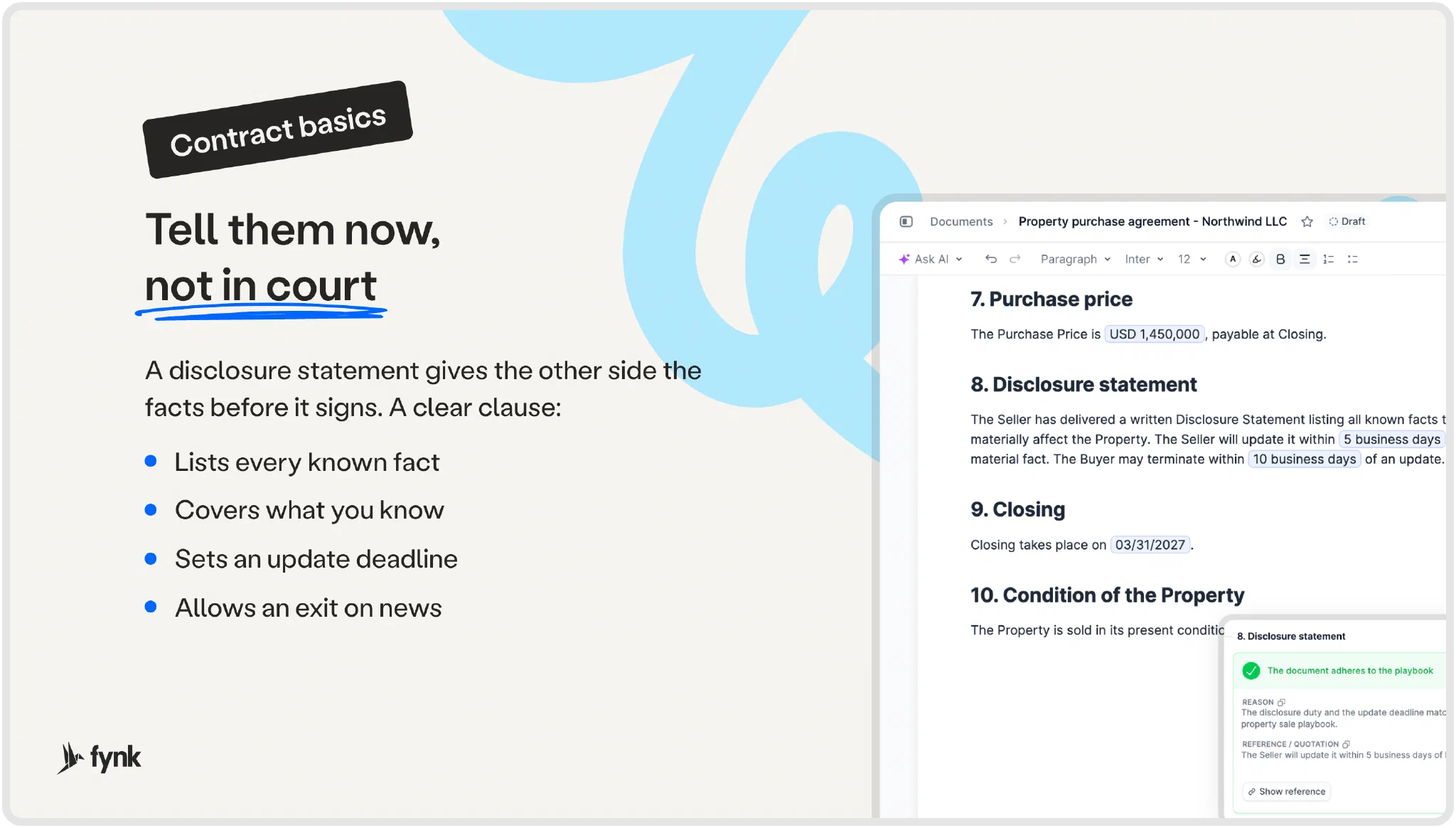
- Date it and update it. If facts change before closing, the statement must be updated.
- Get it acknowledged. Have the other party sign or initial that it received and read the statement.
Disclosure statement vs. disclaimer
A disclosure gives the other side information: “the basement flooded in 2023”. A disclaimer limits your liability: “the property is sold as is, without warranties”. They often appear together, but a disclaimer does not excuse you from a disclosure the law requires. A seller who hides a known defect usually cannot rely on an “as is” clause to escape a fraud claim.
Disclosure clause example
Sample clause: Disclosure statement
Add this clause to a contract, send it and get it signed in fynk.
Use it in fynk for freeHow to keep disclosures complete across contracts
Disclosure duties hide in the fine print: a deadline to update, a right to terminate, a statement the other side must sign. In fynk, the disclosure clause can sit in a template with the deadlines as fields, so the approved wording is the same in every deal. When the other side sends its own contract, AI Review checks it against your playbook and flags a missing disclosure duty or an unusually short deadline before anyone signs.
Which contracts contain a disclosure statement?
Home and property sales, loan and credit agreements, securities and brokerage account agreements, share and asset purchase agreements, franchise agreements and influencer agreements. These free templates already include a disclosure duty:
Free templates with this clause
 Influencer contract template (brand ambassador agreement)
The influencer must clearly disclose the paid relationship in every post, with a label such as #ad at the start of the caption.
Use template Commodity futures customer agreement template
The customer acknowledges that it has received and understood the broker's risk disclosure statement.
Use template Head of terms template
A satisfactory disclosure letter from the seller is a condition of the share purchase going ahead.
Use template
Related clauses
- Disclosure letter A disclosure letter is a document provided during a transaction, typically accompanying a sale agreement, where the seller discloses specific information and any exceptions to the warranties stated in the contract. It serves to clarify details and protect the seller against potential future claims by informing the buyer of actual circumstances that might differ from contractual assumptions.
- full disclosure A full disclosure clause requires a party to reveal all relevant information that may impact the other party's understanding of the contract. This ensures transparency and allows both parties to make informed decisions based on complete and accurate data.
- Representations and warranties "Representations and warranties are contractual statements made by one or both parties, asserting certain facts and conditions as true at the time of the agreement. These affirmations serve to allocate risk and establish grounds for potential legal remedies if the assertions prove to be false or misleading."
- Legally compelled disclosure A legally compelled disclosure clause requires a party to disclose confidential information in compliance with a legal obligation, such as a court order, subpoena, or regulatory demand. This clause often mandates notifying the other party before the disclosure is made and seeks to limit the disclosed information to the minimum necessary to comply with the legal requirement.
Frequently asked questions
A disclosure statement is a statement of facts, not a contract by itself. But if it is false or leaves out a material fact, the person who gave it can be liable for misrepresentation or fraud, and many contracts make it part of the agreement.
It is the seller's written list of known problems with the property, such as leaks, flooding, pests, repairs or lead paint. Most US states require one, and the buyer usually signs to confirm receipt.
In most Chapter 11 cases, the debtor must give creditors a disclosure statement with adequate information about its finances and the reorganization plan, and the court approves it before creditors vote. Small business cases can have simpler rules.
The buyer may be able to cancel the sale or claim damages for misrepresentation or fraud, depending on the state and on what the seller knew. An as-is clause usually does not protect a seller who hid a defect it knew about.
More clauses from the library
See allDispositive power
Dispositive power refers to the authority granted to an individual or entity to manage, direct, or dispose of assets or interests, typically within the context of a trust or investment arrangement. This power can include the ability to buy, sell, transfer, or otherwise regulate the assets, and is often accompanied by fiduciary responsibilities to act in the best interests of the beneficiaries or stakeholders.
9 example clauses
Dispute resolution
The dispute resolution clause outlines the methods by which any disagreements arising from a contract will be managed, specifying procedures such as negotiation, mediation, arbitration, or litigation. This clause aims to provide a clear framework for resolving conflicts efficiently, thus minimizing potential disruptions to the contractual relationship.
20 example clauses
Disputed invoices
A disputed invoice clause sets out what happens when a customer does not accept an invoice: the deadline and form for objecting, whether the undisputed part must still be paid on time, how the disagreement is resolved, and whether interest runs on amounts that turn out to be due.
5 example clauses
Analyze your contracts. Extract important clauses.
Try our AI contract analysis and extract important clauses and information from existing contracts.
Save your favourite clauses
Insert directly with a single click
Upload preferred precedents