
AI in law statistics 2027: why the numbers disagree

Rezvan Golestaneh
Published · 12 min read
Legal AI use is widespread. Approved, measured contract work tells a different story.
- Adoption rates measure different people, tools and definitions of use.
- Working from supplied documents narrows the task, but accuracy still needs checking.
- Policies, ownership and training lag behind use.
- Reported savings need measurement before they become your business case.
Going into 2027, here’s what you need to know about AI in law, based on the latest studies. We read 155 original studies and reports, including 137 published in 2025 or 2026, and checked 1,544 numbers. This page keeps the findings about AI in legal work from the research behind our contract management statistics.
These are findings for planning, not measurements of 2027 activity. The pattern: individual use is high, while organizational and contract-specific use is lower. A chatbot account still needs rules.
How we picked the numbers
We kept original research, separated individual from organizational use, and retained each finding’s population and question. Vendor research is labelled. Benchmarks describe the tested task and version, not every tool available today. Forecasts stay forecasts. When you quote a number, say who was asked and what counted as use.
Why do legal AI adoption studies report anywhere from 8% to 92%?
Legal AI adoption rates differ because surveys ask different people different questions.
87% of interviewed GCs said their teams used GenAI. (FTI Technology and Relativity, 2026) This vendor report’s finding comes from qualitative interviews, so treat it as directional.
85% of US legal professionals reported some AI adoption at their firm. (Clio, 2026) The legal practice software vendor mixed customers with panel respondents.
92% of surveyed lawyers used at least one AI tool in daily work. (Wolters Kluwer, 2026) The legal software vendor surveyed lawyers across the US, Europe and China.
75% of UK legal professionals used AI at least weekly. (LexisNexis UK, 2026) LexisNexis sells legal research and AI tools.
Weekly use reached 89% among in-house lawyers in that UK sample. (LexisNexis UK, 2026)
53% of in-house respondents already used GenAI in legal practice worldwide. (ACC and Everlaw, 2025) Everlaw, a legal software vendor, co-published the study.
47% of corporate legal respondents reported organizational GenAI use. (Thomson Reuters Institute, 2026) This vendor study screened respondents for AI familiarity.
Organizational GenAI use reached 41% among law firm respondents. (Thomson Reuters Institute, 2026)
Fully operational GenAI use reached 23.1% of law departments. (Blickstein Group, 2025) FTI Technology sponsored this vendor report, which mainly reflects large-company legal operations.
Among business, legal and professional services firms, 15% reported AI use in risk, legal and compliance work. (Stanford HAI, AI Index, 2026)
Only 8% of German AI-using companies applied it in legal or tax departments. (Bitkom, 2026)
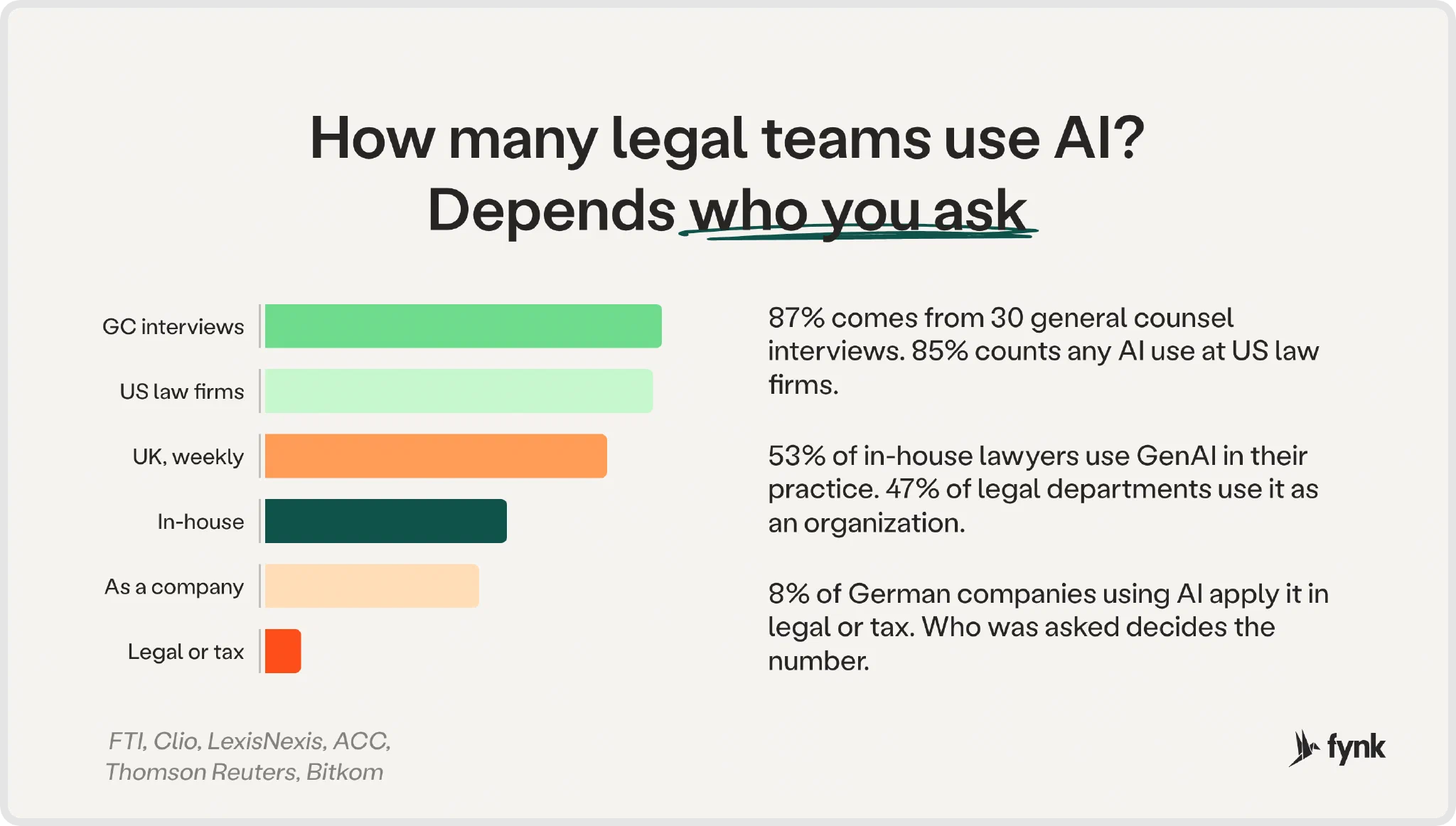
The gap runs from trying AI to putting it into a managed process. These samples cannot establish a universal adoption rate. Ask whether a headline describes a person, a department or an entire business before putting it in a budget request.
What do legal teams actually use AI for?
Research and drafting lead, while tools built for contract work remain less common.
Legal research was an AI use for 54% of legal professionals at AI-using US firms. (Clio, 2026)
Contract drafting was a use for 49% of legal GenAI users. (Thomson Reuters Institute, 2026)
56.5% of law departments always or sometimes used GenAI for contract clause analysis. (Blickstein Group, 2025)
79% of in-house respondents used AI to draft contract clauses. (Juro, 2025) This contract software vendor surveyed a small, mostly senior-lawyer sample.
Only 31% had tried AI redlining in that sample. (Juro, 2025)
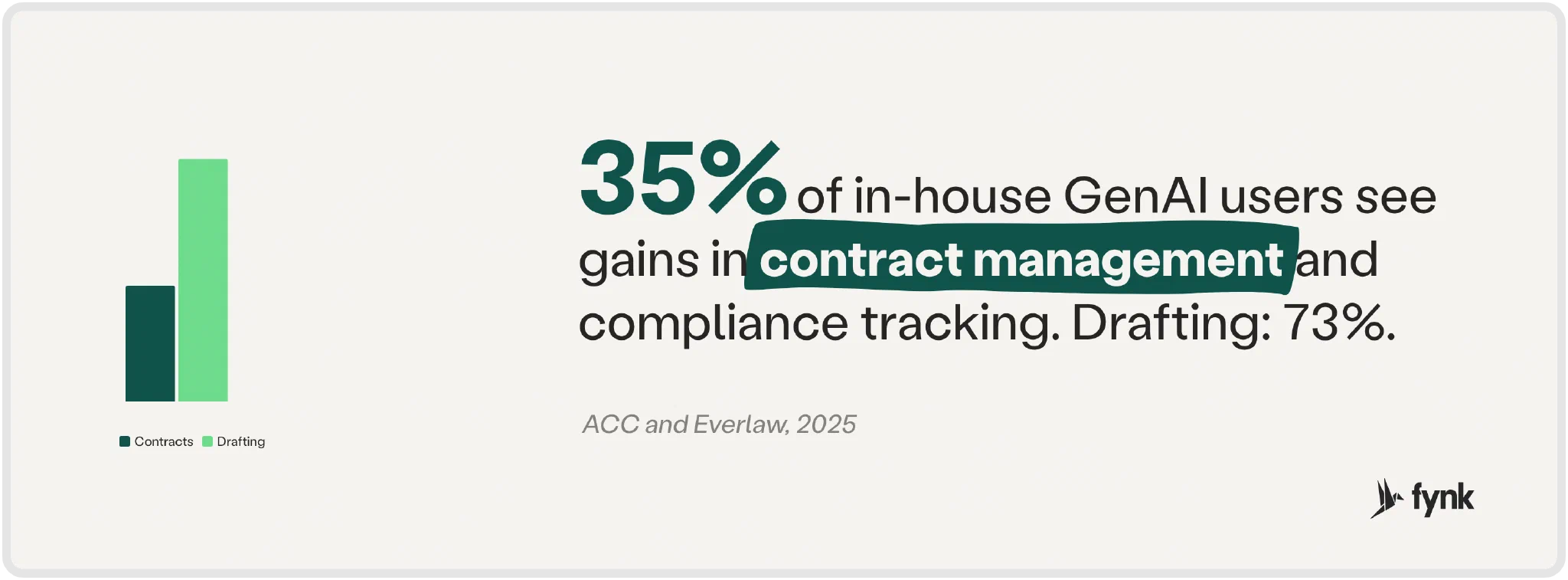
Drafting advice, contracts and policies brought efficiency gains for 73% of GenAI-using respondents. (ACC and Everlaw, 2025)
Contract management and compliance tracking brought efficiency gains for 35% of GenAI-using respondents. (ACC and Everlaw, 2025)
Contract review was the top GenAI use case in surveyed German legal departments. (EY Law and BUJ, 2025)
88% of GenAI-using law departments relied on enterprise suites such as Copilot or Gemini. (Blickstein Group, 2025)
Contract-specific models were used by 41% of GenAI-using law departments. (Blickstein Group, 2025)
Generic AI chatbots were used by 56% of in-house respondents. (Wolters Kluwer, Legisway benchmark, 2025) This vendor survey mostly covered Europe.
AI-powered contract management was used by 14% of in-house respondents in that benchmark. (Wolters Kluwer, 2025)
General chat tools carry much of the use. Writing a clause is a narrower task than managing its approval, signature and obligations. fynk’s AI features work inside the contract repository, where teams draft from templates, move agreements through approval and signing, search them and track dates.
How accurate is legal AI?
Legal AI accuracy depends on the task, source material and tested model.
Hallucination rates ranged from 1.8% to 5.4% among leading models summarizing supplied news articles. (Stanford HAI, 2026) These weren’t contracts.
Rates ranged from 22% to 94% on open factual questions in a different benchmark. (Stanford HAI, 2026) This isn’t a controlled comparison.
GPT-4 without legal sources hallucinated on 43% of research queries. (Stanford RegLab and HAI, 2024) Results describe the tested version.
Lexis+ AI answered 65% of queries accurately in that experiment. (Stanford RegLab and HAI, 2024)
Lexis+ AI hallucinated on 17% of test queries. (Stanford RegLab and HAI, 2024) This tested an older version, not today’s product.
The tested commercial legal research tools gave misleading or false answers on nearly 1 in 5 queries. (Stanford RegLab and HAI, 2024)
The leading model scored 73.4% on CaseLaw v2, a legal research benchmark. (Stanford HAI, 2026)
No tested model scored above 70% on CorpFin, which tests comprehension of long credit agreements. (Stanford HAI, 2026)
The hallucination database recorded 2241 identified cases involving court-addressed AI content. (Damien Charlotin, October 29, 2026) It includes some cases where AI use was alleged but unconfirmed.
83% of UK legal professionals worried about inaccurate or fabricated AI information. (LexisNexis UK, 2026)
81% of UK legal professionals felt more comfortable with AI grounded in legal sources. (LexisNexis UK, 2026) The publisher sells such tools.
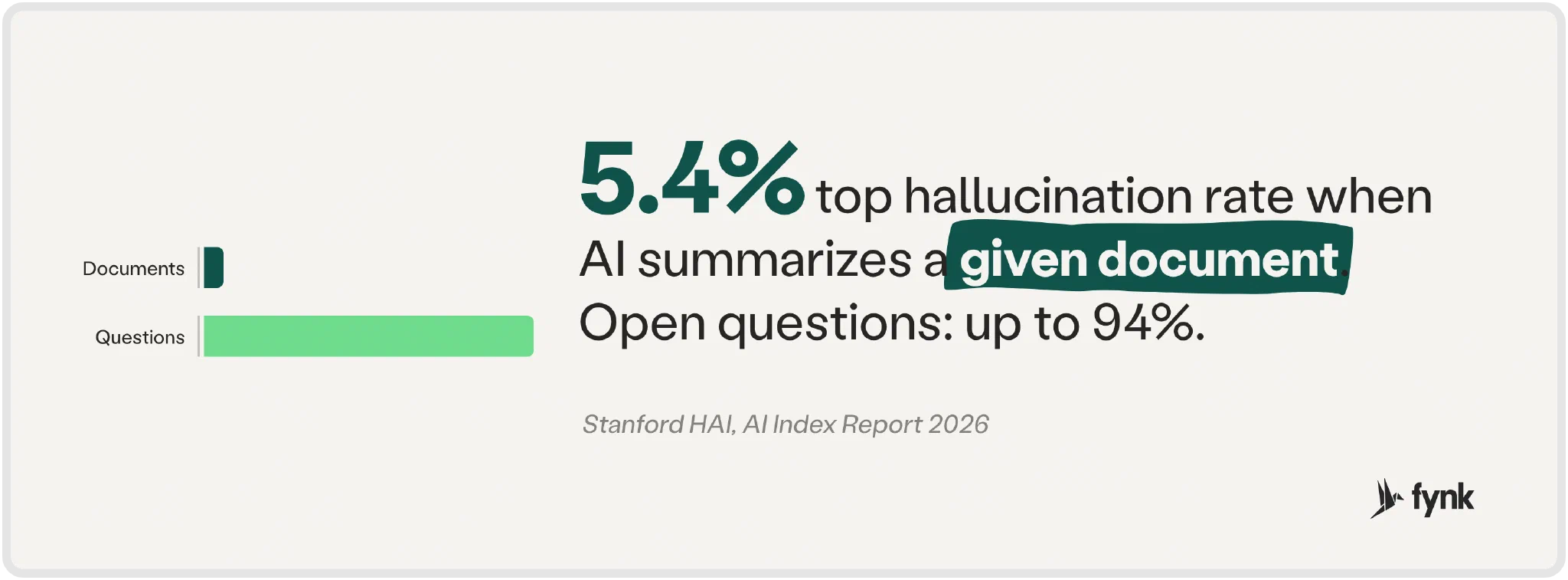
Working on your own documents gives AI a narrower, safer task than asking it what the law says. The benchmarks suggest that distinction; they don’t establish contract accuracy. Check the underlying wording. Confidence in an answer isn’t evidence that it’s right.
Ask your contract anything.
Who governs legal AI?
AI governance ownership and preparation vary widely across the surveyed organizations.
34% of surveyed professionals used AI tools their organization hadn’t approved. (Thomson Reuters Institute, Future of Professionals, 2026) This vendor study covers several professions.
48% of legal respondents’ organizations lacked formal GenAI policies. (Thomson Reuters Institute, GenAI report, 2025) This is separate vendor research.
Only 23% of German companies had established GenAI rules. (Bitkom, AI study, 2026) The survey data comes from 2025.
Legal held primary AI governance responsibility in 6% of surveyed organizations. (Stanford HAI, 2026)
18% of UK legal professionals said nobody owned AI governance in their organization. (LexisNexis UK, 2026)
85% of corporate law departments had a dedicated AI resource or committee. (Harbor and CLOC, 2025) Harbor’s consulting survey covered very large businesses.
64% of surveyed professionals had received no training in GenAI for their work. (Thomson Reuters Institute, 2025 GenAI report)
With a named AI strategy, 66% of professionals said AI met or exceeded value expectations. (Thomson Reuters Institute, Future of Professionals, 2026)
Without an active strategy, 22% of professionals said AI met or exceeded value expectations. (Thomson Reuters Institute, Future of Professionals, 2026)
Unmanaged AI is the practical risk: unseen use, unclear responsibility and unchecked output. A named strategy correlates with better reported results; it doesn’t prove causation. Harbor’s large-company findings also aren’t a staffing model for a small team.
Does legal AI pay off?
Legal AI produces reported savings, but measurement is patchy and client benefits aren’t guaranteed.
Only 18% of surveyed professionals said their organization tracked AI ROI. (Thomson Reuters Institute, 2026 AI report)
40% of surveyed professionals didn’t know whether their organization collected AI ROI metrics. (Thomson Reuters Institute, 2026 AI report)
Among organizations measuring AI ROI, 77% tracked internal cost savings. (Thomson Reuters Institute, 2026 AI report)
Nearly one in three law department respondents could demonstrate tangible AI cost savings. (Blickstein Group, 2025)
70% of general counsel respondents reported measurable AI cost savings. (KPMG Law, 2026) These are self-reported results.
72% of reported AI projects were rated successful in Germany’s legal market. (Legal Tech Monitor, 2025) This vendor-supported study recruited through legal tech channels; projects were mostly pilots.
62% of surveyed lawyers reported saving 6% to 20% of their workweek with AI. (Wolters Kluwer, Future Ready Lawyer, 2026)
59% of in-house respondents saw no noticeable savings yet from outside firms’ GenAI use. (ACC and Everlaw, 2025)
84% of in-house lawyers saw no AI-attributable reduction in fees or billed hours. (Juro, 2026) This separate vendor survey covered in-house lawyers internationally.
67% of corporate legal respondents didn’t know whether outside firms used AI on their work. (Thomson Reuters Institute, 2026 AI report)
Measure it, or you can’t defend it. Time saved internally doesn’t automatically lower an outside firm’s invoice. Ask suppliers how AI changes delivery and pricing, then compare their answer with actual bills.
How do Germany, Austria, Switzerland, the UK and the US compare?
Regional figures describe different populations and tasks, so they cannot rank national legal AI adoption.
61% of European in-house respondents already used GenAI in practice. (ACC and Everlaw, 2025) The European subsample was small.
52% of US in-house respondents already used GenAI in practice. (ACC and Everlaw, 2025)
Weekly AI use reached 75% of UK legal professionals. (LexisNexis UK, 2026)
Some firm-level AI adoption was reported by 85% of US legal professionals. (Clio, 2026)
53.5% of German legal departments used GenAI in general. (EY Law and BUJ, 2025)
Only 40% of German respondents supported AI use in legal departments. (Bitkom, AI study, 2026) This surveyed the public, not companies.
Legal uncertainty was a barrier for 53% of German companies. (Bitkom, AI study, 2026)
66% of German companies said the AI Act brought more disadvantages than advantages. (Bitkom, September 2026 study)
AI text mining was used by 21.0% of Austrian SMEs. (Eurostat, 2025 data)
AI text mining was used by 12.87% of German SMEs. (Eurostat, 2025 data)
90% of German legal respondents said AI affected daily work and talent strategies. (Wolters Kluwer, Future Ready Lawyer, 2026) The German sample size wasn’t disclosed.
Austria’s text-mining measure covers business use, not legal departments. Public approval, legal-team use and company barriers answer different questions. These sources provide no comparable Swiss legal adoption rate. A DACH label doesn’t fill that gap.
What comes next for AI in law?
Agentic AI is already reported in legal organizations; broader automation remains partly a forecast.
Agentic AI use reached 16% among law firm respondents. (Thomson Reuters Institute, 2026 AI report)
Agentic AI use reached 18% among corporate legal respondents. (Thomson Reuters Institute, 2026 AI report) Respondents were told this meant autonomously completing multi-step tasks.
Legal technology budgets are forecast to double by 2028. (Gartner, 2026) The baseline isn’t stated.
Approximately 50% of contract reviews are forecast to move to self-service by 2029. (Gartner, 2026)
The AI Act became generally applicable on August 2, 2026, with exceptions. (European Commission, current policy page)
Annex III high-risk rules apply from December 2, 2027 under the extended timeline. (European Commission)
Annex I product-related high-risk rules apply from August 2, 2028. (European Commission)
Forecasts aren’t instructions to automate everything. Match permissions, review rules and responsibility to the task before expanding it. The AI Act’s staggered dates also call for checking which rules apply to the intended use.
What to do with these numbers
For a company with 10 to 250 people, start with approved tools, a named owner and work you can measure.
Step 1: Give people an approved place to work
Choose a tool that works on your contracts, then tell people which documents they may use. In fynk’s Document List, click the search bar and ask for contracts expiring this quarter. AI search applies filters and sorting without copying agreements into a separate chatbot.

Questions about your contracts, answered from fynk in the AI chat you already use.
Step 2: Write the policy and name its owner
Record approved tools, permitted data, required checks and who handles problems. Give someone responsibility for updating those rules and answering questions. With fynk’s AI assistant, contract questions stay inside your account and answers include source references. All AI processing stays in the EU, and your data is never used to train AI models.
Step 3: Check the text before trusting the answer
Open a contract’s document view and compare its AI summary with the full wording alongside it. Verify obligations, exceptions and dates. For drafting, place your cursor in the editor and describe the clause you need. AI draft supplies a starting point for human review.
Step 4: Turn your playbook into review checks
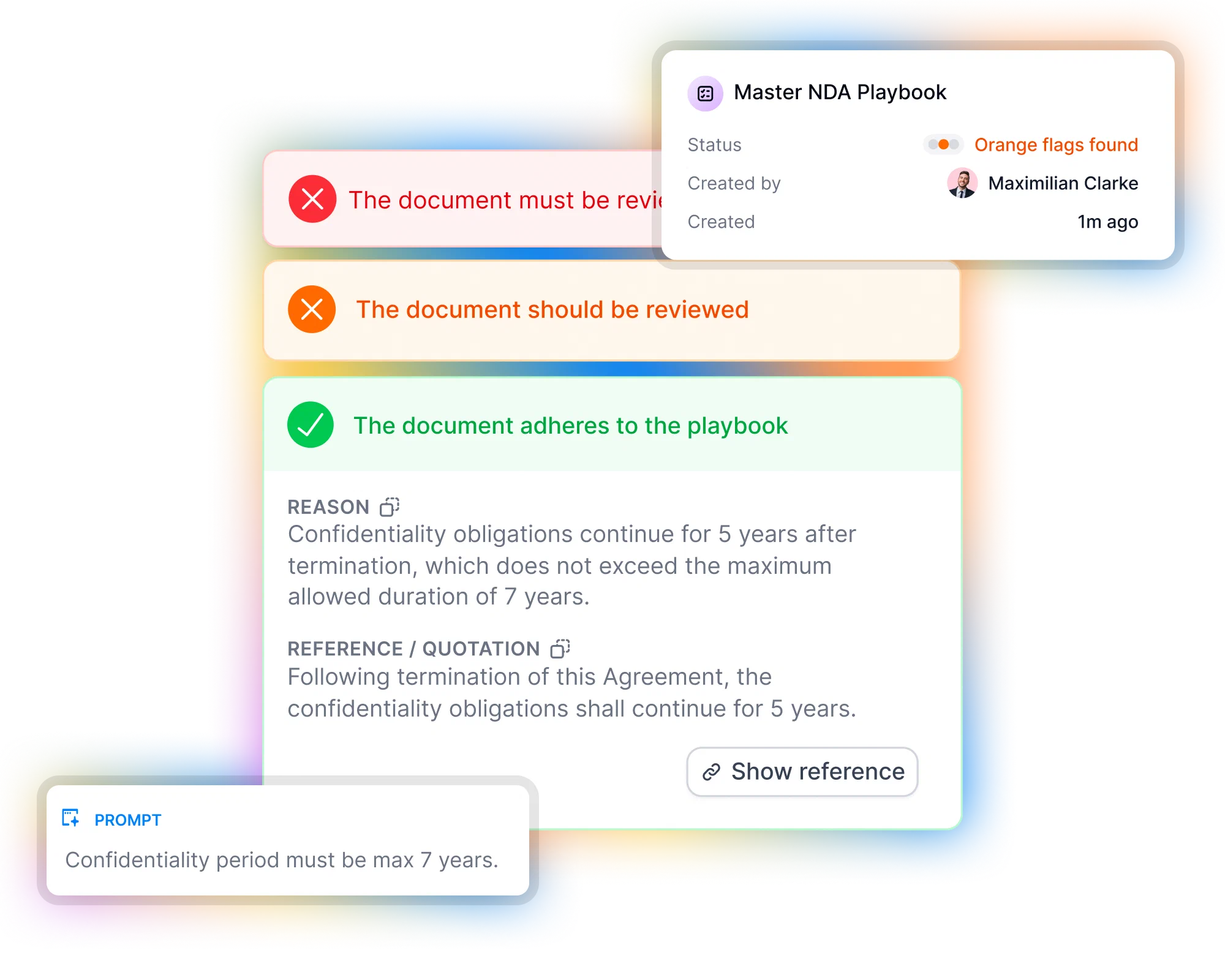
Define acceptable terms and escalation rules for a repeatable contract type. Configure AI review conditions to check clause presence, wording and policy requirements. Open flagged references to inspect the relevant sections. Keep a human responsible for accepting deviations.
Step 5: Measure the work, including corrections
Record time spent drafting, checking and correcting comparable agreements before and after adoption. Include setup, training and tool costs. Separate staff time saved from cash savings. Use those records to decide which tasks deserve wider use.
Searching for a contract management solution?
Find out how fynk can help you close deals faster and simplify your eSigning process – request a demo to see it in action.
What else do people ask about AI in law statistics?
It depends on the measure. Wolters Kluwer reports 92% using at least one AI tool in its international lawyer survey. That doesn't measure organization-wide deployment or contract-specific use.
Yes. Stanford's tested legal research tools produced misleading or false answers on nearly 1 in 5 queries. Those results describe older tested versions, not every current product.
Some report measurable savings, but results differ by sample. Track checking time, corrections and costs before treating faster drafting as a financial return.
These studies don't establish that AI can replace human judgment. Use it for defined tasks, verify the source wording and assign responsibility for exceptions.
Sources
- FTI Technology and Relativity, The Seventh Annual General Counsel Report, 2026; adoption finding from 30 GC/CLO interviews; vendor report.
- Clio, Legal Trends Report 2026, 2026; 2,542 US legal professionals across surveys; vendor report.
- Wolters Kluwer, Future Ready Lawyer Survey Report, 2026; 810 lawyers internationally; vendor report.
- LexisNexis UK, Why AI governance needs a feedback loop, 2026; 543 UK legal professionals; vendor report.
- ACC and Everlaw, Generative AI’s Growing Strategic Value for Corporate Law Departments, 2025; 657 in-house counsel and legal operations professionals; vendor report.
- Thomson Reuters Institute, AI in Professional Services Report, 2026; 1,514 professionals internationally; vendor report.
- Blickstein Group, Balancing Tensions While Driving Towards Strategic Modernization, 2025; legal operations at 68 companies; vendor-sponsored report.
- Stanford HAI, AI Index Report, 2026; multiple benchmarks and business surveys.
- Bitkom, KI in der deutschen Wirtschaft 2026, 2026; 603 German companies, AI-use base 343.
- Juro, State of In-house 2025, 2025; 160 in-house lawyers; vendor report.
- EY Law and BUJ, Legal Operations: erfolgreicher Wandel kommt von innen, 2025; 105 German-market departments, 86 complete responses.
- Wolters Kluwer, Benchmarkstudie: Digitalisierung der Rechtsabteilung, 2025; 700+ in-house professionals, Europe and US; vendor report.
- Stanford RegLab and HAI, Hallucination-Free? Assessing the Reliability of Leading AI Legal Research Tools, 2024; 202 US legal research queries.
- Damien Charlotin, AI Hallucination Cases database, 2026; worldwide court decisions, updated October 29.
- Thomson Reuters Institute, Future of Professionals Report, 2026; 1,816 professionals internationally; vendor report.
- Thomson Reuters Institute, Generative AI in Professional Services Report, 2025; nearly 1,800 professionals; publisher release.
- Bitkom, Studienbericht Künstliche Intelligenz in Deutschland, 2026; 604 companies and 1,005 public respondents; 2025 fieldwork.
- Harbor and CLOC, Law Department Survey, 2025; 135 corporate law departments; publisher release.
- KPMG Law, Global General Counsel Outlook, 2026; 468 general counsel and senior legal leaders.
- Legal Tech Verband Deutschland and partners, Legal Tech Monitor, 2025; almost 300 respondents, project ratings base 74; vendor-supported.
- Juro, State of In-house 2026, 2026; 132 in-house lawyers internationally; vendor report.
- Eurostat, Artificial intelligence by size class of enterprise, 2026; enterprise ICT survey, 2025 SME data.
- Gartner, Legal tech budgets to double by 2028 as legal AI use expands, 2026; analyst predictions, no sample.
- European Commission, AI Act: regulatory framework for AI, 2024, updated policy page; legislation, no survey sample.
Please keep in mind that none of the content on our blog should be considered legal advice. We understand the complexities and nuances of legal matters, and as much as we strive to ensure our information is accurate and useful, it cannot replace the personalized advice of a qualified legal professional.




Get a regular dose of insightful contract management content




Take control of your agreements. Move your business forward.
Run agreements the way they should run: fast, clear, and on your terms.
No setup headaches
Go live in days, not quarters
No lock-in
Full export anytime
No hidden fees
Signatures included, no envelope fee