Film collaboration agreement
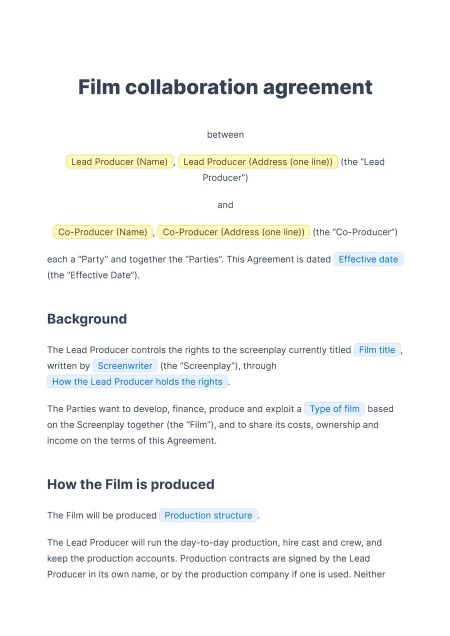
between
Lead Producer (Name), Lead Producer (Address (one line)) (the “Lead Producer”)
and
Co-Producer (Name), Co-Producer (Address (one line)) (the “Co-Producer”)
each a “Party” and together the “Parties”. This Agreement is dated Effective date (the “Effective Date”).
Background
The Lead Producer controls the rights to the screenplay currently titled Film title, written by Screenwriter (the “Screenplay”), through How the Lead Producer holds the rights.
The Parties want to develop, finance, produce and exploit a Type of film based on the Screenplay together (the “Film”), and to share its costs, ownership and income on the terms of this Agreement.
How the Film is produced
The Film will be produced Production structure.
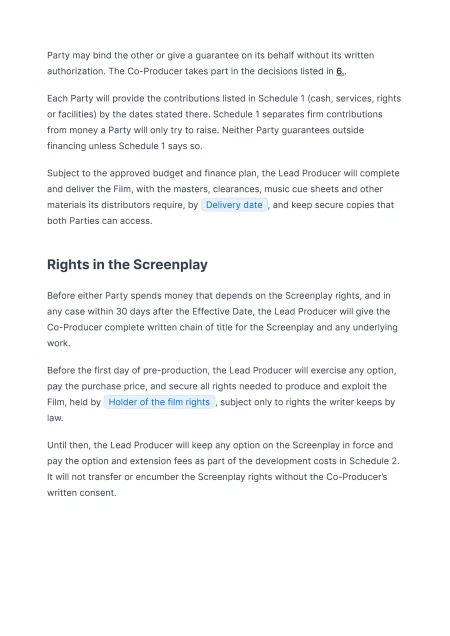
The Lead Producer will run the day-to-day production, hire cast and crew, and keep the production accounts. Production contracts are signed by the Lead Producer in its own name, or by the production company if one is used. Neither Party may bind the other or give a guarantee on its behalf without its written authorization. The Co-Producer takes part in the decisions listed in 6..
Each Party will provide the contributions listed in Schedule 1 (cash, services, rights or facilities) by the dates stated there. Schedule 1 separates firm contributions from money a Party will only try to raise. Neither Party guarantees outside financing unless Schedule 1 says so.
Subject to the approved budget and finance plan, the Lead Producer will complete and deliver the Film, with the masters, clearances, music cue sheets and other materials its distributors require, by Delivery date, and keep secure copies that both Parties can access.
Rights in the Screenplay
Before either Party spends money that depends on the Screenplay rights, and in any case within 30 days after the Effective Date, the Lead Producer will give the Co-Producer complete written chain of title for the Screenplay and any underlying work.
Before the first day of pre-production, the Lead Producer will exercise any option, pay the purchase price, and secure all rights needed to produce and exploit the Film, held by Holder of the film rights, subject only to rights the writer keeps by law.
Until then, the Lead Producer will keep any option on the Screenplay in force and pay the option and extension fees as part of the development costs in Schedule 2. It will not transfer or encumber the Screenplay rights without the Co-Producer’s written consent.
Budget and finance plan
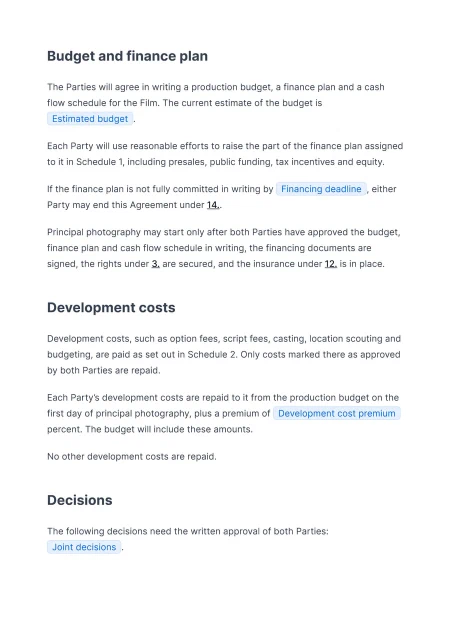
The Parties will agree in writing a production budget, a finance plan and a cash flow schedule for the Film. The current estimate of the budget is Estimated budget.
Each Party will use reasonable efforts to raise the part of the finance plan assigned to it in Schedule 1, including presales, public funding, tax incentives and equity.
If the finance plan is not fully committed in writing by Financing deadline, either Party may end this Agreement under 14..
Development costs
Development costs, such as option fees, script fees, casting, location scouting and budgeting, are paid as set out in Schedule 2. Only costs marked there as approved by both Parties are repaid.
Each Party’s development costs are repaid to it from the production budget on the first day of principal photography, plus a premium of Development cost premium percent. The budget will include these amounts.
No other development costs are repaid.
Decisions
The following decisions need the written approval of both Parties: Joint decisions.
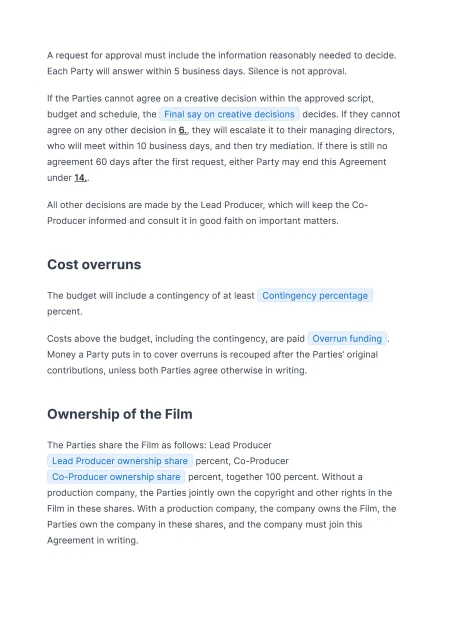
A request for approval must include the information reasonably needed to decide. Each Party will answer within 5 business days. Silence is not approval.
If the Parties cannot agree on a creative decision within the approved script, budget and schedule, the Final say on creative decisions decides. If they cannot agree on any other decision in 6., they will escalate it to their managing directors, who will meet within 10 business days, and then try mediation. If there is still no agreement 60 days after the first request, either Party may end this Agreement under 14..
All other decisions are made by the Lead Producer, which will keep the Co-Producer informed and consult it in good faith on important matters.
Cost overruns
The budget will include a contingency of at least Contingency percentage percent.
Costs above the budget, including the contingency, are paid Overrun funding. Money a Party puts in to cover overruns is recouped after the Parties’ original contributions, unless both Parties agree otherwise in writing.
Ownership of the Film
The Parties share the Film as follows: Lead Producer Lead Producer ownership share percent, Co-Producer Co-Producer ownership share percent, together 100 percent. Without a production company, the Parties jointly own the copyright and other rights in the Film in these shares. With a production company, the company owns the Film, the Parties own the company in these shares, and the company must join this Agreement in writing.
Neither Party may sell, license or encumber its share of the Film without the other Party’s written consent, except to a financier, completion guarantor or distributor as part of the agreed finance plan.
If a Party wants to sell its share, it must tell the other Party the buyer and all material terms, and the other Party may buy the share on the same terms within 30 days. A buyer must take over the seller’s obligations in writing.
Exploitation and distribution
The Parties will appoint sales agents and distributors jointly. Each Party may propose candidates.
Territories
Festival submissions, the release strategy and marketing for the main territories need both Parties’ approval under 6..
Income and recoupment
All income from the Film, wherever it comes from and whoever receives it, is paid into a collection account that the Parties set up jointly, and paid out in the order in Schedule 3 (the “Recoupment Order”).
Once all items before the last step of the Recoupment Order are paid, the remaining income (“Net Profits”) is split between the Parties in proportion to their ownership shares in 8., unless Schedule 3 says otherwise.
Profit participations granted to cast, crew or financiers come out of the Net Profits before the Parties’ split only if both Parties approved them. Otherwise, they come out of the share of the Party that granted them.
Statements of all income, deductions and payments are sent to both Parties every calendar quarter for the first 3 years after the Film’s first release, and once a year after that.
Each Party may, once a year and with 30 days’ written notice, have an independent accountant inspect the production and collection accounts, which are kept for at least 7 years. The inspecting Party pays the cost, unless an underpayment of more than 5 percent is found; then the Party responsible for the underpayment pays it.
Credits
The Parties will receive these credits on screen and in paid advertising where producers are credited: Credits.
The Lead Producer’s company logo and the Co-Producer’s company logo will appear together, at the same size, wherever a company logo of either Party appears.
Accidental failure to give a credit is not a material breach if it is corrected after notice in materials the responsible Party controls, where reasonably possible, and distributors are asked to do the same.
Insurance
The Lead Producer will take out production insurance usual for a film of this budget from the start of pre-production, and errors and omissions insurance before the Film is delivered. Both Parties will be named as insured. The cost is part of the budget.
Cast, crew and guild rules
The Lead Producer will hire cast and crew under written contracts that give the Parties all rights needed to exploit the Film and that follow any applicable collective agreements and guild or union rules.
If the Film is not made
Either Party may end this Agreement by written notice if:
the finance plan is not fully committed by the date in 4.;
principal photography has not started by Start of principal photography; or
the other Party materially breaches this Agreement and does not remedy the breach within 30 days after a written notice describing it.
If this Agreement ends before principal photography, the rights in the Screenplay Rights after the project ends, as far as the underlying agreements allow. If the Lead Producer, or anyone it transfers or licenses the Screenplay to, later starts principal photography of a film based on the Screenplay, the Lead Producer will repay the Co-Producer’s approved, unrepaid development costs, plus the premium in 5., no later than that day.
If this Agreement ends after principal photography has started because of a Party’s breach, the other Party may complete and exploit the Film within the approved budget, if needed with a replacement producer, and gets access to the footage, contracts and records. The Parties keep their ownership shares and their rights under 10., less any extra costs the breach caused.
A Party prevented from performing by events beyond its reasonable control, other than lack of money, will tell the other Party promptly and limit the effects. Its obligations are suspended while the event lasts. If it lasts more than 90 days, either Party may end this Agreement by written notice.
Confidentiality and publicity
Each Party will keep the terms of this Agreement and the other Party’s non-public information confidential, use it only for the Film, and protect it during this Agreement and for 3 years after it ends. This does not apply to information that is public, already known to the receiving Party, or independently developed. Disclosures to cast, crew, advisers, financiers, funding bodies, insurers and distributors who need to know and are bound by confidentiality, and disclosures required by law, are allowed.
Press releases about the Film need both Parties’ approval.
Promises
Each Party promises that:
it has the authority to sign and perform this Agreement;
anything it contributes to the Film will not infringe anyone’s rights;
it will act in good faith and keep the other Party informed of anything that could seriously delay or stop the Film.
Each Party will indemnify the other against third-party claims, and reasonable defense costs, caused by its breach of these promises. The other Party will tell it promptly of the claim and not settle it without its consent.
General
Nothing in this Agreement creates an employment or agency relationship between the Parties, and neither Party may bind the other, except as stated in 2..
Neither Party may transfer this Agreement without the other Party’s prior written consent.
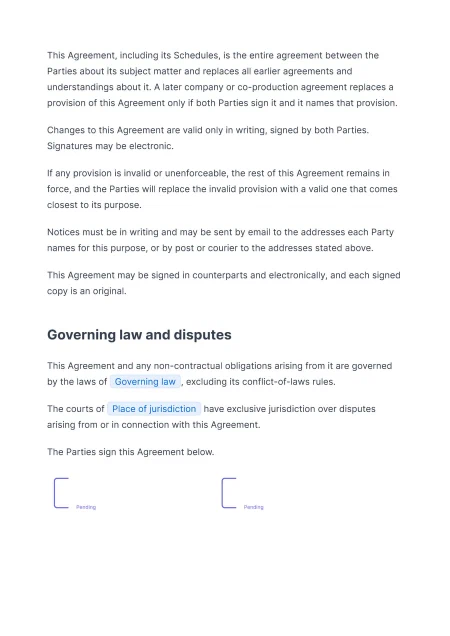
This Agreement, including its Schedules, is the entire agreement between the Parties about its subject matter and replaces all earlier agreements and understandings about it. A later company or co-production agreement replaces a provision of this Agreement only if both Parties sign it and it names that provision.
Changes to this Agreement are valid only in writing, signed by both Parties. Signatures may be electronic.
If any provision is invalid or unenforceable, the rest of this Agreement remains in force, and the Parties will replace the invalid provision with a valid one that comes closest to its purpose.
Notices must be in writing and may be sent by email to the addresses each Party names for this purpose, or by post or courier to the addresses stated above.
This Agreement may be signed in counterparts and electronically, and each signed copy is an original.
Governing law and disputes
This Agreement and any non-contractual obligations arising from it are governed by the laws of Governing law, excluding its conflict-of-laws rules.
The courts of Place of jurisdiction have exclusive jurisdiction over disputes arising from or in connection with this Agreement.
The Parties sign this Agreement below.
Schedule 1: Contributions
| Party | Contribution (cash, services, rights, facilities) | Value | Due date | Firm or to be raised |
|---|---|---|---|---|
Schedule 2: Development costs
| Item | Paid by | Amount | Approved by both Parties (yes or no) |
|---|---|---|---|
Schedule 3: Recoupment order
| Step | Who is paid | What is paid | Cap |
|---|---|---|---|