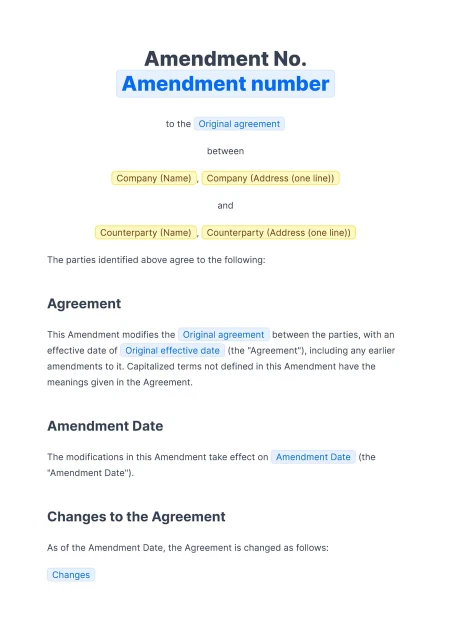
The parties identified above agree to the following:
Agreement
This Amendment modifies the Original agreement between the parties, with an effective date of Original effective date (the "Agreement"), including any earlier amendments to it. Capitalized terms not defined in this Amendment have the meanings given in the Agreement.
Amendment Date
The modifications in this Amendment take effect on Amendment Date (the "Amendment Date").
Changes to the Agreement
As of the Amendment Date, the Agreement is changed as follows:
Changes
Everything else stays the same
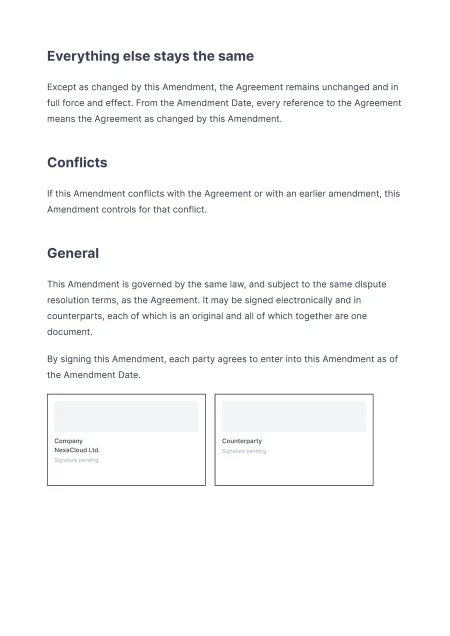
Except as changed by this Amendment, the Agreement remains unchanged and in full force and effect. From the Amendment Date, every reference to the Agreement means the Agreement as changed by this Amendment.
Conflicts
If this Amendment conflicts with the Agreement or with an earlier amendment, this Amendment controls for that conflict.
General
This Amendment is governed by the same law, and subject to the same dispute resolution terms, as the Agreement. It may be signed electronically and in counterparts, each of which is an original and all of which together are one document.
By signing this Amendment, each party agrees to enter into this Amendment as of the Amendment Date.
Company
NexaCloud Ltd.
Signature pending
Counterparty
Signature pending
Disclaimer: The original creator, the author of this template, and fynk GmbH are not responsible for any damages or liabilities that may result from using this template. This template should not be considered a substitute for legal advice, and consulting with a legal professional is recommended before use. fynk GmbH, the original creator, and the author do not provide legal advice and will not be held accountable for any legal consequences arising from its use.
More than 12,000 teams chose fynk to outgrow legal chaos · Used in over 60 countries
What a contract amendment covers and how to use this template
Learn when to use an amendment instead of an addendum or a new contract, how to word changes so they are unambiguous, and what makes an amendment enforceable.
Contract amendment
A written agreement between the parties to an existing contract that changes, removes, or adds specific terms of that contract. The rest of the original contract stays in force. An amendment binds only if the parties agree to it in the way the original contract requires, usually in writing and signed by both.
Use this template if:
You want to change part of a signed contract, such as fees, term, scope, service levels, or deadlines, without rewriting the whole agreement
The original contract requires changes to be made in writing and signed by both parties, which most commercial contracts do
You have made, or expect to make, several changes over time and want each one numbered and dated
You need one format that works for any contract, from a SaaS subscription to a services agreement or a lease
Amendment, addendum, or new contract?
Document
What it does
Use it when
Amendment
changes or deletes existing terms
the price goes up, the term is extended, a clause is rewritten
Addendum
adds new terms without changing existing ones
you add a new service, a data processing agreement, or a schedule
New order form or statement of work
creates a new transaction under the existing master terms
you buy a new product or start a new project, as with a statement of work
Amended and restated agreement
replaces the whole contract with a clean new version
there have been so many amendments that nobody can read the contract anymore
In practice, many people say “amendment” for any change, and this template can also add terms. What matters legally is not the title but that both parties clearly agree to the change. For a side-by-side comparison with examples, read addendum vs amendment, or see what an addendum is.
How to word the changes
The most common amendment mistake is vague wording like “Section 4 is amended to reflect the new pricing.” Six months later, nobody agrees what the new pricing was. Write every change so someone who was not in the room can apply it:
Type of change
Wording that works
Replace a clause
“Section 4.1 (Fees) is deleted and replaced in full with: The monthly fee is $1,200, payable in advance.”
Change one number or date
“In Section 2.1 (Term), ’twelve (12) months’ is replaced with ’twenty-four (24) months’.”
Add a clause
“The following is added as Section 9.4 (Security Reviews): …”
Delete a clause
“Section 7.3 (Exclusivity) is deleted in its entirety.”
Change an exhibit
“Exhibit A (Service Levels) is replaced in full with the Exhibit A attached to this Amendment.”
Refer to sections by number and heading, quote the full new text, and do not paraphrase. The template’s Changes field asks for exactly this, with examples in the question.
Keep every amendment next to the contract it changes.find a home.
Follow the original contract’s amendment clause. Most commercial contracts say they can only be changed in a writing signed by both parties. An email exchange or a phone call usually will not do. This template is a signed writing, which meets that requirement.
The right people sign. The amendment should be signed by people authorized to bind each company, normally the same roles that signed the original contract.
Something in return, under US law. In most US states, a change to a contract needs consideration, meaning each side gets something. Most amendments have it naturally: a price increase comes with a longer term, extra scope comes with extra fees. A change that only benefits one side, such as a discount with nothing in return, is safer if it gives the other side something too, even a small concession. Contracts for the sale of goods are an exception: under UCC § 2-209, they can be modified without consideration if the change is made in good faith.
Clear effective date. The template separates the date of the original agreement from the Amendment Date, the day the changes take effect. That date can be in the past, today, or in the future, for example the start of the next billing period.
Tracking several amendments
Long-running contracts collect amendments. This template numbers them (Amendment No. 1, No. 2, and so on) and states that each amendment controls over the original agreement and earlier amendments where they conflict. If you reach the point where nobody can read the contract without three other documents next to it, consider an amended and restated agreement that pulls everything into one clean version.
How to complete and sign the amendment in fynk
Fill in the fields. Enter the amendment number, the original agreement and its date, the Amendment Date, and the changes. Your company is already set as a party.
Show what changed. If the counterparty proposes edits, redlining keeps every suggestion visible, and PDF comparison shows the difference between versions of the original contract.
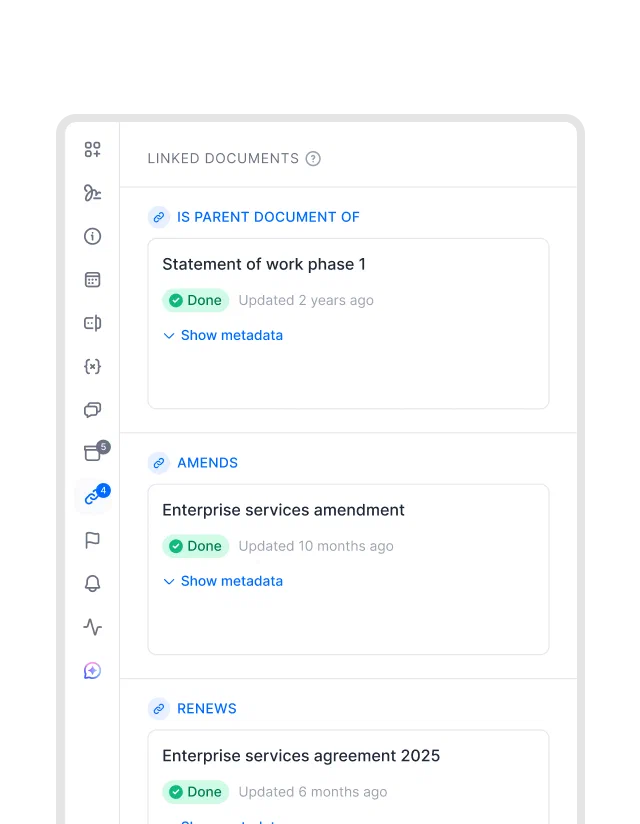
Sign and connect it to the contract. Both sides sign with an electronic signature. Link the signed amendment to the original contract with related files, so anyone opening the contract sees every change made to it.
A written agreement that changes specific terms of an existing contract, such as price, term, or scope, while the rest of the contract stays in force. Both parties to the original contract must agree to it.
Identify the original contract by title, parties, and date. State when the changes take effect. Then list each change by section number, with the exact new wording for replacements and additions and a clear statement for deletions. Add that everything else stays the same, and have both parties sign.
An amendment changes or deletes existing terms. An addendum adds new terms or documents without changing what is already there. Both need the agreement of all parties to the original contract.
In almost all cases, yes. Most contracts require changes to be in writing and signed by both parties, and without both signatures it is hard to prove that the other side agreed. Electronic signatures are valid for this in the US and EU. Learn more about the legality of electronic signatures.
Yes, if both parties agree. Set the Amendment Date to the date from which the change should apply. Be careful with changes that affect payments already made or obligations already performed, and spell out how they are handled.
Usually not. A notary is only needed if the original contract or the law required one, for example for certain real estate documents. Ordinary commercial contracts and their amendments do not need notarization.