
Contract metadata extraction: fields, methods and AI

Rezvan Golestaneh
Updated · Published · 10 min read
AI-powered contract metadata extraction turns unstructured contract text into clean, searchable fields, automatically and in seconds, with no templates required.
- The fields worth extracting from every contract, and why each one matters
- The four extraction methods compared: manual, rule-based, ML and AI/NLP
- A step-by-step walkthrough of how fynk extracts, reviews and stores metadata
- Yes, you can extract metadata from old or scanned PDFs too
Most companies know roughly what is in their contracts. Few can answer, within a minute, which supplier agreements renew automatically next quarter, or which customer contracts have uncapped liability. The information is there, but it is locked in PDFs. Contract metadata extraction is how you get it out.
Contract metadata extraction pulls key facts out of contract text and stores them as structured fields: parties, contract type, start and end dates, renewal and notice terms, value, payment terms and governing law.
- Four methods exist: manual entry, rule-based extraction, machine learning, and AI using natural language processing (NLP).
- AI extraction is the easiest because it needs no templates or rules and works on PDFs, Word files and scans.
- A human should still confirm the result, especially dates and values that trigger reminders or reports.
- The payoff is a searchable contract repository, automatic renewal reminders and reliable reporting.
What is contract metadata extraction?
Contract metadata extraction is the process of identifying the key information inside a contract and converting it into structured data, today usually with the help of AI.
- Contract metadata extraction
- The automated identification of defined data points in a contract, such as parties, dates, amounts and terms, and their transfer into structured fields that can be searched, filtered, reported on and used to trigger workflows. It is also called contract data extraction or key term extraction.
In other words, it turns complex contract text into clean, usable fields. If you are new to the concept, start with our explainer on what contract metadata is. The fields most teams extract are:
| Field | Example | Why it matters |
|---|---|---|
| Parties | Acme Inc. and Supplier GmbH | Find every contract with a counterparty |
| Contract type | NDA, master services agreement, lease | Filter and report by category |
| Effective date and end date | 1 March 2026 to 28 February 2027 | Know what is in force |
| Renewal terms | Renews automatically for 12 months | Avoid unwanted renewals |
| Notice period | 3 months before the end date | Trigger a reminder in time |
| Contract value and payment terms | EUR 48,000 a year, 30 days net | Spend analysis and cash planning |
| Governing law and jurisdiction | Laws of England and Wales | Assess legal risk across the portfolio |
| Obligations, SLAs and KPIs | 99.5% uptime, monthly reporting | Track what each side must deliver |
| Signatories and signature date | Signed by the CFO on 12 February 2026 | Prove who committed the company |
Modern contract metadata extraction uses AI, NLP and machine learning to understand legal language, detect clauses and interpret context. This allows teams to:
- Search and filter contracts instantly
- Automate renewals, reminders and the approval process
- Generate summaries and risk reports
- Feed contract data into CLM, CRM, CPQ and ERP systems
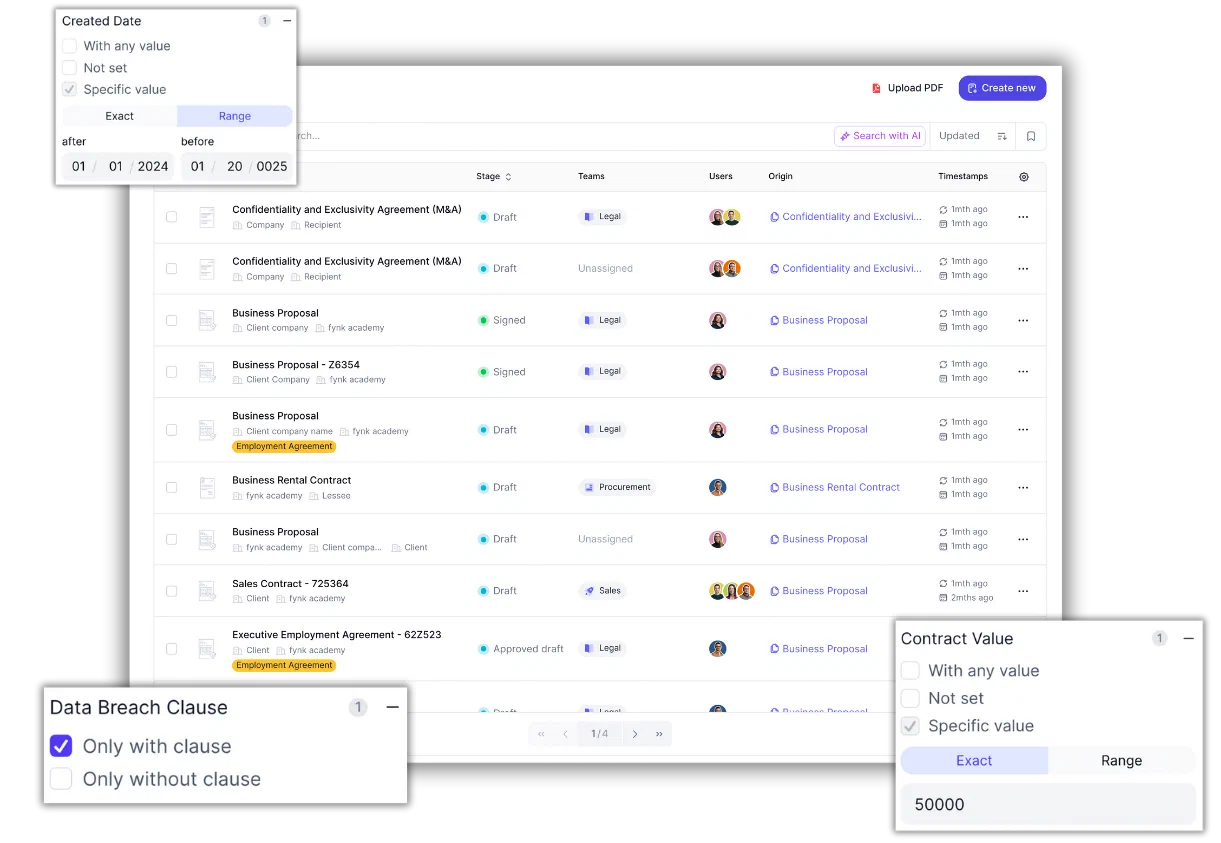


Metadata search in fynk
Why contract metadata extraction is important
Contract metadata extraction turns unstructured documents into structured, usable information. Instead of digging through pages of legal text, teams get the key details they need to make decisions, stay compliant and avoid missed deadlines.
- Saves time: no more manual searching through PDFs for dates, clauses or obligations.
- Reduces risk: renewal deadlines, termination terms and obligations are identified automatically, so nothing slips through the cracks.
- Enables automation: metadata powers reminders, approvals, dashboards and workflows. You cannot automate any of these without structured data.
- Improves consistency: AI extracts contract metadata the same way every time, which reduces typing errors and differing interpretations.
- Makes contracts searchable: filter by contract type, parties, renewal dates, values and more.
- Supports reporting: analyse spend, risk and contract lifecycles with reliable data.
- Connects systems: metadata syncs into CRM and ERP tools, creating a single source of truth.
What are the methods of metadata extraction?
| Method | How it works | Strengths | Weaknesses |
|---|---|---|---|
| Manual | A person reads and types the data | Handles any document | Slow, expensive, error-prone at scale |
| Rule-based | Templates, keywords or regex patterns | Fast on standardised documents | Breaks when wording or layout changes |
| Machine learning | Models trained on labelled examples | Adapts to new layouts | Needs training data and upkeep |
| AI / NLP | Language models read the text in context | No setup, handles varied wording and scans | Needs human confirmation of critical fields |
1. Manual extraction
A person reads the document and types metadata into a spreadsheet or system.
- Accurate when done carefully, but slow
- Does not scale beyond a few dozen contracts
- Prone to typing errors and inconsistent interpretation
2. Rule-based extraction
The system uses predefined rules, templates or regex patterns, for example “find the date after the words commences on”.
- Works well for highly standardised documents, such as your own templates
- Fails when formatting or wording changes, which is common on third-party paper
- Requires ongoing maintenance
3. Machine learning (ML) extraction
Models learn patterns from examples (training data) and recognise metadata automatically.
- More flexible than rule-based methods
- Can adapt to new layouts
- Requires training and good-quality labelled data
4. AI / NLP (natural language processing) extraction
The most advanced method, and the one fynk uses.
- Understands context, not just patterns: it can tell a notice period from a payment period
- Extracts metadata from PDFs, scans, old documents and unstructured text
- Identifies clauses, obligations, terms, values and more
- Requires no templates or manual setup
What is the easiest extraction method?
The easiest extraction method is AI-powered extraction.
Unlike manual or rule-based methods, AI needs:
- No templates
- No rules to configure
- No formatting requirements
- No separate handling for PDFs, scans or messy documents
With tools like fynk, you upload the contract and the AI extracts parties, dates, terms, values, obligations and more within seconds.
What makes contract data hard to extract
Even good AI has to deal with the way contracts are written. Knowing the hard cases tells you which fields to double-check:
- Dates that are calculated, not stated. “The term ends 24 months after go-live” has no end date in the text until go-live is known.
- Renewal and notice terms hidden in different clauses. The renewal sits in the term clause, the notice period in the termination clause, and the notice form in the boilerplate.
- Amendments and side letters. A later amendment can change the value or end date of the main contract. Extract both and link them.
- Poor scans. Skewed, faded or handwritten pages need good OCR before anything else works.
- Defined terms. “The Services” or “the Initial Term” only make sense together with the definitions section.
This is why the best results come from AI extraction plus a quick human review of the fields that drive deadlines and money.
How does AI contract metadata extraction work (with example)?
The fastest way to extract contract metadata at scale is a contract lifecycle management platform like fynk, which has the AI built in. Here is how the process works, step by step.
Step 1. Upload your contract
Start by importing your contract into fynk, or try AI analysis on a single document.
You can:
- Drag and drop a PDF, Word file or scanned document into fynk.
- Upload many contracts at once with AI import. The AI analysis runs automatically in the background.
- Create documents from files in your other tools through fynk integrations.
Step 2. Run AI analysis
fynk’s AI reads the document and, after a few seconds, gives you a list of metadata such as:
- Parties
- Effective date, signature date and expiration
- Renewal and termination details
- Payment terms
- Obligations and deliverables
- Governing law and jurisdiction
- Contract value (if present)
- Signatory information
- The detected contract type
- Key clauses and their structure
- Additional metadata fields identified by the AI
- A summary of your document
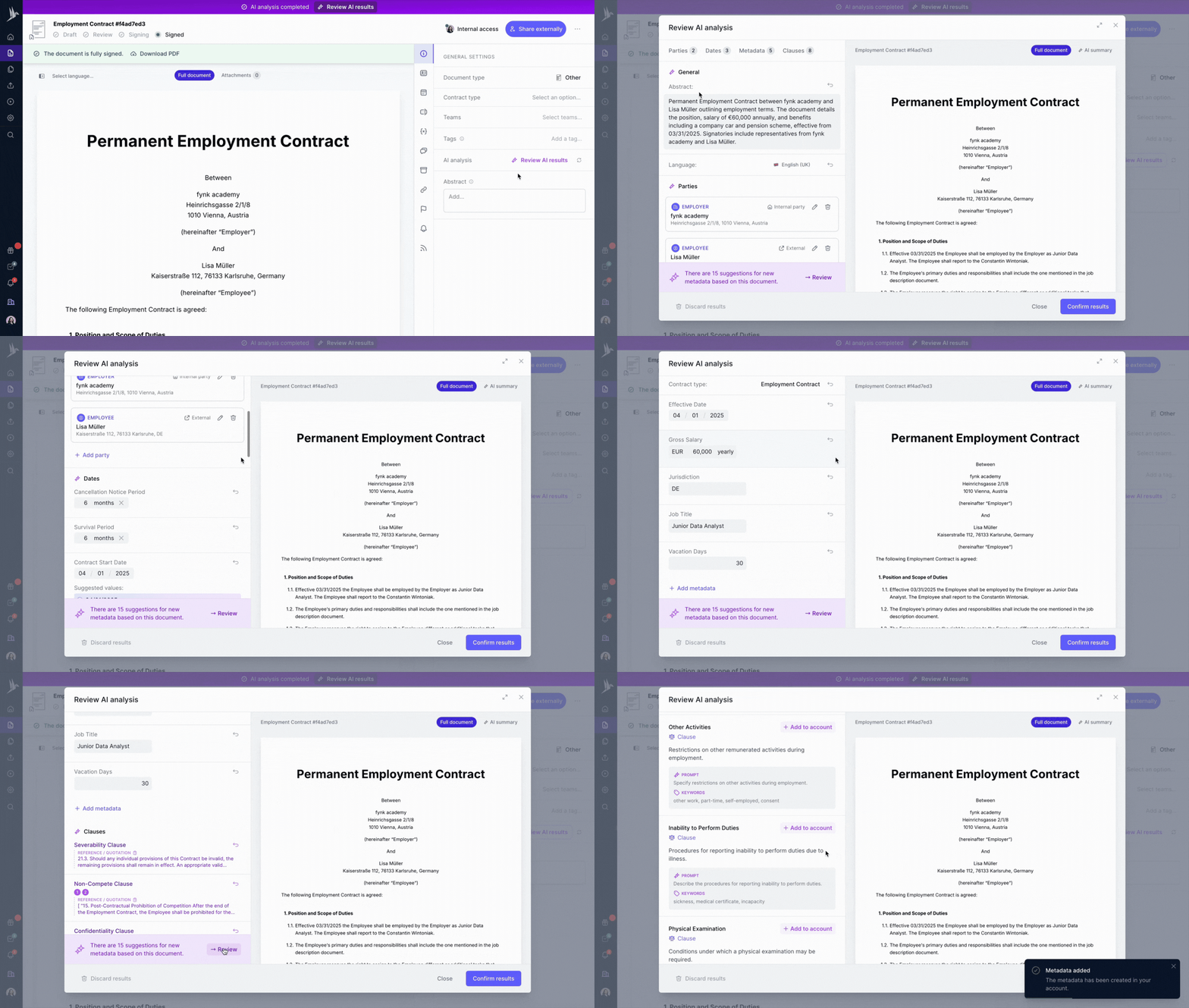
AI analysis in fynk
Step 3. Review and confirm extracted metadata
Once the AI extraction is complete, fynk shows all metadata fields in a panel next to the document.
You can:
- Review each extracted field
- Edit or confirm values
- Add custom metadata fields as needed
Nothing is finalised without your approval, so accuracy stays high while manual work stays minimal. And when details change later, you don’t have to redo it document by document: select the contracts you updated, choose which metadata to refresh, and re-run AI analysis on just those fields.
Step 4. Save and sync your metadata
Once you approve the extracted information, fynk stores all metadata in your workspace so you can:
- Search and filter across your full contract repository
- Build dashboards and reports
- See every renewal and notice date in the contract calendar and get reminders
- Sync metadata with Salesforce, HubSpot or Pipedrive, or with other tools through the fynk API
For how to name, structure and maintain your fields once they exist, see our contract metadata best practices.
Using metadata extraction to create perfect contract summaries
AI-powered contract summaries are only as good as the data behind them, which is why extracting accurate contract metadata is a crucial first step.
The AI is really helpful as well to just sum up the most important things… When I get sent a contract, how the AI puts it together and makes it easy to have a quick overview about the most important points is really helpful.

Once metadata is extracted, fynk uses it to generate summaries that are:
- Accurate: key facts like parties, dates, values and obligations come from confirmed fields, which reduces interpretation errors.
- Consistent: summaries follow a standard format because they rely on structured data.
- Complete: the essentials are included because extraction checks for them.
- Contextual: AI links clauses and terms together, giving more insight than a bullet list.
For example, instead of a generic summary like:
“This contract includes renewal terms and payment obligations,”
fynk produces a precise version based on the metadata:
“The agreement between Company A and Supplier B renews annually unless notice is given 30 days before the end date. Payment terms require invoices to be settled within 45 days.”
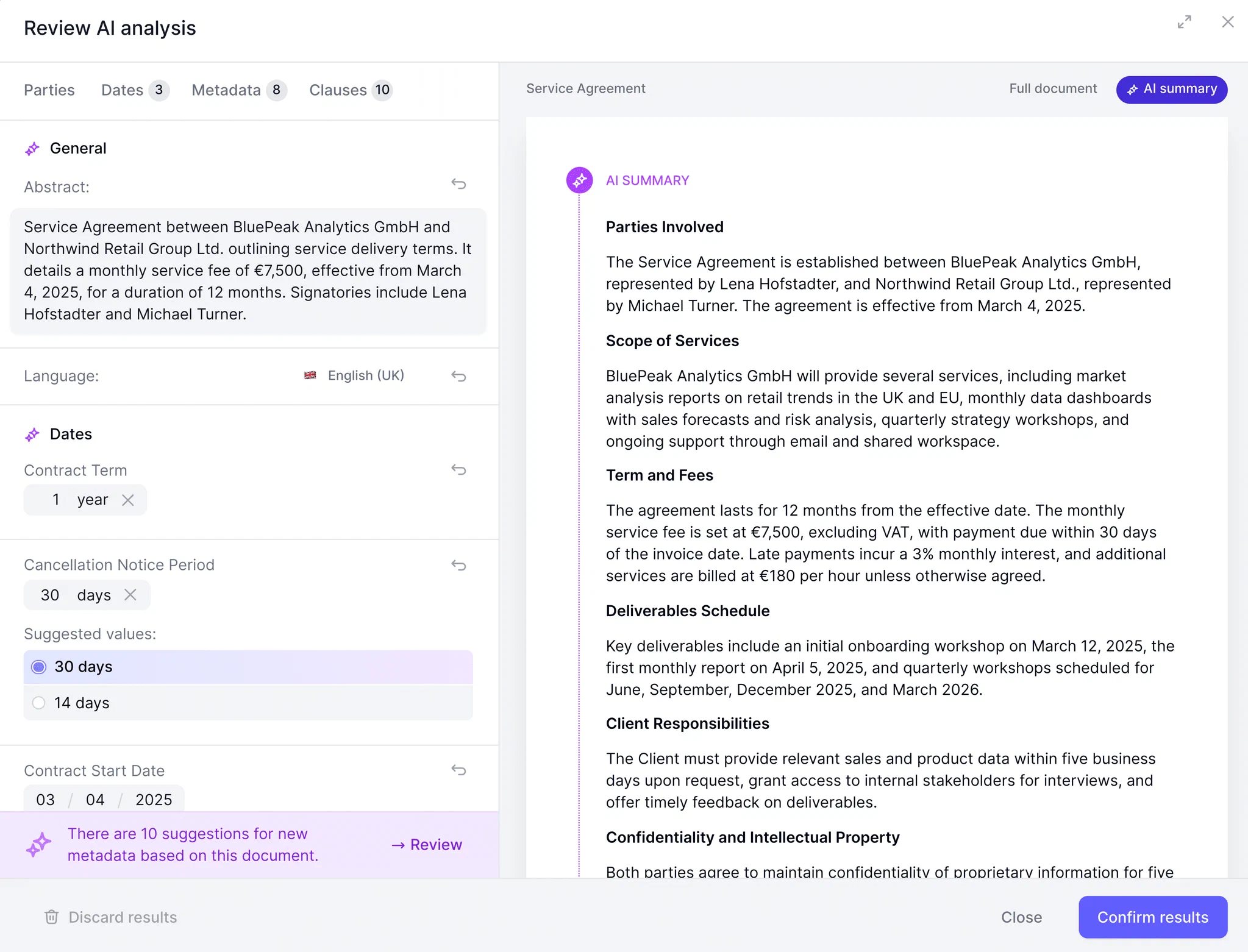
AI summary in fynk
Can I extract metadata from a PDF?
Yes. With fynk you can extract metadata from a PDF, even a very old one.
fynk’s AI uses OCR and NLP to read:
- Digitally created PDFs
- Scanned PDFs
- Low-quality or older documents
- PDFs with mixed formatting or inconsistent layouts
fynk’s OCR reviews and corrects its own output as it reads, which catches edge cases that standard parsers miss. Even if a PDF was never digital, fynk can recognise the text, interpret the clauses and extract key metadata such as parties, dates, contract values, renewal terms and obligations. For more on how AI reads contracts beyond metadata, see AI and automated contract review.
Now over to you
Contract metadata does not have to stay buried in PDFs or scattered across spreadsheets. With the right tools, every contract becomes structured, usable data, which unlocks automation, visibility and better decisions across your organisation.
Whether you manage hundreds of agreements or are just getting started, AI-powered extraction is one of the fastest ways to improve your workflow. Upload a contract, watch the AI extract the metadata in seconds, and see how much time you save.
Ask your contract anything.
FAQs
It is the process of pulling key facts out of a contract, such as parties, dates, renewal terms, value and governing law, and storing them as structured fields. Today it is usually done by AI, with a person confirming the critical fields.
Clauses are the text of the contract, such as the termination clause. Metadata is the data you take from that text, such as a three-month notice period or an end date. Metadata is what you search, filter and set reminders on.
Accuracy is high for common fields such as parties, dates and values. It drops where terms are implied, calculated from other events or spread across amendments. That is why the extracted fields should be reviewed before they drive reminders or reports.
You can view your metadata directly in the document view. After the AI analysis finishes, open the contract and look at the right-hand panel, where all extracted metadata fields such as parties, dates, values and obligations are displayed in an organized list.
You can manage all your metadata fields under Settings, Metadata. Some system metadata cannot be removed or edited, as it contains key information required for features like notifications and reminders to work.
Yes. In addition to AI-extracted fields, fynk lets you create custom metadata fields (text, number, date, dropdown and more) in your settings. Custom fields can be added to any contract and used for filtering, reporting and workflows.
Yes. fynk uses metadata such as end dates, renewal terms and contract values to trigger reminders, approval workflows and notifications, so critical deadlines and obligations are not missed.
Please keep in mind that none of the content on our blog should be considered legal advice. We understand the complexities and nuances of legal matters, and as much as we strive to ensure our information is accurate and useful, it cannot replace the personalized advice of a qualified legal professional.




Get a regular dose of insightful contract management content

Take control of your agreements. Move your business forward.
Run agreements the way they should run: fast, clear, and on your terms.
No setup headaches
Go live in days, not quarters
No lock-in
Full export anytime
No hidden fees
Signatures included, no envelope fee