
What’s the difference between a lawyer and an attorney?

Rezvan Golestaneh
Updated · Published · 10 min read
In everyday American English, “lawyer” and “attorney” are used as synonyms, and most people who call themselves either one hold a law license. The strict meanings are different, though, and the difference decides who can represent you.
Every attorney is a lawyer, but not every lawyer is an attorney. A lawyer is anyone trained in the law, typically a law school graduate with a Juris Doctor (JD). An attorney, short for attorney-at-law, is a lawyer who has passed a state bar exam and been admitted to the bar, which is what gives them the authority to act on a client’s behalf.
That license is the whole difference. Only an admitted attorney can represent you in court, file documents for you or give you legal advice as a professional. A law graduate who never passed the bar can research, teach and work in policy or compliance, but cannot practice law for clients.
- Lawyer
- A person educated and trained in the law. In the US this usually means a graduate of a law school with a JD. The word says nothing about a license on its own, which is why it also covers law professors, policy advisers and JD holders working in business.
- Attorney (attorney-at-law)
- A lawyer who has been admitted to the bar of at least one US jurisdiction and is licensed to practice law there. An attorney can represent clients in court, sign and file pleadings, give legal advice and hold client money in trust. Attorneys are bound by their state’s rules of professional conduct and can be disciplined or disbarred.
Lawyer vs. attorney at a glance
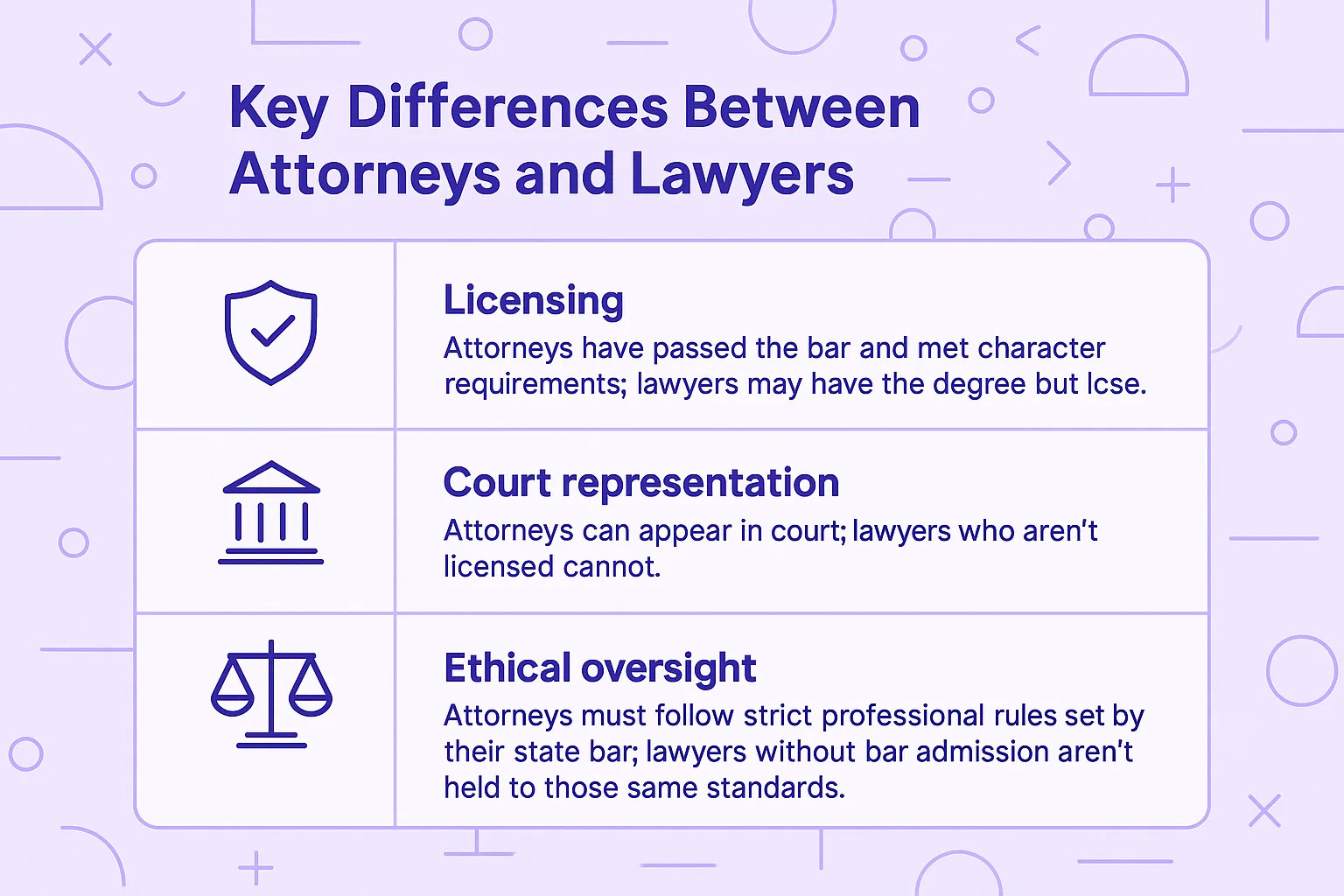


The table compares a law graduate who has not been admitted to the bar with an admitted attorney. Once a lawyer is admitted, the two columns merge.
| Lawyer (not admitted) | Attorney (admitted to the bar) | |
|---|---|---|
| Education | Law degree, usually a three-year JD | The same JD |
| Bar exam | Not passed, or not taken | Passed in at least one jurisdiction, plus the MPRE ethics exam in almost every state |
| Bar admission | None | Admitted after a character and fitness review and an oath |
| Can represent clients in court | No | Yes, in the courts of the state where they are admitted |
| Can give legal advice to clients | No, doing so is the unauthorized practice of law | Yes |
| Can draft documents | Yes, for their own use or under an attorney’s supervision | Yes, and can sign and file them for clients |
| Ethics rules | Not subject to bar discipline | Bound by the state’s rules of professional conduct, most of them based on the ABA Model Rules |
| Continuing legal education | Not required | Required in most states to keep the license active |
| Title use | “JD” or “law graduate” | “Attorney”, “attorney-at-law”, “counselor” and the courtesy title “Esq.” |
| Typical work | Academia, policy, compliance, legal publishing, business roles | Private practice, litigation, in-house counsel, government, public defense |
Where the words come from
“Lawyer” is Middle English: a person versed in law. “Attorney” comes from the Old French atorné, “one appointed” to act for someone else. That root explains why the word has two meanings today. An attorney-at-law is appointed to act for a client in legal matters. An attorney-in-fact is anyone appointed to act for another person under a power of attorney.
England used to have attorneys too. The Judicature Act of 1873 folded them into the solicitors’ profession, which is why the word “attorney” now sounds American to British ears.
How to become a lawyer and an attorney in the US
The path to becoming a lawyer and the path to becoming an attorney are the same until law school ends. The bar is where they split.
- Earn a bachelor’s degree. Any major works. There is no required pre-law subject.
- Take an admissions test. Most law schools require the LSAT, and many also accept the GRE.
- Complete law school. A JD takes three years full time at a school accredited by the American Bar Association. Some states, notably California, also admit graduates of state-accredited schools. At this point you are a lawyer in the broad sense.
- Pass the MPRE. The Multistate Professional Responsibility Examination is a two-hour, 60-question ethics test. Every US jurisdiction requires it except Wisconsin and Puerto Rico, and Connecticut and New Jersey accept a law school ethics course instead.
- Pass the bar exam. Each state sets its own requirements. Most use the Uniform Bar Exam (UBE), whose score can be transferred between participating states. The redesigned NextGen UBE started rolling out in July 2026.
- Pass character and fitness and take the oath. The bar reviews your background, finances and honesty before admission. After the oath you are an attorney.
- Keep the license. Most states require continuing legal education (CLE) hours every reporting period, plus annual dues.
A license only covers the jurisdiction that granted it. An attorney admitted in New York cannot appear in a Texas court without being admitted there, either by passing the Texas exam, by transferring a UBE score, through admission on motion, or for a single case pro hac vice.
What lawyers and attorneys earn
The US Bureau of Labor Statistics reports a median annual wage of $159,670 for lawyers in May 2025. That figure covers licensed attorneys. Pay varies widely by practice area, firm size and city: first-year associates at the largest firms earn well above the median, while public interest and government lawyers often earn well below it.
What “Esquire” (Esq.) means
Esquire, abbreviated Esq., is a courtesy title US attorneys put after their name, as in “Jane Smith, Esq.” It signals that the person is licensed to practice law. It is not a degree, it is not granted by any authority and it adds no legal powers. A law graduate who has not been admitted should not use it, because it implies a license they do not have.
One convention to know: use either “Esq.” or a prefix such as “Ms.”, never both. In the UK the word is an old social courtesy title for men and has nothing to do with being a lawyer.
Attorney-at-law vs. attorney-in-fact
The two terms share a word and nothing else.
| Attorney-at-law | Attorney-in-fact | |
|---|---|---|
| Who it is | A licensed lawyer | Anyone named as an agent in a power of attorney |
| Needs a law license | Yes | No, it can be a spouse, adult child, friend or colleague |
| Source of authority | Bar admission plus a client engagement | The power of attorney document, and only within its scope |
| Typical tasks | Advice, litigation, drafting and filing | Banking, property sales, signing contracts, healthcare decisions |
If you have been named as someone’s agent, our guide on how to sign as power of attorney shows the correct signature formats. For signing on behalf of a company or a colleague, see p.p. and for/on behalf of.
Lawyer vs. attorney outside the US
The lawyer/attorney split is an American one. Other common-law countries divide their legal professions differently, and some use “attorney” to mean something else entirely.
England and Wales. The profession has two branches. Solicitors advise clients, draft documents, run transactions and handle most litigation work. They are regulated by the Solicitors Regulation Authority and now qualify through the Solicitors Qualifying Examination (SQE). Barristers specialise in advocacy and specialist opinions, are called to the Bar by one of the four Inns of Court and are regulated by the Bar Standards Board. Solicitors can earn higher rights of audience and appear in the senior courts as solicitor-advocates. Senior barristers and solicitor-advocates can be appointed King’s Counsel (KC).
Scotland. Solicitors and advocates, who are members of the Faculty of Advocates and fill the barrister role.
Canada. In the common-law provinces the profession is fused: lawyers are licensed by a provincial law society and called as “barrister and solicitor”. Quebec separates avocats from notaires.
Australia. Lawyers are admitted by a state or territory Supreme Court and can then practise as solicitors or join an independent bar as barristers. Separate bars are strongest in New South Wales, Victoria and Queensland.
India. Lawyers who appear in court are advocates, enrolled with a State Bar Council under the Advocates Act 1961.
South Africa. The profession is split into attorneys, who work like solicitors, and advocates, who work like barristers.
Germany. A Rechtsanwalt must pass two state law examinations and be admitted by a regional bar (Rechtsanwaltskammer). There is no separate courtroom branch.
So in South Africa an attorney is closer to an English solicitor than to an American attorney. When you hire across borders, ask what the person is licensed to do, not what they are called.
Which one do you need?
In practice, any lawyer who offers you legal services is an attorney, because offering those services without a license is illegal in every US state. The real question is whether you need someone to represent you or only to explain something.
You need an attorney if:
- You are going to court, or someone has sued you
- Someone needs to argue your case before a judge or negotiate on your behalf
- Legal papers have to be filed officially
- You are facing criminal charges
- You want full legal representation, not just information
- The outcome could seriously affect your rights, your business or your finances
Someone with legal training may be enough if:
- You want to understand how a contract or a clause generally works
- You need legal research, background or a second pair of eyes on wording
- No court and no client relationship is involved
- You are exploring options before you decide to act
- The issue is low-risk and mostly informational
If what you have is a contract question, a lot of it can be settled before it ever reaches a lawyer. In-house legal teams use contract management software to keep every agreement, version and deadline in one place, so the attorneys spend their hours on the clauses that carry risk, not on finding the latest draft. fynk does this with a central document hub, AI review against your own playbook and approval workflows.
It’s about time your documents
find a home.
Other legal roles that get confused with lawyers
| Role | What they do | Licensed to practice law? |
|---|---|---|
| Paralegal | Researches, drafts documents and manages case files under an attorney’s supervision | No. Arizona and Utah now license limited paraprofessionals for some matters |
| Counsel | A lawyer who advises, often in-house. “General counsel” is a company’s top lawyer; “of counsel” is a senior lawyer affiliated with a firm who is neither partner nor associate | Yes |
| Advocate | A courtroom lawyer in the UK (Scotland), India, South Africa and much of Europe. In the US, simply anyone who speaks up for others | Depends on the country |
| Legal counsel / legal adviser | Common in-house title outside the US | Usually, but check the jurisdiction |
| Notary public | Witnesses signatures and certifies documents in the US | No. Civil-law notaries in Europe are lawyers, US notaries are not |
| Judge | Decides cases. Almost all are former attorneys | Usually admitted, but judges do not represent clients |
A law graduate who chooses not to sit the bar has plenty of options too: compliance, contract management, mediation, policy, academia, journalism and legal tech all value legal training without requiring a license.
FAQs
A lawyer is anyone trained in the law, usually a law school graduate. An attorney is a lawyer who has passed the bar exam and been admitted to practice in at least one state, which allows them to represent clients and give legal advice. Every attorney is a lawyer, but not every lawyer is an attorney.
If you need advice or representation, you need a licensed attorney. Anyone who offers you legal services for a fee in the US must be admitted to the bar, so in practice the lawyer you hire will be an attorney. Check the state bar’s online directory to confirm the license is active.
No. The word attorney, and the courtesy title Esq., imply bar admission. A graduate who is not admitted can say they hold a JD, but holding themselves out as an attorney can count as the unauthorized practice of law.
Esq. is short for Esquire, a courtesy title US attorneys use after their name to show they are licensed to practice law. It is not a degree and gives no extra powers.
An attorney-at-law is a licensed lawyer. An attorney-in-fact is anyone appointed as an agent under a power of attorney to handle someone else’s financial, business or healthcare matters. An attorney-in-fact does not need to be a lawyer.
Every US state prohibits the unauthorized practice of law. Depending on the state, consequences range from injunctions and civil penalties to criminal misdemeanor charges, and the person may have to refund fees.
Only after being admitted there. Options include sitting that state’s bar exam, transferring a Uniform Bar Exam score, admission on motion for experienced attorneys (often five of the last seven years in practice) or pro hac vice admission for a single case.
Yes, in a few federal settings created by statute or agency rules. Enrolled agents can represent taxpayers before the IRS, registered patent agents can prosecute patent applications at the USPTO, and non-attorney representatives can handle Social Security claims.
Roughly. In England and Wales, solicitors advise clients and handle most legal work, while barristers specialise in courtroom advocacy. A US attorney does the work of both. In South Africa, attorney is the name for the solicitor branch of the profession.
Please keep in mind that none of the content on our blog should be considered legal advice. We understand the complexities and nuances of legal matters, and as much as we strive to ensure our information is accurate and useful, it cannot replace the personalized advice of a qualified legal professional.




Get a regular dose of insightful contract management content




Take control of your agreements. Move your business forward.
Run agreements the way they should run: fast, clear, and on your terms.
No setup headaches
Go live in days, not quarters
No lock-in
Full export anytime
No hidden fees
Signatures included, no envelope fee