
Aleatory contracts: meaning, insurance and examples

Rezvan Golestaneh
Updated · Published · 11 min read
An aleatory contract is one where at least one party’s performance depends on an uncertain event, so the values exchanged are unequal. Insurance is the textbook case.
- The one-sentence answer to why insurance policies are aleatory contracts
- Aleatory vs. commutative contracts, side by side
- The other insurance contract characteristics exam questions pair it with
- Examples beyond insurance: annuities, wagers, life estates, options and royalties
Aleatory contracts are a special type of agreement where what each party ends up giving or receiving depends on an event nobody controls. The word comes from the Latin alea, a die, and the dice image is accurate: when the contract is signed, nobody knows how the exchange will balance out.
An aleatory contract is an agreement in which at least one party’s performance depends on an uncertain event, so the values exchanged are unequal.
Insurance policies are considered aleatory contracts because the insurer only has to pay if an uncertain event occurs (a fire, an accident, a death), and the payout can be far larger or far smaller than the premiums paid. Two features make it aleatory: performance is triggered by chance, and the exchange of value is unequal by design.
The opposite is a commutative contract, where both sides know at signing what they give and get, such as a sale at a fixed price.
- Aleatory contract
- A contract in which the performance of at least one party, or the extent of that performance, depends on an uncertain event. Neither party can tell at signing whether it will come out ahead. Insurance policies, annuities, wagers and options are the standard examples.
- Commutative contract
- A contract in which each party’s performance is fixed and roughly equivalent from the start: a price for goods, a fee for a service, rent for an apartment. Most commercial contracts are commutative.
Why insurance policies are aleatory contracts
Insurance exam questions usually phrase this as “insurance policies are considered aleatory contracts because…”. The expected answer has two parts.
- Performance depends on an uncertain event. The insurer’s promise to pay is triggered only by a covered loss. If no loss happens during the policy term, the insurer pays nothing and keeps the premium.
- The exchange of value is unequal. A policyholder might pay USD 1,200 a year for home insurance and never claim, or claim USD 300,000 after a fire in the first month. Either way, what one side pays and what the other delivers are not equal, and nobody knows in advance which way the imbalance will run.
“Unequal” does not mean “unfair”. The premium is priced on the probability of the loss across thousands of policyholders, so the exchange balances out for the insurer over a large pool, even though it rarely balances for a single policy.
Swiss Re Institute’s sigma research put global life insurance premiums alone at about USD 3.1 trillion in 2024, which gives a sense of how much of the economy runs on contracts of this type.
Aleatory vs. commutative contracts
| Aleatory contract | Commutative contract | |
|---|---|---|
| What triggers performance | An uncertain event (loss, death, price move, outcome of a game) | The agreement itself and the passage of time |
| Value exchanged | Unequal, and unknown at signing | Roughly equal, and known at signing |
| Who knows the outcome at signing | Nobody | Both parties |
| Can one side pay and get nothing? | Yes, that is normal | No, that would be a breach |
| Typical examples | Insurance, annuities, wagers, options, royalty deals | Sales, service agreements, leases, employment |
| Main legal risk | Disputes over whether the trigger occurred, non-disclosure, moral hazard | Non-performance and late performance |
Other characteristics of insurance contracts
Licensing exams almost always test “aleatory” alongside the other legal characteristics of an insurance policy. Each describes a different feature, and a single policy has all of them.
| Characteristic | What it means | How to recognise it in an exam question |
|---|---|---|
| Aleatory | Performance depends on an uncertain event; the values exchanged are unequal | “Unequal exchange”, “depends on chance”, “may pay more than premiums received” |
| Adhesion | The insurer drafts the policy and the applicant can only accept or reject it as written. Ambiguities are read against the insurer | “Take it or leave it”, “drafted by one party”, “ambiguity favours the insured” |
| Unilateral | Only the insurer makes a legally enforceable promise. The insured can stop paying premiums without being sued; the policy simply lapses | “Only one party is legally bound”, “insured makes no enforceable promise” |
| Conditional | The insurer pays only if the insured meets certain conditions, such as paying premiums and filing claims on time | “Must meet conditions to collect”, “proof of loss” |
| Personal | Property and casualty cover insures a person, not the property, so it cannot be transferred to a new owner without the insurer’s consent | “Cannot be assigned without consent” |
| Utmost good faith (uberrimae fidei) | Both sides must disclose material facts honestly. Concealment or misrepresentation can void the policy | “Must disclose”, “concealment”, “misrepresentation” |
Two clarifications that trip people up. First, “unilateral” here means that only one side makes an enforceable promise, which is the defining feature of a unilateral contract in general. It says nothing about who drafted the policy; that is adhesion. Second, life insurance is generally freely assignable, so the “personal contract” label belongs mainly to property and casualty insurance.
A related principle is insurable interest: the policyholder must stand to lose something if the event happens. It is what separates insurance from a bet on someone else’s misfortune. In England, the Life Assurance Act 1774 made it a legal requirement for life policies for exactly that reason.
Examples of aleatory contracts beyond insurance
| Example | The uncertain event | Why it is aleatory |
|---|---|---|
| Life annuity | How long the annuitant lives | The insurer pays for life. A buyer who dies early receives less than they paid in; one who lives long receives more |
| Life estate | The death of the life tenant | Someone holds property for as long as they live. Its value to them depends entirely on how long that is |
| Wagers, lotteries and gambling | The outcome of a game, race or draw | One stake, and either nothing or a multiple comes back |
| Options and derivatives | Market prices on a future date | The seller of an option keeps the premium if the price stays put, or must buy or sell at a loss if it moves |
| Royalty agreements | Future sales of a book, song or product | The creator’s income can be negligible or very large, and nobody knows which at signing |
| Exploration concessions | Whether oil, gas or minerals are found | One party carries large costs for a return that may never come |
| Purchase of a future catch or harvest | How much the fisher catches or the field yields | The buyer pays a fixed price for whatever the result turns out to be |
Two well-known cases show how large the swings can be:
- Buffett’s Coca-Cola puts (1993). Berkshire Hathaway sold put options on 5 million Coca-Cola shares at a USD 35 strike while the stock traded above that level. If the price stayed above USD 35, Berkshire kept the premiums; if it fell, Berkshire was obliged to buy at USD 35. Its obligation was conditional on a market move nobody could predict.
- The D’Arcy oil concession (1901). William Knox D’Arcy obtained a concession to search for oil in Persia and spent years and most of his money without result. Oil was struck in 1908, and the discovery led to the Anglo-Persian Oil Company, the forerunner of BP.
Key characteristics of aleatory contracts
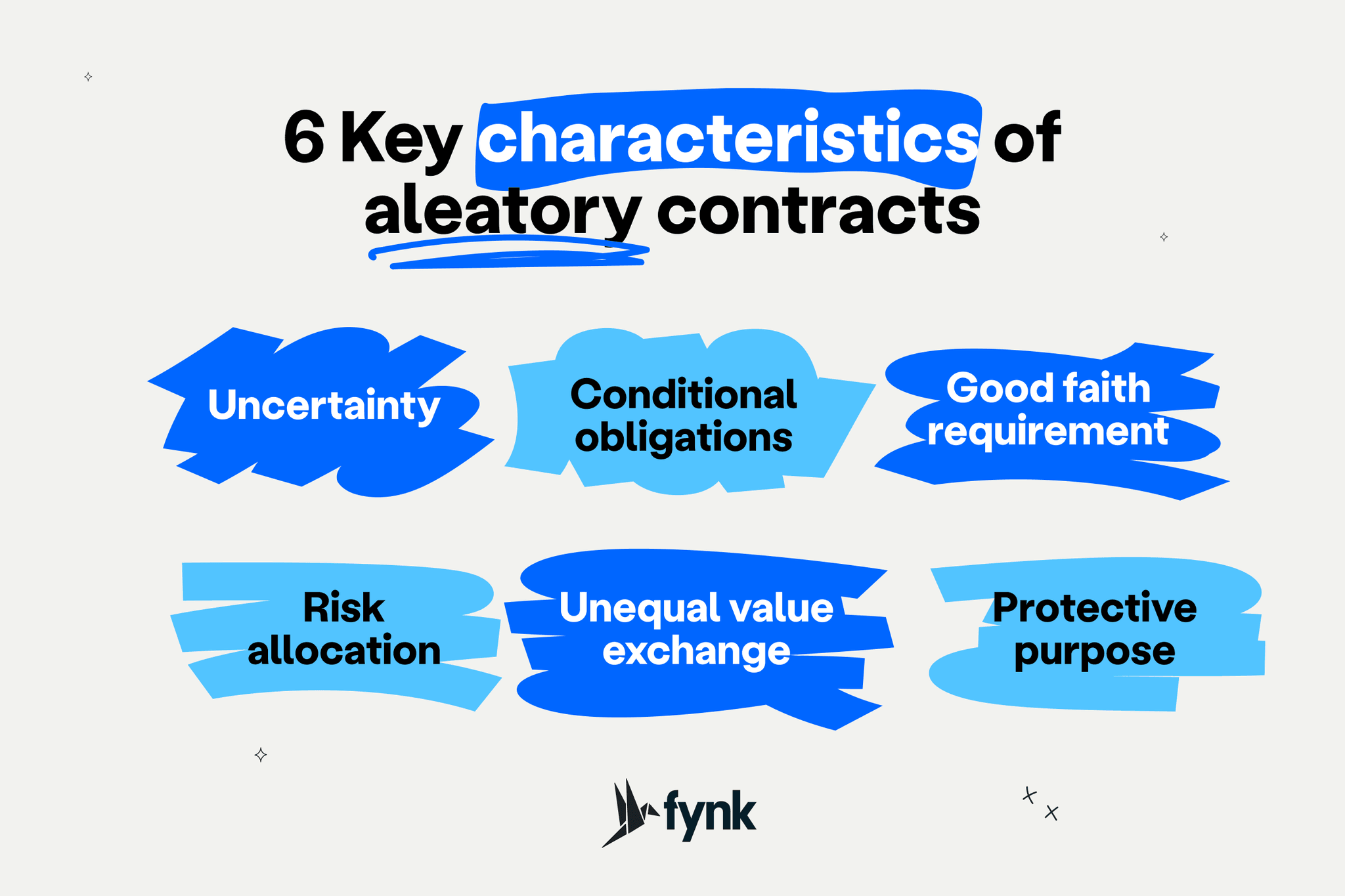


- Uncertainty. Not only whether the event happens, but also when, and how large the impact is.
- Conditional obligations. At least one promise only becomes due if the event occurs. In some contracts, such as swaps, both sides are bound conditionally, in opposite directions.
- Good faith. Because one side usually knows more about the risk, honest disclosure is what keeps the bargain workable. Insurers rely on it at underwriting; policyholders rely on clearly stated exclusions.
- Risk allocation. The risk is not removed. It is moved, from an individual to a pool (insurance) or from someone who does not want it to someone paid to carry it (hedging).
- Unequal exchange of value. The perceived value is balanced at signing, while the actual value can swing widely afterwards.
- Protective or speculative purpose. The same instrument can protect against a loss (a put option held as a hedge) or chase a gain (the same put bought as a bet).
How aleatory contracts work
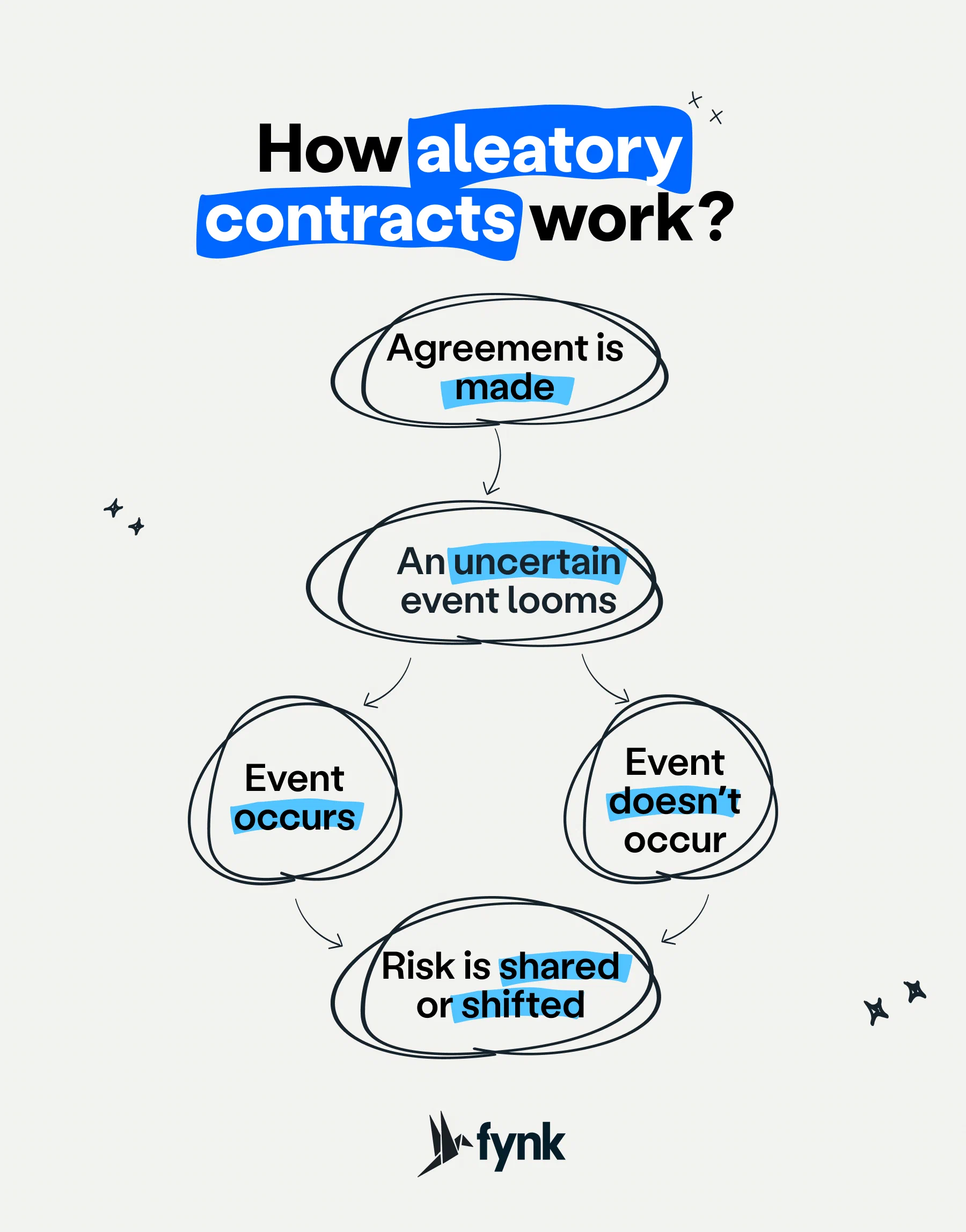
- The parties agree. One pays a premium, fee or stake now. The other promises to pay or perform if a defined event happens.
- The event is uncertain. A fire, an accident, a death, a price move, a jackpot. Nobody knows if or when it will occur.
- Trigger. If the event occurs, the conditional obligation becomes due: the insurer pays the claim, the option seller buys the shares.
- No trigger. If it does not occur within the term, the upfront payment stays with the party that received it.
- Risk has moved. One side bought protection or a chance of gain; the other was paid to carry the risk.
Are aleatory contracts enforceable?
Yes, provided they meet the usual requirements of an enforceable contract and the uncertain event is defined clearly. The exception is gambling, where the rules vary by country:
- England and Wales: gambling debts were unenforceable under the Gaming Act 1845. Section 335 of the Gambling Act 2005 reversed that, so a contract relating to gambling can now be enforced.
- Germany: under § 762 BGB, gaming and betting create no enforceable obligation, but money already paid cannot be reclaimed. State-approved lotteries are binding under § 763 BGB.
- United States: enforceability of gambling debts depends on state law and on whether the gambling was lawful where it took place.
- Civil-law codes name the category directly: the French Code civil (art. 1108) and the Louisiana Civil Code (art. 1912) both define aleatory contracts as those whose effects depend on an uncertain event.
Risks to watch in aleatory contracts
| Risk | What it means | How contracts handle it |
|---|---|---|
| Moral hazard | The protected party takes more risk because the loss is covered | Deductibles, exclusions, co-insurance |
| Non-disclosure | One side hides a material fact before signing | Disclosure duties, the right to rescind for misrepresentation |
| Basis risk | The payout does not match the actual loss | Careful trigger definitions, indemnity-based cover |
| Counterparty risk | The party that has to pay cannot | Collateral, margin, solvency regulation |
| Missed conditions | A claim deadline or notice requirement is missed, so the cover lapses | Tracking every condition and deadline |
Keep track of the conditions that decide the payout
The last risk in that table is the one that is entirely avoidable. Most aleatory contracts are decided not only by whether the event happens, but by whether someone met the conditions around it: the claim deadline, the notice period, the renewal date. In fynk, those dates and values become contract metadata you can filter and report on, and reminders notify the right people before a deadline passes.
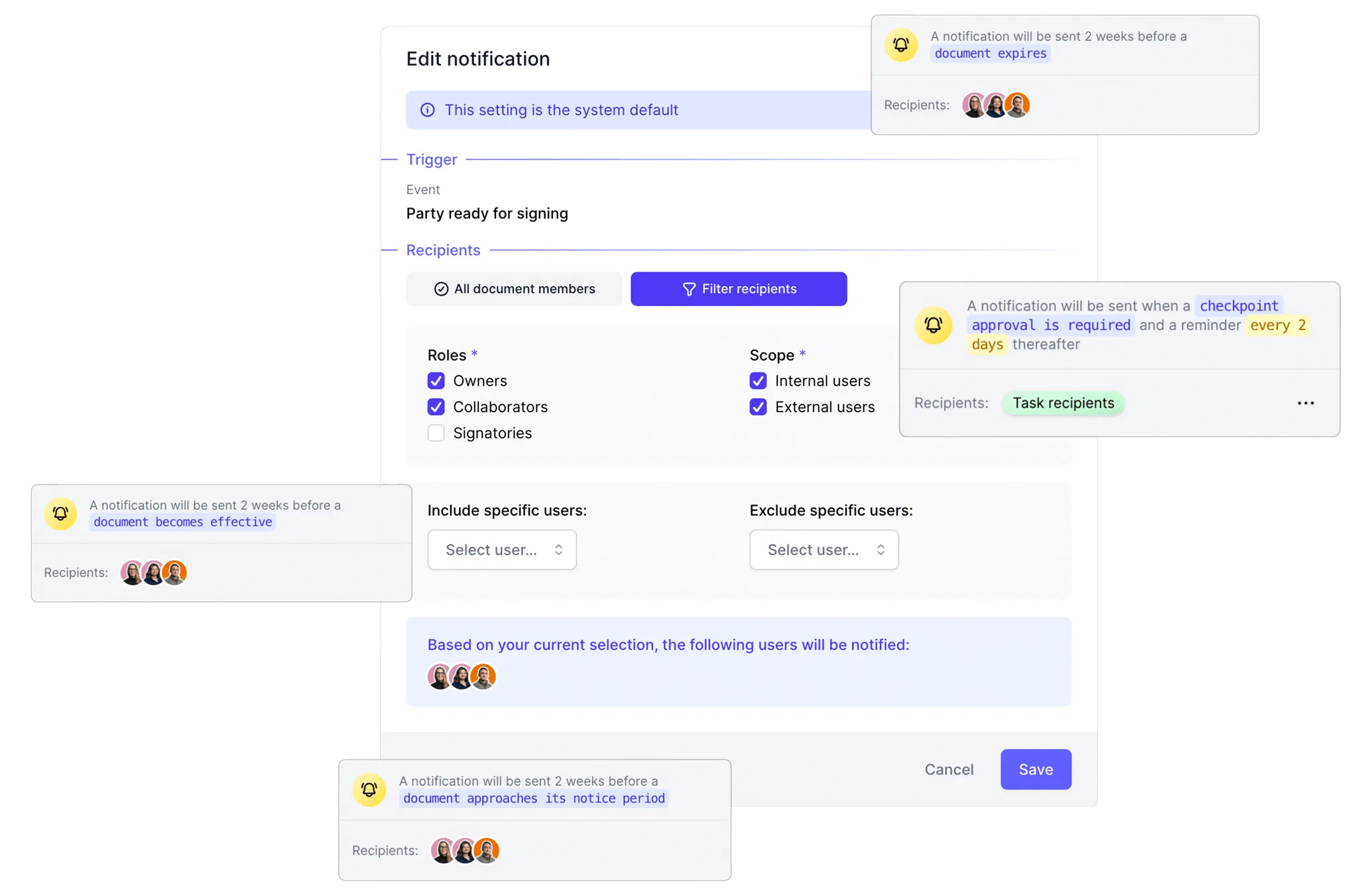
Stop relying on memory for deadlines that
cost money.
FAQs about aleatory contracts
Because the insurer's performance depends on an uncertain event, and the exchange of value is unequal. The policyholder pays a known premium, while the insurer pays only if a covered loss happens. The payout can be much larger than the premiums, or nothing at all.
Aleatory means dependent on chance. In insurance it describes a contract where one party may receive far more, or far less, than it gives, depending on whether an insured event occurs during the policy term.
A home insurance policy. You pay, say, USD 1,200 a year. If the house burns down, the insurer may pay hundreds of thousands. If nothing happens, the insurer pays nothing and keeps the premium. Life insurance and car insurance work the same way.
In a commutative contract both parties know at signing what they will give and receive, and the values are roughly equal, as in a sale at a fixed price. In an aleatory contract at least one performance depends on an uncertain event, so the values exchanged are unequal and unknown at signing.
Yes. Insurance is described as unilateral because only the insurer makes a legally enforceable promise. The policyholder can stop paying premiums without being sued for it; the policy simply lapses.
A contract drafted entirely by one party, the insurer, which the applicant can only accept or reject as written. Because the insured had no say in the wording, courts generally interpret ambiguous terms in the insured's favour.
A life annuity is. The insurer pays for as long as the annuitant lives, so the total paid out depends on an uncertain lifespan. A buyer who dies early receives less than they paid; one who lives a long time receives more.
Generally yes, if they meet the normal requirements of a valid contract and define the triggering event clearly. Gambling contracts are the main exception: their enforceability depends on the country and, in the US, on the state.
Moral hazard is the tendency of a protected party to take more risk because a loss would be covered, for example driving less carefully when fully insured. Insurers counter it with deductibles, exclusions and underwriting.
Searching for a contract management solution?
Find out how fynk can help you close deals faster and simplify your eSigning process – request a demo to see it in action.
Please keep in mind that none of the content on our blog should be considered legal advice. We understand the complexities and nuances of legal matters, and as much as we strive to ensure our information is accurate and useful, it cannot replace the personalized advice of a qualified legal professional.


Get a regular dose of insightful contract management content


Take control of your agreements. Move your business forward.
Run agreements the way they should run: fast, clear, and on your terms.
No setup headaches
Go live in days, not quarters
No lock-in
Full export anytime
No hidden fees
Signatures included, no envelope fee