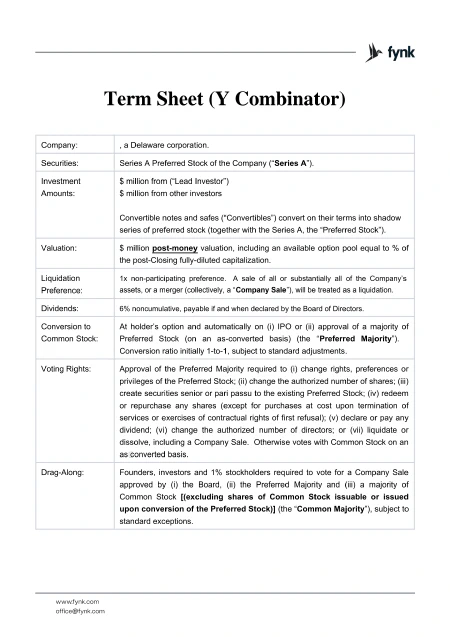
Series A Preferred Stock of the Company (“Series A”).
Investment Amounts:
$main investment amount in millions million from Lead investor (Name) (“Lead Investor”) $other investment amount in millions million from other investors
Convertible notes and safes (“Convertibles”) convert on their terms into shadow series of preferred stock (together with the Series A, the “Preferred Stock”).
Valuation:
$post-money valuation amount million post-money valuation, including an available option pool equal to percentage size of the post-closing option pool% of the post-Closing fully-diluted capitalization.
Liquidation Preference:
1x non-participating preference.A sale of all or substantially all of the Company’s assets, or a merger (collectively, a “Company Sale”), will be treated as a liquidation.
Dividends:
6% noncumulative, payable if and when declared by the Board of Directors.
Conversion to Common Stock:
At holder’s option and automatically on (i) IPO or (ii) approval of a majority of Preferred Stock (on an as-converted basis) (the “Preferred Majority”). Conversion ratio initially 1-to-1, subject to standard adjustments.
Voting Rights:
Approval of the Preferred Majority required to (i) change rights, preferences or privileges of the Preferred Stock; (ii) change the authorized number of shares; (iii) create securities senior or pari passu to the existing Preferred Stock; (iv) redeem or repurchase any shares (except for purchases at cost upon termination of services or exercises of contractual rights of first refusal); (v) declare or pay any dividend; (vi) change the authorized number of directors; or (vii) liquidate or dissolve, including a Company Sale. Otherwise votes with Common Stock on an as‑converted basis.
Drag-Along:
Founders, investors and 1% stockholders required to vote for a Company Sale approved by (i) the Board, (ii) the Preferred Majority and (iii) a majority of Common Stock [(excluding shares of Common Stock issuable or issued upon conversion of the Preferred Stock)] (the “Common Majority”), subject to standard exceptions.
Other Rights & Matters:
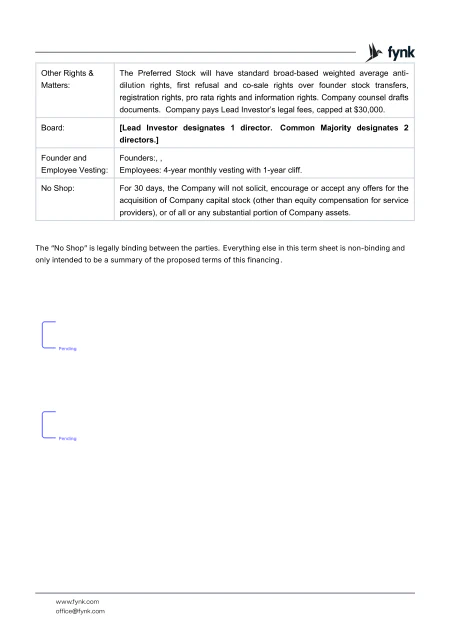
The Preferred Stock will have standard broad-based weighted average anti-dilution rights, first refusal and co-sale rights over founder stock transfers, registration rights, pro rata rights and information rights. Company counsel drafts documents. Company pays Lead Investor’s legal fees, capped at $30,000.
Board:
[Lead Investor designates 1 director. Common Majority designates 2 directors.]
Founder and Employee Vesting:
Founders:founder name #1, founder name #2, founder name #3 Employees: 4-year monthly vesting with 1-year cliff.
No Shop:
For 30 days, the Company will not solicit, encourage or accept any offers for the acquisition of Company capital stock (other than equity compensation for service providers), or of all or any substantial portion of Company assets.
The “No Shop” is legally binding between the parties.Everything else in this term sheet is non-binding and only intended to be a summary of the proposed terms of this financing.
CEO (Name) CEO (Address (multi-line))
Pending
Lead investor (Name) Lead investor (Address (multi-line))
Pending
Disclaimer: The original creator, the author of this template, and fynk GmbH are not responsible for any damages or liabilities that may result from using this template. This template should not be considered a substitute for legal advice, and consulting with a legal professional is recommended before use. fynk GmbH, the original creator, and the author do not provide legal advice and will not be held accountable for any legal consequences arising from its use.
More than3.000 teamschose fynk to outgrow legal chaos.
Venture capital term sheet explained in simple terms
Learn everything there is about venture capital term sheets for startups—what they are, when to use them, and what they should contain.
What is a term sheet?
A term sheet is a non-binding agreement outlining the key terms and conditions under which an investor (usually a VC) plans to fund your company. Much like the relationship status update between your startup and your investor; it’s “complicated” if you don’t get it right. Term sheets are not a legally binding commitment or an enforceable contract
, but they get everyone on the same page before the real paperwork hits the table.
For VC-backed startups, getting a term sheet feels like leveling up; it’s validation, excitement, and a tiny bit of terror all rolled into one. A term sheet shows your valuation, the investor’s expectations, and the big-picture framework of your business. Important topics like ownership dilution, control rights, and exit conditions take center stage, shaping your company’s destiny.
When to use a term sheet
A term sheet enters the chat when talks with investors heat up, when the “We love what you’re doing!” turns into “Let’s make it official.” For VC-backed startups, this moment typically follows pitch meetings, intense due diligence
, and enough coffee to power a small country.
You’ll whip out a term sheet when:
Securing Venture Capital Investment: Whether it’s your seed round or a Series A glow-up, a term sheet locks down who, how much, and what rights.
Raising Angel Funding: Even with angel investors, a formal term sheet keeps relationships sunny and misunderstandings at bay.
Negotiating Strategic Partnerships: When a partner wants a slice of your magic for cash, a term sheet sets expectations early.
Preparing for Mergers and Acquisitions: Early-stage exits often start with a term sheet, easing the move toward a definitive agreement.
Who uses it?
Founders and Co-Founders: To steer the ship and defend the vision.
Venture Capitalists and Angel Investors: To secure protections and guide outcomes.
Legal Counsel: To keep negotiations smooth without tossing in unnecessary drama.
What’s included in the term sheet?
1. Company Overview
Meet the star of the show: your company. This section identifies exactly who’s raising the cash, usually a Delaware corporation for venture finance fame.
2. Securities Offered
Investors aren’t throwing money for hugs. They’re getting Series A Preferred Stock, complete with special perks. Convertible notes and SAFEs, if any, will also convert into preferred shares under shadow terms.
3. Investment Amounts
Who’s bringing the dough, and how much? This section spells it out, including any past promises from convertible securities.
4. Valuation
Post-money valuation takes the spotlight here: it’s the company’s worth immediately after the new investment, including the refreshed option pool reserved for future hires.
5. Liquidation Preference
Investors want their money back first (can you blame them?). The 1x non-participating liquidation preference ensures they get their investment back, but no double-dipping.
6. Dividends
Investors are entitled to 6% non-cumulative dividends, but only if and when declared by the Board. Investors love the option; startups love not having to fork over cash unnecessarily.
7. Conversion to Common Stock
Preferred shares automatically convert to common stock at the investor’s choice or upon specific trigger events like an IPO or majority investor approval, with an initial 1:1 ratio.
8. Voting Rights
Major moves, like new senior shares or a sale, require the nod from a majority of preferred shareholders, giving investors meaningful sway without a full takeover.
9. Drag-Along Rights
Major investor protections are baked using drag-along rights
. Certain major decisions (like issuing new senior securities or selling the company) require approval from a majority of preferred shareholders, safeguarding their influence.
10. Anti-Dilution Protection and Other Investor Rights
A broad-based weighted average anti-dilution clause shields investors if future rounds get spicy (read: cheap). Plus, they get first dibs on new offerings, co-sale rights, and crystal-clear info access.
11. Board Composition
Board control matters! Here, the Lead Investor appoints one director, while the Common Stock Majority appoints two, balancing investor oversight with founder control.
12. Founder and Employee Vesting
A four-year vesting schedule with a one-year cliff ensures everyone’s earning their stripes, no instant equity bonanzas here.
13. No-Shop Agreement
To prevent last-minute shopping for better deals, the startup agrees not to solicit or accept other offers for a limited period (usually 30 days).
How to write a term sheet
Here’s a quick 5-step guide to draft a great term sheet:
1. Start With the Basics
Spell out the Company, the Securities on offer, and the Investment Amount. These three pillars hold the whole thing up.
2. Nail the Valuation and Cap Table
Define the post-money valuation and sketch out the new ownership map, including a refreshed option pool for future rockstars.
3. Protect Both Sides
Layer in essential safeguards:
Liquidation preferences (keep it at 1x non-participating)
Anti-dilution provisions
Voting rights for major changes
These protections make investors happy; without making founders look desperate.
4. Define Governance
Lay down Board Composition and drag-along rights. Founders want control, investors want assurance; you can make both happen.
5. Add Standard Provisions
Cap it off with vesting schedules, a no-shop clause, and a quick note on legal fees. Use plain language, no legal gobbledygook needed.
✨ Pro Tip: Startups typically draft a “friendly” version first, then negotiate details with the lead investor’s legal team. Staying flexible and fast can make all the difference in sealing the deal.
Term sheet template
Our term sheet template is modeled after industry gold standards like the Y Combinator Series A format, making it startup-tested and investor-approved. Whether you’re closing your first big funding round or negotiating a Series A raise, this template gives you a head start with the key terms investors expect.
Bonus points if you use this template using fynk, where you’ll unlock power features like:
Electronic Signatures
(SES, AES, QES; pick your flavor) for lightning-fast execution.
Dynamic, customizable templates that grow with you.
AI Playbooks to spot sketchy terms before you get blindsided.
Searching for a contract management solution?
Find out how fynk can help you close deals faster and simplify your eSigning process – request a demo to see it in action.