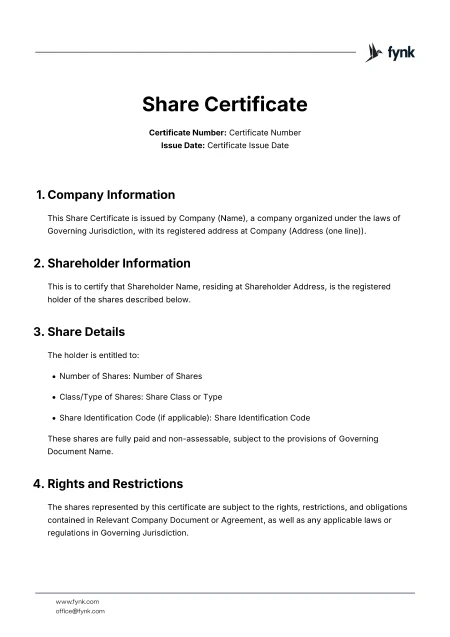
Certificate Number:Certificate Number Issue Date:Certificate Issue Date
Company Information
This Share Certificate is issued by Company (Name), a company organized under the laws of Governing Jurisdiction, with its registered address at Company (Address (one line)).
Shareholder Information
This is to certify that Shareholder Name, residing at Shareholder Address, is the registered holder of the shares described below.
These shares are fully paid and non-assessable, subject to the provisions of Governing Document Name.
Rights and Restrictions
The shares represented by this certificate are subject to the rights, restrictions, and obligations contained in Relevant Company Document or Agreement, as well as any applicable laws or regulations in Governing Jurisdiction.
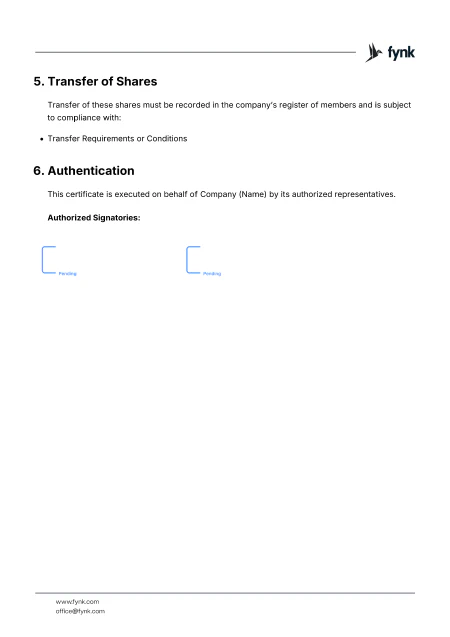
Transfer of Shares
Transfer of these shares must be recorded in the company’s register of members and is subject to compliance with:
Transfer Requirements or Conditions
Authentication
This certificate is executed on behalf of Company (Name) by its authorized representatives.
Authorized Signatories:
Pending
Pending
Disclaimer: The original creator, the author of this template, and fynk GmbH are not responsible for any damages or liabilities that may result from using this template. This template should not be considered a substitute for legal advice, and consulting with a legal professional is recommended before use. fynk GmbH, the original creator, and the author do not provide legal advice and will not be held accountable for any legal consequences arising from its use.
More than1.000 teamschose fynk to outgrow legal chaos.
What a share certificate covers and how to use this template
Learn what a share certificate is, what information it must contain, how it differs from other equity documents, and how to use this template to issue shares correctly.
What is a share certificate?
A share certificate is an official document issued by a company that certifies a named person or entity owns a specified number of shares in that company. It is a formal record of equity ownership and is typically required under corporate law when shares are issued or transferred.
Share certificates serve several functions:
Evidence of ownership - the certificate is the primary documentary proof that the named holder owns the stated number of shares
Record of share class and rights - identifies whether the shares are common, preferred, or another class, each carrying different voting, dividend, and liquidation rights
Transfer documentation - a signed and endorsed certificate is required to effect a transfer of registered shares in many jurisdictions
Capitalization table support - together with the company’s share register, certificates form the documentary basis of the company’s cap table
In many modern startups, especially those using electronic cap table platforms, physical certificates are replaced by book-entry records - but a certificate template remains essential for investors or jurisdictions that require physical documentation.
Key elements of a share certificate
1. Company information
The certificate must identify:
Full legal name of the corporation
State or jurisdiction of incorporation
The company’s registered address or principal place of business
This anchors the certificate to the specific legal entity that issued the shares.
2. Shareholder information
The certificate identifies the registered holder:
Full legal name of the individual or entity receiving the shares
The shareholder’s address (for registered share purposes)
Accuracy is critical - the name on the certificate should match the shareholder’s legal name exactly as it appears in the company’s share register and any underlying subscription or purchase agreement.
3. Share class and number
The certificate specifies:
Class of shares - common stock, Series A preferred, Class B ordinary shares, etc.
Number of shares - the exact number of shares represented by the certificate
Par value (if applicable) - the nominal face value per share
The rights, preferences, and restrictions of each share class are typically set out in the company’s articles of incorporation, certificate of incorporation, or articles of association - not in the certificate itself.
4. Issue date and consideration
The certificate records:
Date of issuance - the date on which the shares were issued to this shareholder
Consideration paid - the total amount paid, or a statement that the shares are fully paid and non-assessable
For founder shares or shares issued for services, consideration may be a nominal cash amount or a description of the services or property contributed.
5. Transfer restrictions
Many private company shares are subject to restrictions on transfer, including:
Right of first refusal - the company or existing shareholders have the right to purchase shares before a third-party transfer
Lock-up periods - shares may not be transferred for a defined period after issuance
Securities law legends - a mandatory legend stating that the shares have not been registered under the Securities Act and may not be resold without registration or an applicable exemption
These restrictions must be printed as a legend on the face of the certificate and are typically cross-referenced to the applicable shareholder agreement or investment documents.
6. Officer signatures and corporate seal
A valid share certificate must be signed by authorized company officers - typically:
Chief Executive Officer or President
Secretary or Chief Financial Officer
Some jurisdictions also require the company’s corporate seal to be affixed. For certificates issued to founders or employees under equity incentive plans, additional signatures from the plan administrator may be required.
Who needs a share certificate?
Founders and early-stage companies issuing equity to co-founders, angel investors, or seed round participants
Legal teams and corporate secretaries managing the company’s share register and capitalization table
Finance teams tracking equity issued under employee stock option plans or investor agreements
Corporate attorneys advising clients on share issuance mechanics, transfer restrictions, and securities law compliance
Investors requesting physical or electronic evidence of their shareholding following a financing round
How to customize this template
Insert the company’s full legal name and jurisdiction of incorporation exactly as it appears in the company’s formation documents.
Confirm the correct share class name - match it exactly to the class defined in the certificate of incorporation or articles of association.
For preferred stock, add the series designation (e.g., “Series A Preferred Stock”) and reference the relevant certificate of designation.
Review the transfer restriction legend with legal counsel to ensure it reflects the current restrictions under the applicable shareholder agreement and securities law.
Confirm officer titles and ensure the signing officers have authority to issue the certificate under the company’s bylaws.
For shares subject to vesting, note the applicable vesting schedule and reference the stock purchase or restricted stock agreement.
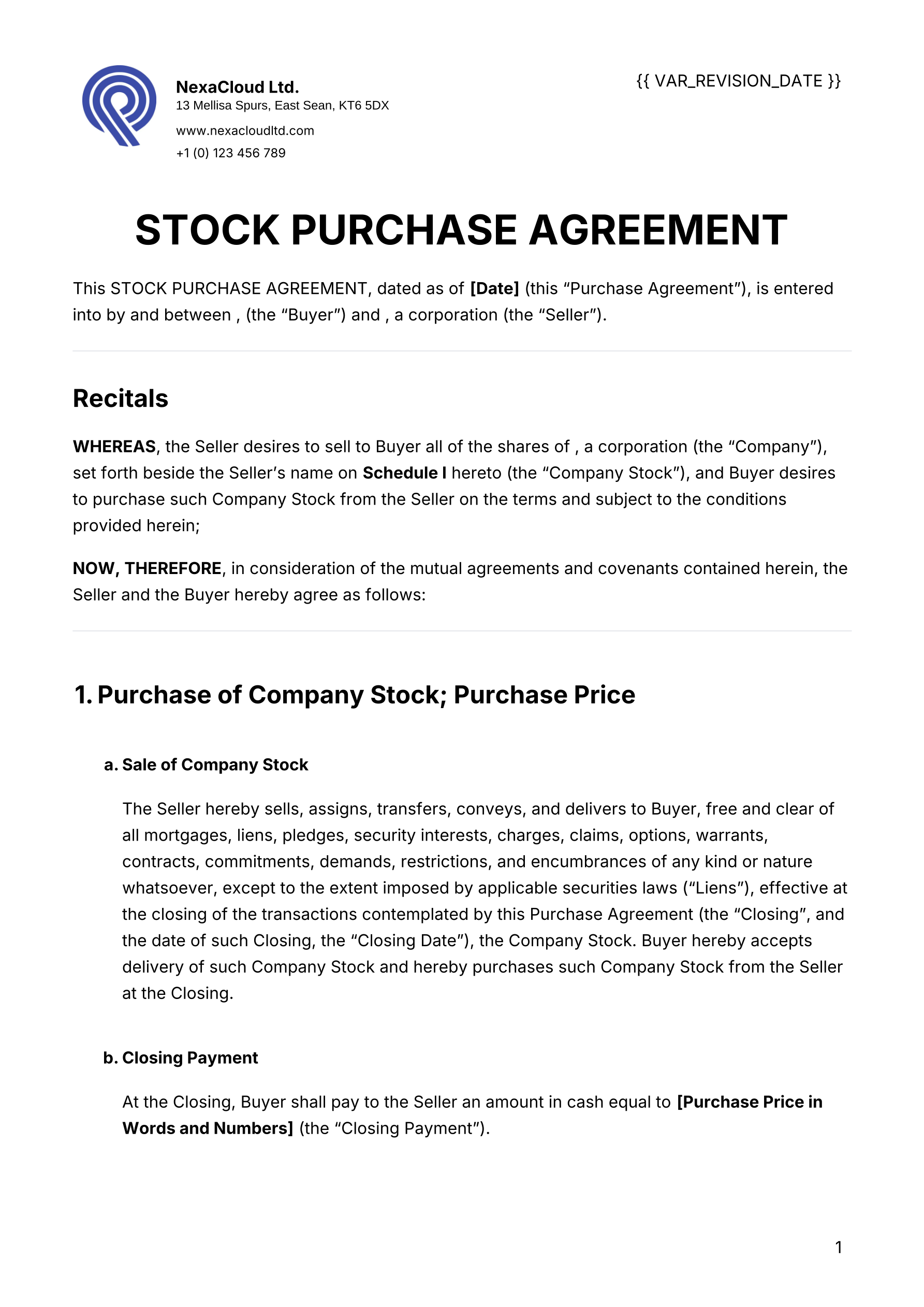
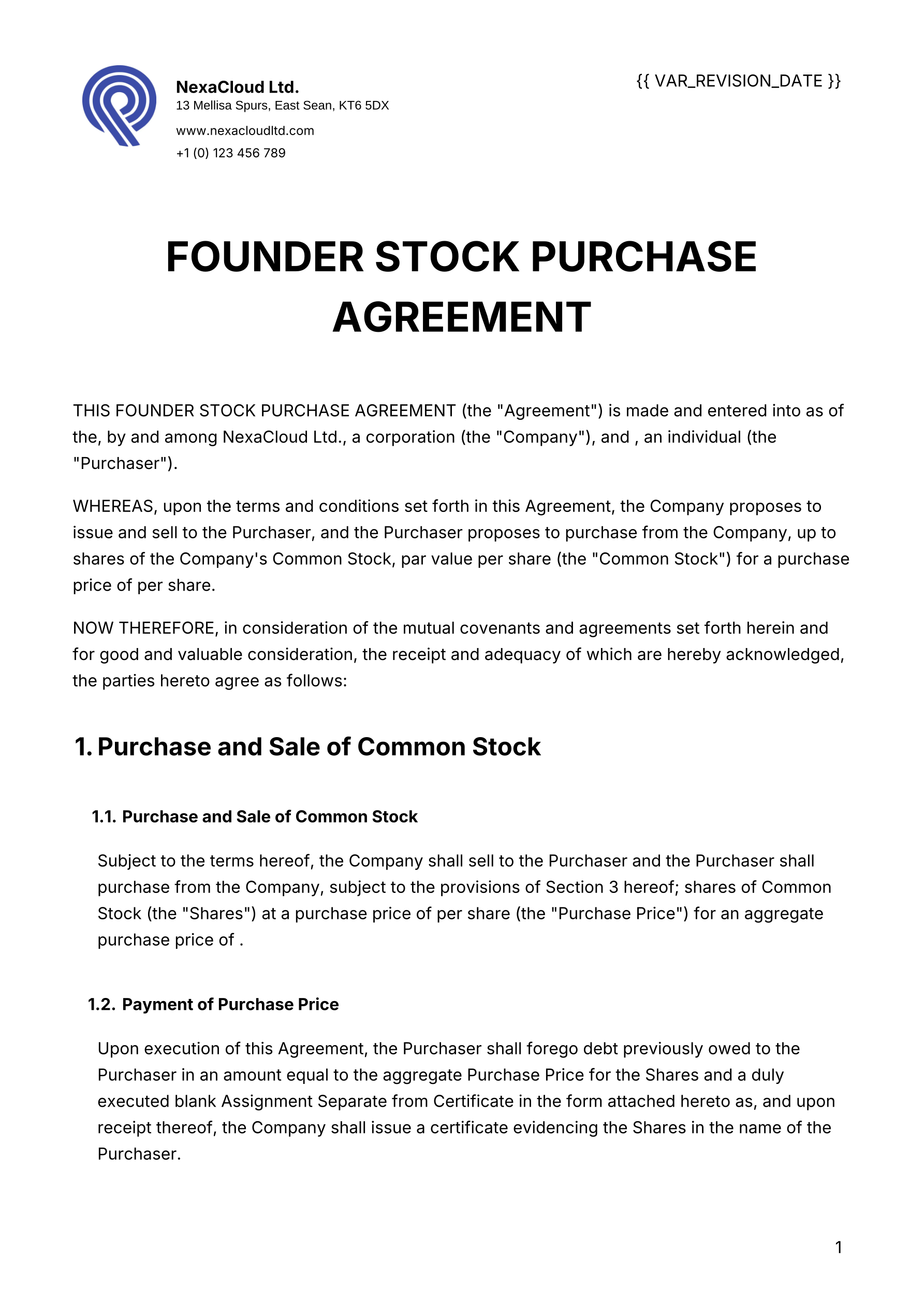
For the underlying agreement governing the sale and purchase of the shares being certificated, see:
This share certificate template is ready to customize in fynk. Adjust party names, share class, number of shares, consideration, and transfer restriction legends for your issuance, then collect officer signatures electronically.
With fynk, you can:
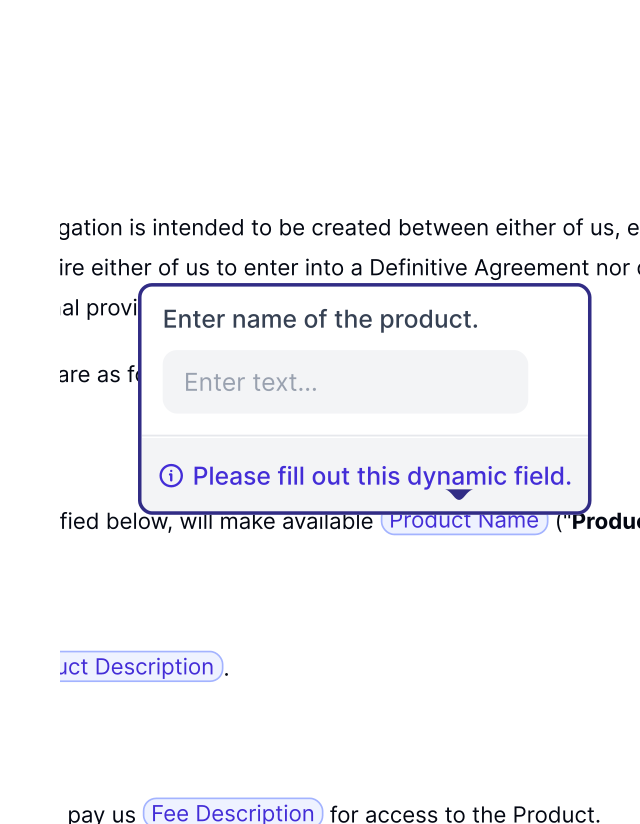
Use dynamic fields to populate the shareholder name, share class, share count, issue date, and consideration across the certificate instantly.
Shareholder name, share class, and number of shares populated across the certificate automatically.
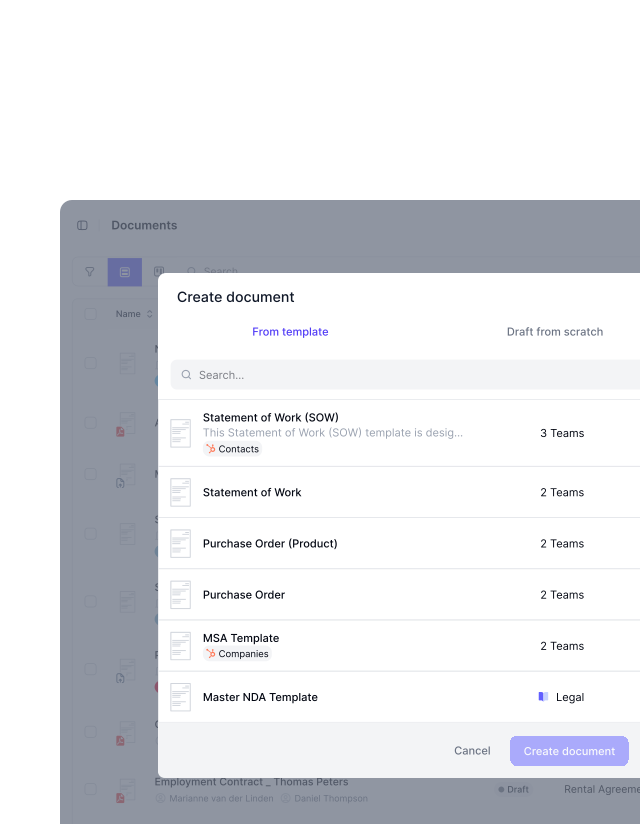
Issue certificates at scale using fynk’s bulk sending - generate individual certificates for all participants in a financing round from a single template.
Individual certificates for every shareholder in a round, generated from one template.
Store every issued certificate in a structured document hub linked to the corresponding shareholder, share class, and investment round.
Certificates, subscription agreements, and cap table documents organized in one place.
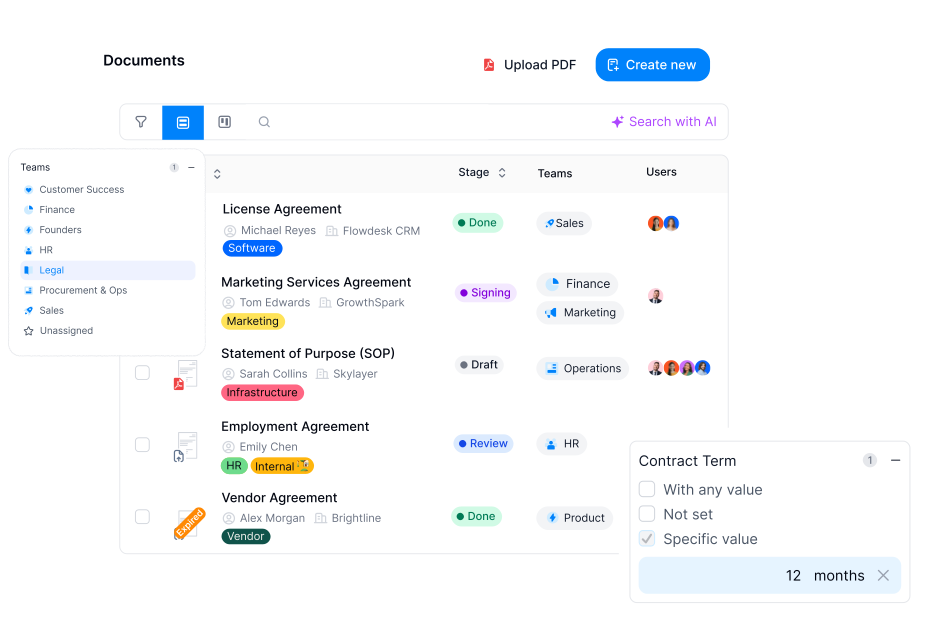
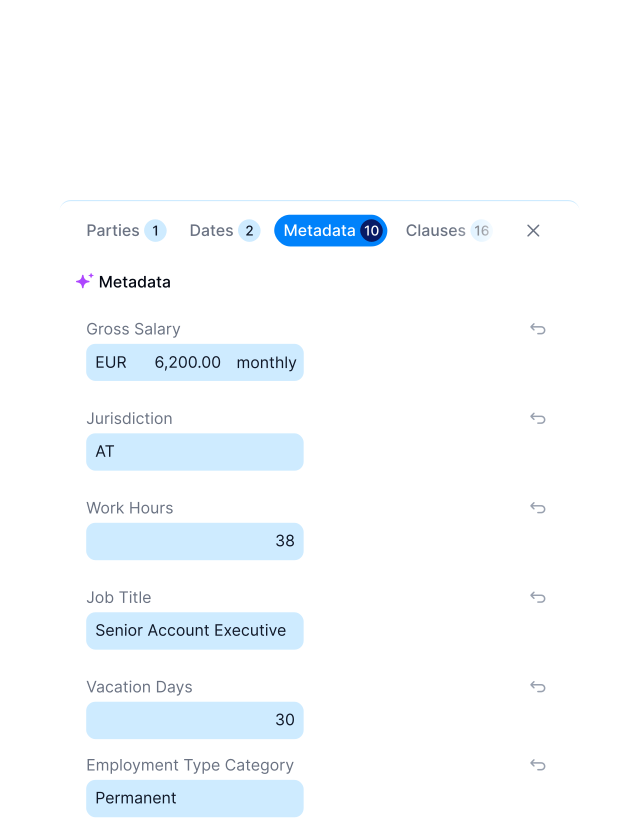
Track contract metadata - tag each certificate by share class, issue date, investor name, and round to filter and report across your full cap table history.
Certificates filtered by investor, share class, or financing round.
FAQs
What is a share certificate?
A share certificate is an official document issued by a company that certifies a named person or entity owns a specified number of shares in the company. It records the shareholder's name, the company name, the share class, the number of shares, the date of issue, the consideration paid, and any applicable transfer restrictions.
Is a share certificate required by law?
Requirements vary by jurisdiction. In the US, most states permit corporations to issue shares in uncertificated (book-entry) form, and many modern startups operate without physical certificates. However, some investors, certain jurisdictions, and specific types of equity arrangements (such as restricted stock) may still require a physical or electronic certificate. Always check applicable state law and any shareholder agreement provisions.
What transfer restrictions should appear on a share certificate?
Private company share certificates typically include a securities law legend stating that the shares have not been registered under the Securities Act of 1933 and may not be transferred without registration or an applicable exemption. They may also reference a right of first refusal, co-sale rights, or lock-up restrictions set out in the shareholder agreement. The specific legends required depend on how the shares were issued and what agreements govern the shareholder.
What happens to a share certificate when shares are transferred?
When registered shares are transferred, the original certificate is typically surrendered to the company (or its transfer agent), cancelled, and replaced with a new certificate issued in the name of the transferee. The transfer must be recorded in the company's share register. In uncertificated systems, the share register is updated directly without a physical exchange of certificates.
Can a share certificate be used as proof of ownership in a dispute?
A share certificate is strong evidence of ownership but is not conclusive in all jurisdictions. The company's official share register is the definitive record of legal ownership. If there is a discrepancy between the certificate and the share register, the share register typically prevails. For this reason, maintaining an accurate, up-to-date share register is essential alongside issuing certificates.
Searching for a contract management solution?
Find out how fynk can help you close deals faster and simplify your eSigning process – request a demo to see it in action.