Head of Terms Template

A head of terms records the principal commercial terms agreed between parties at the early stage of a deal, before formal contracts are drafted. It brings structure to negotiations, reduces the risk of misunderstanding, and gives both parties confidence that the key points have been settled before committing time and money to detailed documentation.

This head of terms template is suitable for commercial transactions, M&A deals, real estate transactions, joint ventures, and significant service arrangements. It covers the core deal terms, exclusivity, confidentiality, and the binding and non-binding status of the document.

  • Screenshot 0
  • Screenshot 1
  • Screenshot 2
  • Screenshot 3
  • Screenshot 4
  • Screenshot 5

Full Text Template

The full content of the template is available, when you want to edit the text and enter your details make sure to click on the button to use the template.

Head of Terms

Gov.UK. & Jonathan Lea network.

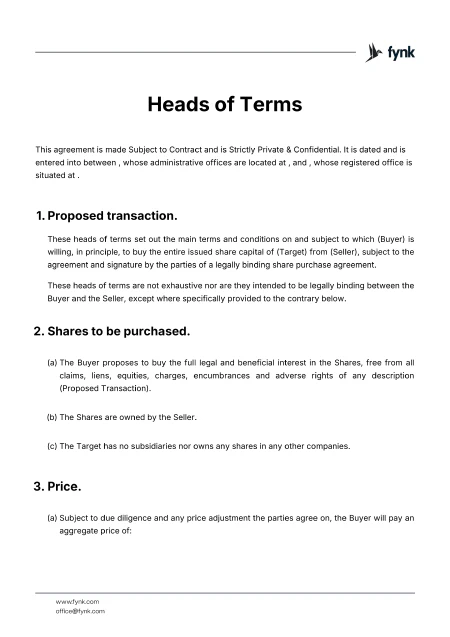
Heads of Terms

This agreement is made Subject to Contract and is Strictly Private & Confidential. It is dated and is entered into between , whose administrative offices are located at , and , whose registered office is situated at .

Proposed transaction.

These heads of terms set out the main terms and conditions on and subject to which (Buyer) is willing, in principle, to buy the entire issued share capital of (Target) from (Seller), subject to the agreement and signature by the parties of a legally binding share purchase agreement.

These heads of terms are not exhaustive nor are they intended to be legally binding between the Buyer and the Seller, except where specifically provided to the contrary below.

Shares to be purchased.

The Buyer proposes to buy the full legal and beneficial interest in the Shares, free from all claims, liens, equities, charges, encumbrances and adverse rights of any description (Proposed Transaction).

The Shares are owned by the Seller.

The Target has no subsidiaries nor owns any shares in any other companies.

Price.

Subject to due diligence and any price adjustment the parties agree on, the Buyer will pay an aggregate price of:

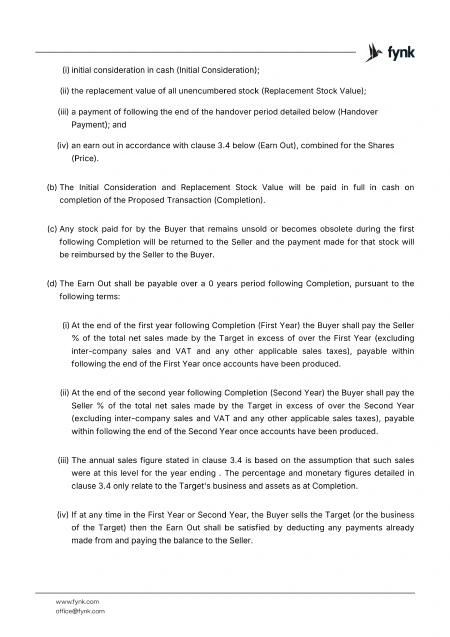
initial consideration in cash (Initial Consideration);

the replacement value of all unencumbered stock (Replacement Stock Value);

a payment of following the end of the handover period detailed below (Handover Payment); and

an earn out in accordance with clause 3.4 below (Earn Out), combined for the Shares (Price).

The Initial Consideration and Replacement Stock Value will be paid in full in cash on completion of the Proposed Transaction (Completion).

Any stock paid for by the Buyer that remains unsold or becomes obsolete during the first following Completion will be returned to the Seller and the payment made for that stock will be reimbursed by the Seller to the Buyer.

The Earn Out shall be payable over a 0 years period following Completion, pursuant to the following terms:

At the end of the first year following Completion (First Year) the Buyer shall pay the Seller % of the total net sales made by the Target in excess of over the First Year (excluding inter-company sales and VAT and any other applicable sales taxes), payable within following the end of the First Year once accounts have been produced.

At the end of the second year following Completion (Second Year) the Buyer shall pay the Seller % of the total net sales made by the Target in excess of over the Second Year (excluding inter-company sales and VAT and any other applicable sales taxes), payable within following the end of the Second Year once accounts have been produced.

The annual sales figure stated in clause 3.4 is based on the assumption that such sales were at this level for the year ending . The percentage and monetary figures detailed in clause 3.4 only relate to the Target's business and assets as at Completion.

If at any time in the First Year or Second Year, the Buyer sells the Target (or the business of the Target) then the Earn Out shall be satisfied by deducting any payments already made from and paying the balance to the Seller.

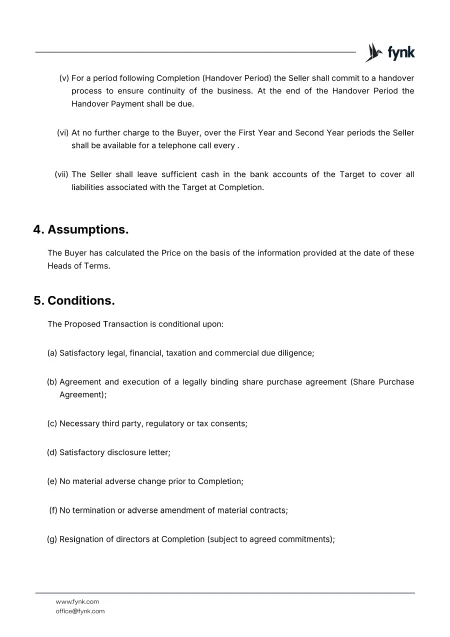
For a period following Completion (Handover Period) the Seller shall commit to a handover process to ensure continuity of the business. At the end of the Handover Period the Handover Payment shall be due.

At no further charge to the Buyer, over the First Year and Second Year periods the Seller shall be available for a telephone call every .

The Seller shall leave sufficient cash in the bank accounts of the Target to cover all liabilities associated with the Target at Completion.

Assumptions.

The Buyer has calculated the Price on the basis of the information provided at the date of these Heads of Terms.

Conditions.

The Proposed Transaction is conditional upon:

Satisfactory legal, financial, taxation and commercial due diligence;

Agreement and execution of a legally binding share purchase agreement (Share Purchase Agreement);

Necessary third party, regulatory or tax consents;

Satisfactory disclosure letter;

No material adverse change prior to Completion;

No termination or adverse amendment of material contracts;

Resignation of directors at Completion (subject to agreed commitments);

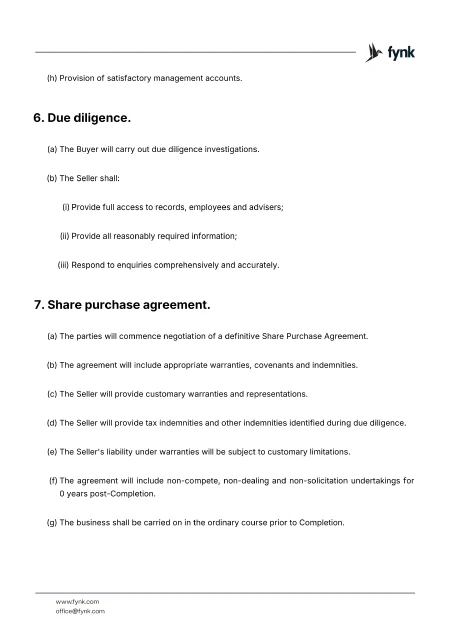
Provision of satisfactory management accounts.

Due diligence.

The Buyer will carry out due diligence investigations.

The Seller shall:

Provide full access to records, employees and advisers;

Provide all reasonably required information;

Respond to enquiries comprehensively and accurately.

Share purchase agreement.

The parties will commence negotiation of a definitive Share Purchase Agreement.

The agreement will include appropriate warranties, covenants and indemnities.

The Seller will provide customary warranties and representations.

The Seller will provide tax indemnities and other indemnities identified during due diligence.

The Seller's liability under warranties will be subject to customary limitations.

The agreement will include non-compete, non-dealing and non-solicitation undertakings for 0 years post-Completion.

The business shall be carried on in the ordinary course prior to Completion.

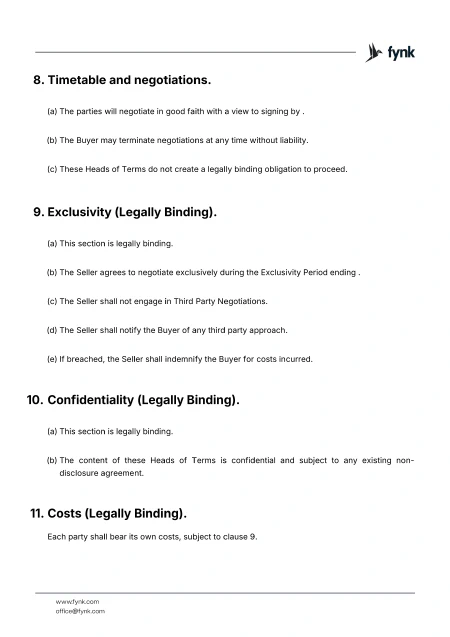
Timetable and negotiations.

The parties will negotiate in good faith with a view to signing by .

The Buyer may terminate negotiations at any time without liability.

These Heads of Terms do not create a legally binding obligation to proceed.

Exclusivity (Legally Binding).

This section is legally binding.

The Seller agrees to negotiate exclusively during the Exclusivity Period ending .

The Seller shall not engage in Third Party Negotiations.

The Seller shall notify the Buyer of any third party approach.

If breached, the Seller shall indemnify the Buyer for costs incurred.

Confidentiality (Legally Binding).

This section is legally binding.

The content of these Heads of Terms is confidential and subject to any existing non-disclosure agreement.

Costs (Legally Binding).

Each party shall bear its own costs, subject to clause 9.

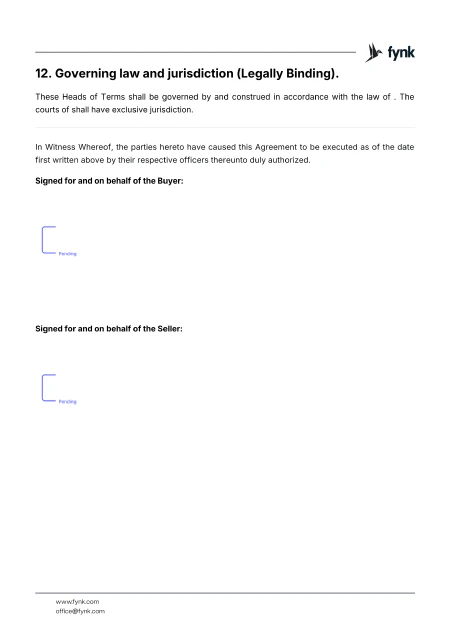
12. Governing law and jurisdiction (Legally Binding).

These Heads of Terms shall be governed by and construed in accordance with the law of . The courts of shall have exclusive jurisdiction.


In Witness Whereof, the parties hereto have caused this Agreement to be executed as of the date first written above by their respective officers thereunto duly authorized.

Signed for and on behalf of the Buyer:

Pending

Signed for and on behalf of the Seller:

Pending

Use this template

Disclaimer: The original creator, the author of this template, and fynk GmbH are not responsible for any damages or liabilities that may result from using this template. This template should not be considered a substitute for legal advice, and consulting with a legal professional is recommended before use. fynk GmbH, the original creator, and the author do not provide legal advice and will not be held accountable for any legal consequences arising from its use.

Making contract management easier for companies such as

Conrad logo Oekostrom AG Logo Datarade Logo Rampf Logo Unite Logo

Background Information

How to use a head of terms to structure your deal

Learn what a head of terms document is, when to use one, which clauses are typically binding, and how to adapt this template for your transaction.

What Is a Head of Terms?

A head of terms (also called heads of agreement, a letter of intent, a memorandum of understanding, or a term sheet, depending on the context and jurisdiction) is a preliminary document that summarizes the key terms of a proposed transaction or commercial arrangement before formal contracts are negotiated and signed. For a deeper look at the negotiation process itself, see our guide to contract negotiation.

It serves several purposes:

  • Aligns expectations – ensures both parties have genuinely agreed on the principal terms before investing in detailed legal drafting.
  • Guides drafting – gives lawyers and advisers a clear brief for the formal transaction documents.
  • Signals commitment – demonstrates that negotiations have reached a point where key terms are settled, which can help secure financing, board approval, or regulatory clearance.
  • Creates momentum – a signed head of terms moves a deal forward and creates pressure to reach completion.

Binding vs. Non-Binding Provisions

One of the most important characteristics of a head of terms is that it is typically partly binding and partly non-binding.

Usually non-binding

The commercial deal terms (price, structure, conditions precedent, timelines) are usually expressed as non-binding in a head of terms. This means neither party is legally obligated to complete the transaction on those terms, and either party can walk away without liability (subject to any exclusivity clause).

This is intentional: detailed legal negotiation is still to follow, and the formal contract will be the binding document.

Usually binding

Certain provisions are typically drafted to be legally binding even at the head of terms stage:

  • Confidentiality – both parties agree to keep negotiations and disclosed information confidential, regardless of whether the deal completes.
  • Exclusivity – a commitment by one or both parties not to negotiate with third parties during a defined period while the deal is being finalized.
  • Costs – whether each party bears its own costs or whether there is a cost allocation arrangement if the deal falls through.
  • Governing law – the law applicable to the head of terms itself (especially relevant for international transactions).

The document should clearly state which provisions are binding and which are not, to avoid disputes about the legal status of the document. Understanding what makes a contract enforceable helps parties determine which provisions to designate as binding from the outset.

When to Use a Head of Terms

A head of terms is appropriate for:

  • Mergers and acquisitions – recording the agreed price, structure (asset or share deal), conditions precedent, and exclusivity before detailed due diligence and contract drafting.
  • Real estate transactions – capturing agreed rent, lease length, break options, and rent review terms before formal lease or sale documentation.
  • Joint ventures and partnerships – setting out equity splits, governance arrangements, and business scope before the joint venture agreement is drafted.
  • Significant commercial contracts – major supply, licensing, or services arrangements where the commercial terms are complex enough to warrant preliminary agreement before drafting.
  • Investment and fundraising – term sheets for equity investment rounds, covering valuation, investment amount, rights, and conditions.

Key Sections of a Head of Terms

1. Parties

Identify the legal entities involved in the proposed transaction. Include their registered names and addresses.

2. Background and proposed transaction

A brief description of what the deal involves: what is being bought, sold, licensed, or agreed.

3. Principal commercial terms

The substantive deal terms will vary by transaction type but typically include:

  • Purchase price or consideration – how much, in what form (cash, shares, deferred), and on what timeline.
  • Transaction structure – asset deal or share deal; licensing or services arrangement; equity split in a joint venture.
  • Conditions precedent – what must happen before the deal can complete (e.g., regulatory approval, board consent, due diligence satisfactory to the buyer, financing).
  • Key warranties and protections – a summary of the principal warranties and any cap or basket on liability.
  • Timetable – target dates for due diligence, contract exchange, and completion.

4. Exclusivity

A binding commitment by the seller or target not to solicit or negotiate with alternative buyers or partners during a defined exclusivity period. This is particularly important in M&A and real estate transactions.

Define:

  • The length of the exclusivity period
  • What constitutes a breach (direct or indirect solicitation, or accepting unsolicited approaches)
  • Whether there is a break fee for breach of exclusivity

5. Confidentiality

A binding obligation covering:

  • All information exchanged in the course of negotiations
  • The existence and terms of the head of terms itself
  • Duration of the obligation
  • Permitted disclosure (e.g., to advisers who are themselves bound by confidentiality)

6. Costs

State whether each party bears its own legal and advisory costs. If there is a cost contribution arrangement (e.g., if the buyer withdraws after exclusivity), set this out clearly.

7. Non-binding statement

A clear statement on non-binding nature confirms that, except for the binding provisions (confidentiality, exclusivity, costs, governing law), the document does not constitute a legally enforceable commitment to complete the transaction.

8. Governing law

Specify the law that governs the head of terms, even if the formal contracts will be governed by the same or different law.

Common Mistakes in Head of Terms Documents

  • Unclear binding/non-binding distinction – failing to specify which provisions are binding creates significant risk that the entire document, including the commercial terms, will be treated as binding.
  • Missing exclusivity or too-short exclusivity – without exclusivity, the other party may continue talking to third parties throughout the negotiation.
  • Vague conditions precedent – conditions such as “subject to satisfactory due diligence” without specifying what “satisfactory” means can create disagreements about whether a condition has been met.
  • No confidentiality – publicly known negotiations can affect valuations, employee relations, and competitor behavior.

Who Should Use This Template

  • M&A lawyers and corporate advisers drafting heads of terms for transaction clients
  • Founders and business owners entering significant commercial negotiations or investment rounds
  • Real estate professionals recording agreed lease or purchase terms before formal documentation
  • In-house legal teams managing complex commercial negotiations

If you need a more formal preliminary document with binding effect, a Memorandum of Understanding may be appropriate:

Head of Terms Template

This head of terms template is ready to customize in fynk. Adjust the commercial terms, exclusivity period, conditions precedent, and binding provisions for your specific transaction, then send for signature.

With fynk, you can:

  • Manage the head of terms alongside the subsequent formal contract in one record
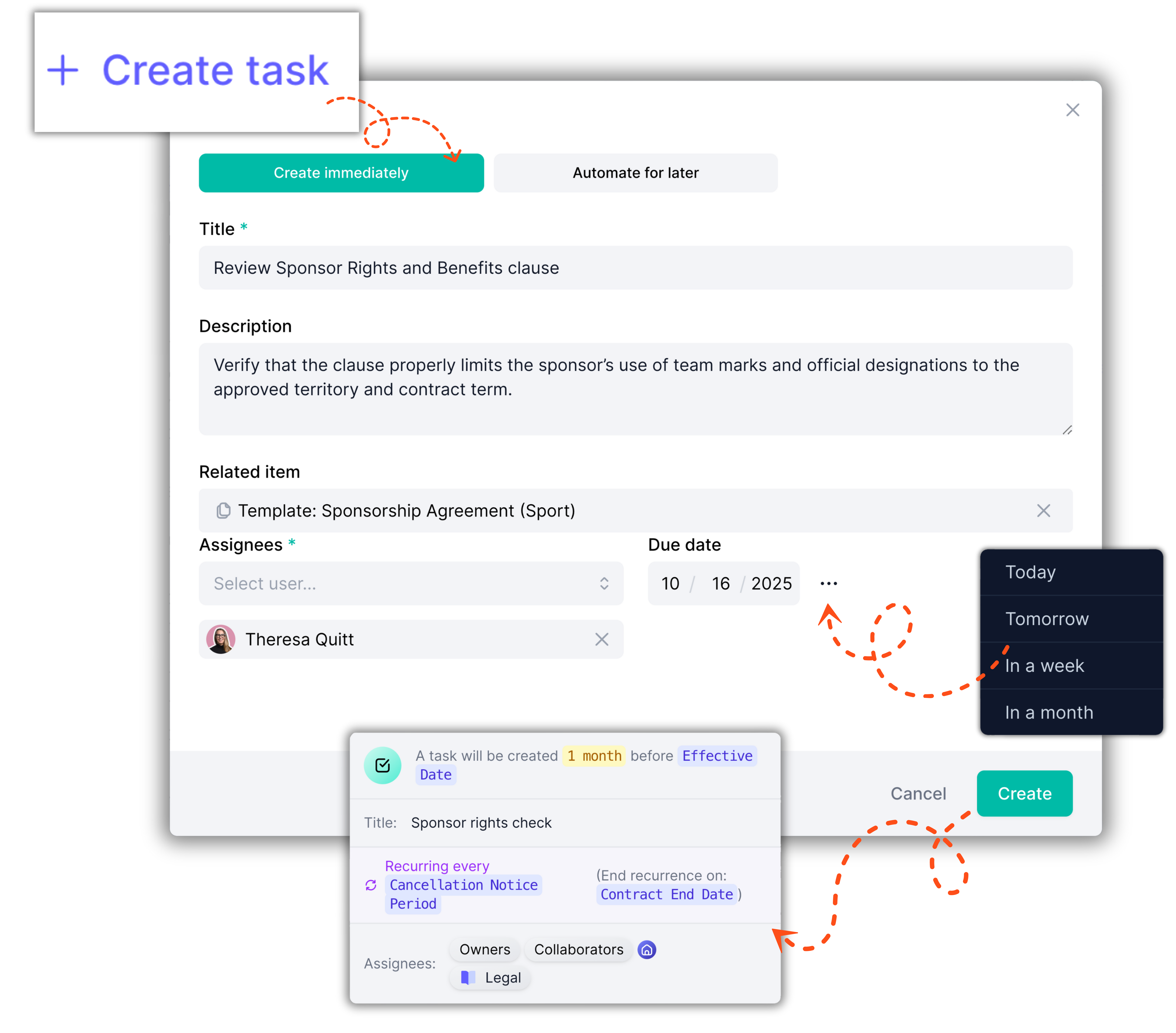
  • Set exclusivity period reminders to ensure formal contracts are progressed
Task reminders in fynk
White zoom-in icon
Grey info bubble icon

Get notified before your exclusivity window closes so formal contracts are progressed in time.

  • Track negotiation history and amendments in one place
  • Send for electronic signature to confirm mutual agreement on the key terms

FAQs

What is a head of terms?
A head of terms is a preliminary document that records the key commercial terms agreed between parties before formal contracts are drafted. It aligns expectations, guides legal drafting, and signals commitment to the deal. It is also called heads of agreement, a letter of intent, or a term sheet.
Is a head of terms legally binding?
A head of terms is typically partly binding and partly non-binding. The commercial deal terms (price, structure, conditions) are usually non-binding. However, provisions such as confidentiality, exclusivity, governing law, and costs are typically drafted to be legally binding from the outset.
What is the difference between a head of terms and a letter of intent?
The documents serve the same purpose and the terms are often used interchangeably. 'Head of terms' is more common in UK and Commonwealth usage. 'Letter of intent' is more common in US practice. Both record agreed deal terms before formal contracts, with binding and non-binding provisions.
Should a head of terms include an exclusivity clause?
Yes, in most M&A and real estate transactions. Without exclusivity, the other party may continue negotiating with third parties while you invest time and money in due diligence and legal drafting. Exclusivity should be for a defined period, with clear consequences for breach.
What happens if a party withdraws after signing a head of terms?
Because the deal terms are usually non-binding, either party can generally withdraw without liability for the deal not completing. However, if exclusivity or a break fee clause is included, walking away during the exclusivity period may trigger a financial consequence. Confidentiality obligations also continue after withdrawal.

Searching for a contract management solution?

Find out how fynk can help you close deals faster and simplify your eSigning process – request a demo to see it in action.

Ready to sign?
Use this template today.

Clause Library: learn more about the clauses in this template

Learn more about the clauses appearing in this template and find other clauses that are used in real contracts.

Exclusivity

An exclusivity clause is a contractual provision that restricts one party from engaging in certain activities or dealings with other parties outside the agreement. Typically used to secure a commitment, it ensures that the party provides services, products, or rights solely to the other contracting party, often to maintain competitive advantage or preserve confidentiality.

16 example clauses

Confidentiality clause

A confidentiality clause is a provision in a contract that obligates one or both parties to keep certain information confidential and not to disclose it to third parties without prior consent. This clause is designed to protect sensitive information such as trade secrets, business strategies, and proprietary data shared during the course of the contractual relationship.

20 example clauses

Governing law and jurisdiction

The "Governing Law and Jurisdiction" clause specifies which region's legal framework will be applied in interpreting and enforcing the terms of a contract and designates the location where any legal disputes will be resolved. This clause is crucial for determining procedural and substantive legal matters, ensuring both parties are aware of the legal standards and courts that will have authority in case of conflicts.

14 example clauses

Representations and warranties

"Representations and warranties are contractual statements made by one or both parties, asserting certain facts and conditions as true at the time of the agreement. These affirmations serve to allocate risk and establish grounds for potential legal remedies if the assertions prove to be false or misleading."

13 example clauses

Related Templates

Are you looking for more templates? fynk has them all!