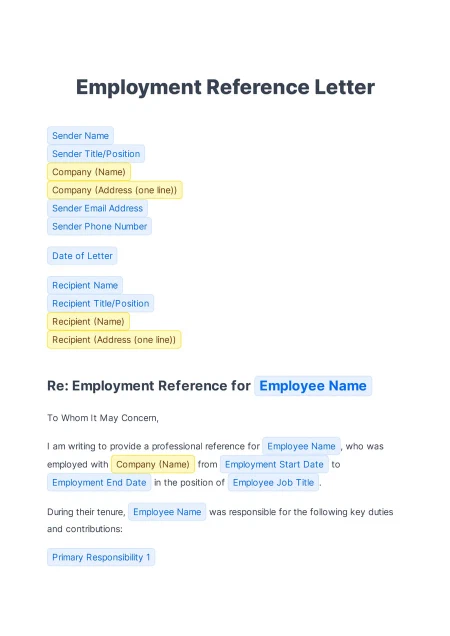
Sender Name Sender Title/Position Company (Name) Company (Address (one line)) Sender Email Address Sender Phone Number
Date of Letter
Recipient Name Recipient Title/Position Recipient (Name) Recipient (Address (one line))
Re: Employment Reference for Employee Name
To Whom It May Concern,
I am writing to provide a professional reference for Employee Name, who was employed with Company (Name) from Employment Start Date to Employment End Date in the position of Employee Job Title.
During their tenure, Employee Name was responsible for the following key duties and contributions:
Primary Responsibility 1
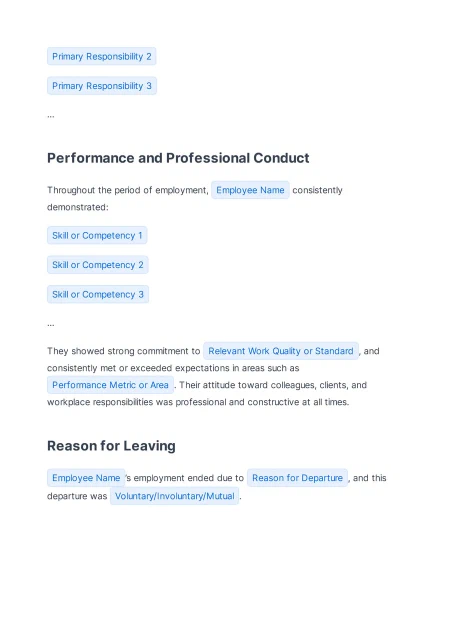
Primary Responsibility 2
Primary Responsibility 3
…
Performance and Professional Conduct
Throughout the period of employment, Employee Name consistently demonstrated:
Skill or Competency 1
Skill or Competency 2
Skill or Competency 3
…
They showed strong commitment to Relevant Work Quality or Standard, and consistently met or exceeded expectations in areas such as Performance Metric or Area. Their attitude toward colleagues, clients, and workplace responsibilities was professional and constructive at all times.
Reason for Leaving
Employee Name’s employment ended due to Reason for Departure, and this departure was Voluntary/Involuntary/Mutual.
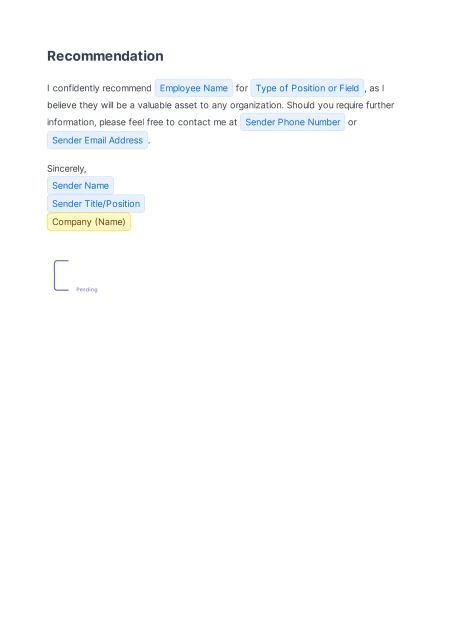
Recommendation
I confidently recommend Employee Name for Type of Position or Field, as I believe they will be a valuable asset to any organization. Should you require further information, please feel free to contact me at Sender Phone Number or Sender Email Address.
Sincerely, Sender Name Sender Title/Position Company (Name)
Pending
Disclaimer: The original creator, the author of this template, and fynk GmbH are not responsible for any damages or liabilities that may result from using this template. This template should not be considered a substitute for legal advice, and consulting with a legal professional is recommended before use. fynk GmbH, the original creator, and the author do not provide legal advice and will not be held accountable for any legal consequences arising from its use.
More than
3,000 teams
chose fynk to outgrow legal chaos.
What an employment reference letter covers and how to use this template
Learn what an employment reference letter is, the difference between a factual reference and a character reference, what to include and what to avoid, and how to use this template to respond to reference requests consistently.
What is an employment reference letter?
An employment reference letter is a formal written statement from a current or former employer confirming the employment history of an individual and, optionally, providing an assessment of their performance and character. It is typically requested by:
Financial institutions verifying employment for mortgage or loan applications
Landlords verifying income and employment stability for tenancy applications
Visa and immigration authorities confirming employment for visa applications
Professional licensing bodies verifying work experience requirements
Reference letters vary in what they cover:
Factual reference - confirms employment dates, job title, and salary only; does not include any assessment of performance or conduct. Many large organizations now provide factual references only as a matter of policy, to limit liability.
Character or professional reference - includes an assessment of the employee’s skills, performance, reliability, and suitability for future roles.
What to include in an employment reference letter
1. Employer details
The letter should be on company letterhead and include:
Company name and address
Name and title of the signatory
Date of the letter
Contact information for follow-up inquiries
The signatory should be a person with direct knowledge of the employee’s work - typically their line manager, HR director, or a senior officer of the company.
2. Employee identification
Identify the employee clearly:
Full legal name
Employee ID or reference number (optional, for internal tracking)
The position held and the department or team
3. Dates of employment
State the precise dates of employment:
Start date
End date (or “to present” for current employees)
Whether the employment was full-time, part-time, or on another basis
Accurate dates are critical - errors can delay or derail the process the employee is trying to complete.
4. Job title and role description
Describe the employee’s role in enough detail to be useful:
Official job title
Key responsibilities and the scope of the role
Seniority level and any direct reports or team leadership
For factual references, this section may be limited to job title only. For professional references, a brief description of responsibilities provides context for the prospective employer.
5. Performance assessment (optional)
If the employer is willing to comment on performance, this section may include:
Overall performance rating or qualitative assessment
Key strengths, skills, or achievements
Suitability for a specific type of role or responsibility
Any noteworthy contributions
This section is entirely at the employer’s discretion. If included, it should be accurate and supportable - inaccurate positive assessments can expose the employer to negligent misrepresentation claims, while unjustified negative statements can constitute defamation.
6. Reason for leaving (optional)
Stating the reason for leaving is discretionary. Where included, it should be factual and neutral - for example, “resigned to pursue a new opportunity” or “role made redundant as part of a company restructure.”
7. Eligibility for rehire (optional)
Some reference requests - particularly from prospective employers - ask whether the employee is eligible for rehire. Employers can decline to answer this question, but if they do respond, the answer should be accurate and consistent with internal records.
8. Contact for further inquiries
Always include a named contact - typically in HR - who can respond to follow-up questions from the recipient. This avoids putting the signatory in the position of handling all inquiries personally.
What to avoid in a reference letter
Inaccurate statements - positive or negative. False statements can lead to negligent misrepresentation (if positive and relied on to the recipient’s detriment) or defamation claims (if negative and untrue).
Discriminatory content - never reference protected characteristics such as age, health, pregnancy, religion, or national origin.
Speculation - stick to what the writer personally knows. Avoid speculating about why the employee left or how they might perform in a different context.
Inconsistency - reference letters for the same employee should be consistent. Inconsistent references can create legal exposure.
Who needs an employment reference letter?
HR and People teams managing the reference request process for current and departing employees
Legal teams advising on liability exposure and ensuring reference letters meet the company’s reference policy
Line managers asked to provide a personal reference for a former direct report
Employees requesting a reference to support a new job application, mortgage, tenancy, or visa application
Small business owners and startups without a formal HR function who need to provide references on an ad hoc basis
How to customize this template
Decide at the outset whether to provide a factual reference (dates and title only) or a full professional reference - many organizations have a stated policy on this.
Confirm the accuracy of all employment dates, job titles, and salary figures before signing.
If including a performance assessment, ensure it is supportable and consistent with the employee’s performance reviews and any internal records.
For employees who left under difficult circumstances, consult legal counsel before including anything beyond factual confirmation.
Always have the letter reviewed by HR before sending, even if it is signed by a line manager.
Keep a copy of every reference letter issued in the employee’s personnel file.
For the underlying employment relationship that the reference covers, see:
This employment reference letter template is ready to customize in fynk. Adjust the employee details, employment dates, role description, and performance assessment for each individual, then send for authorized signature.
With fynk, you can:
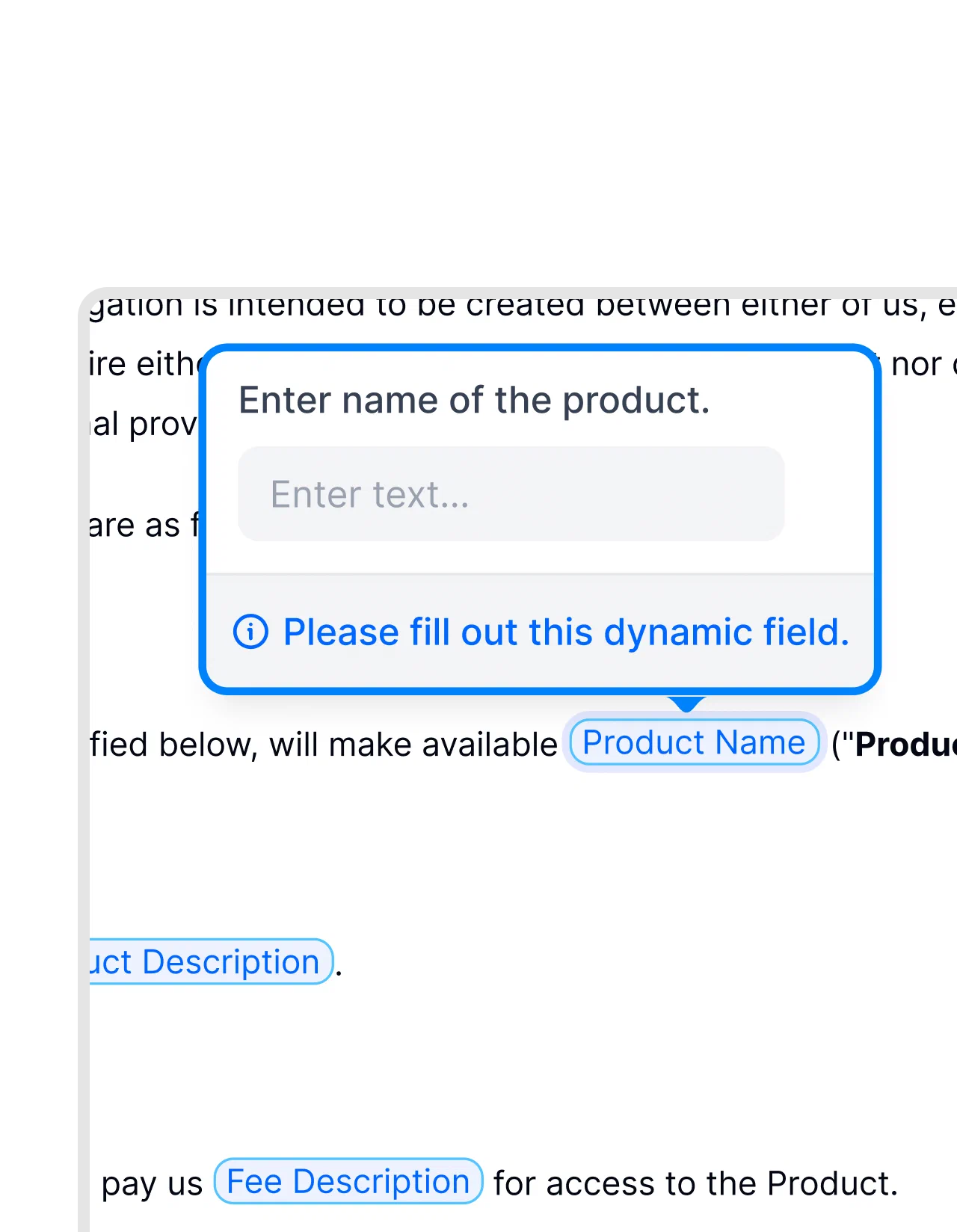
Use dynamic fields to populate the employee’s name, job title, employment dates, and department throughout the letter in one step - eliminating manual errors on dates and titles.
Employee name, job title, and employment dates propagated through every field automatically.
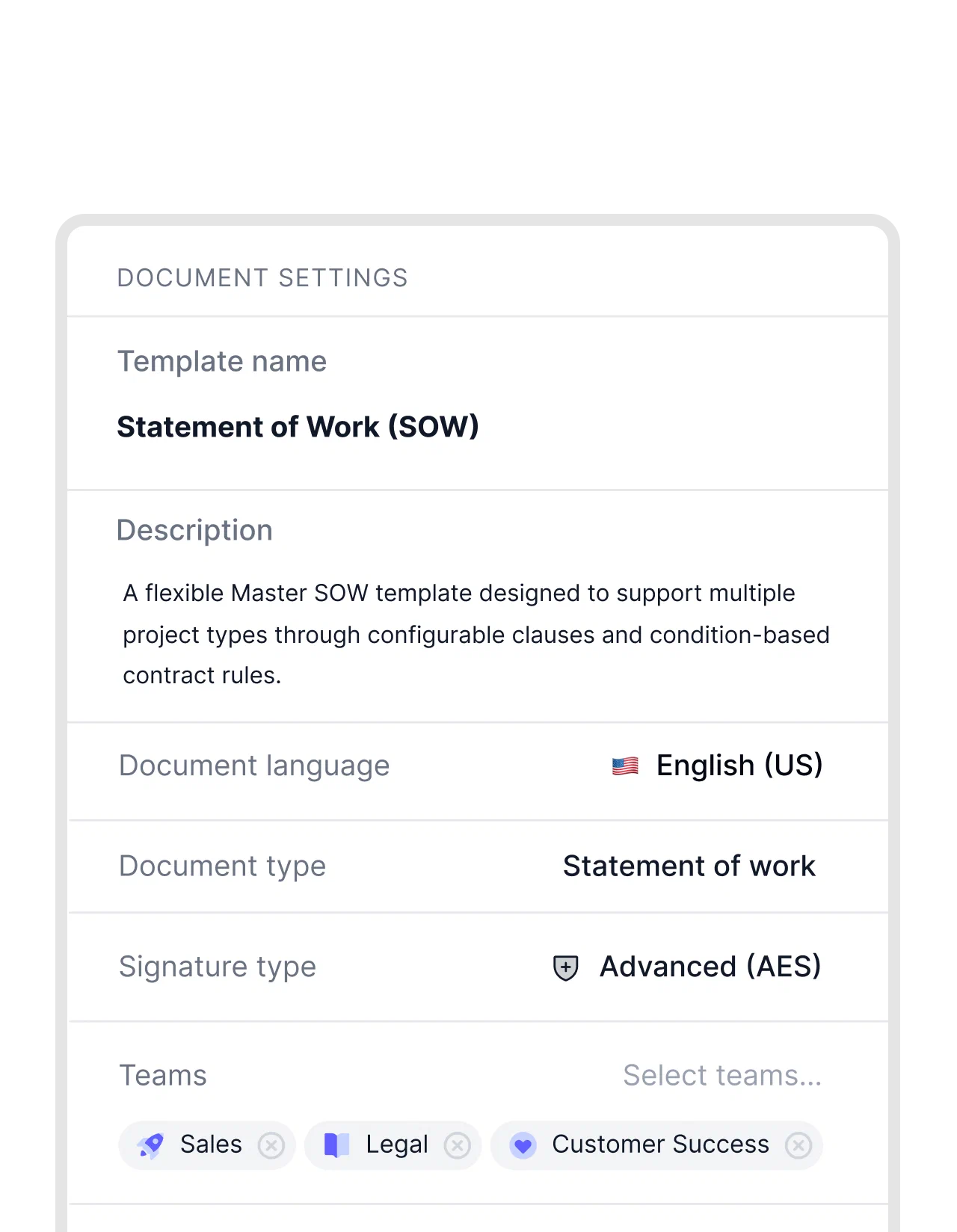
Standardize reference letters across HR teams using a locked template - ensuring consistent language, accurate factual statements, and compliance with the company’s reference policy.
One approved template used by all managers and HR staff.
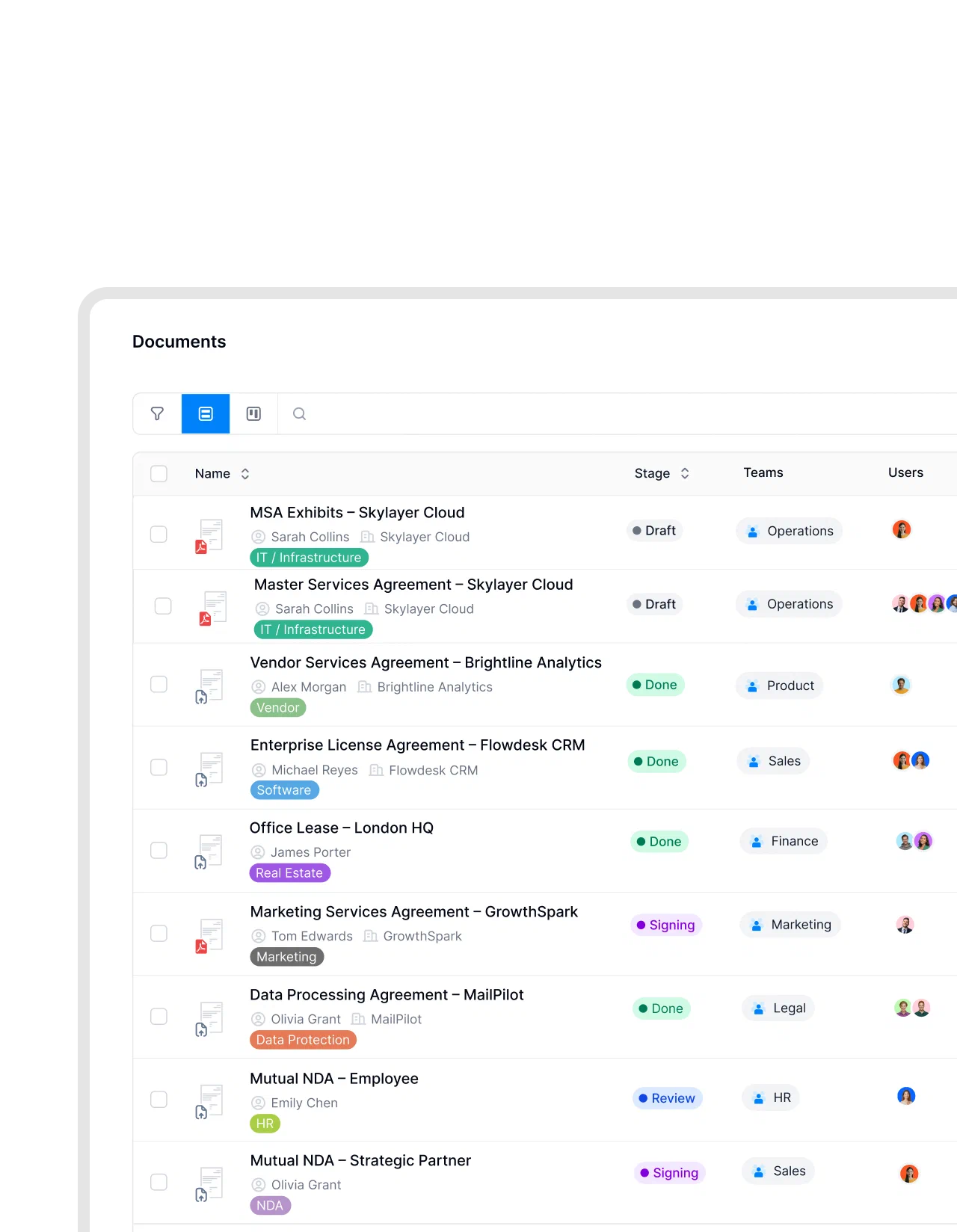
Store every issued reference letter alongside the employee’s employment contract and offboarding documents in a structured document hub.
Reference letters, offer letters, and employment contracts in one searchable workspace.
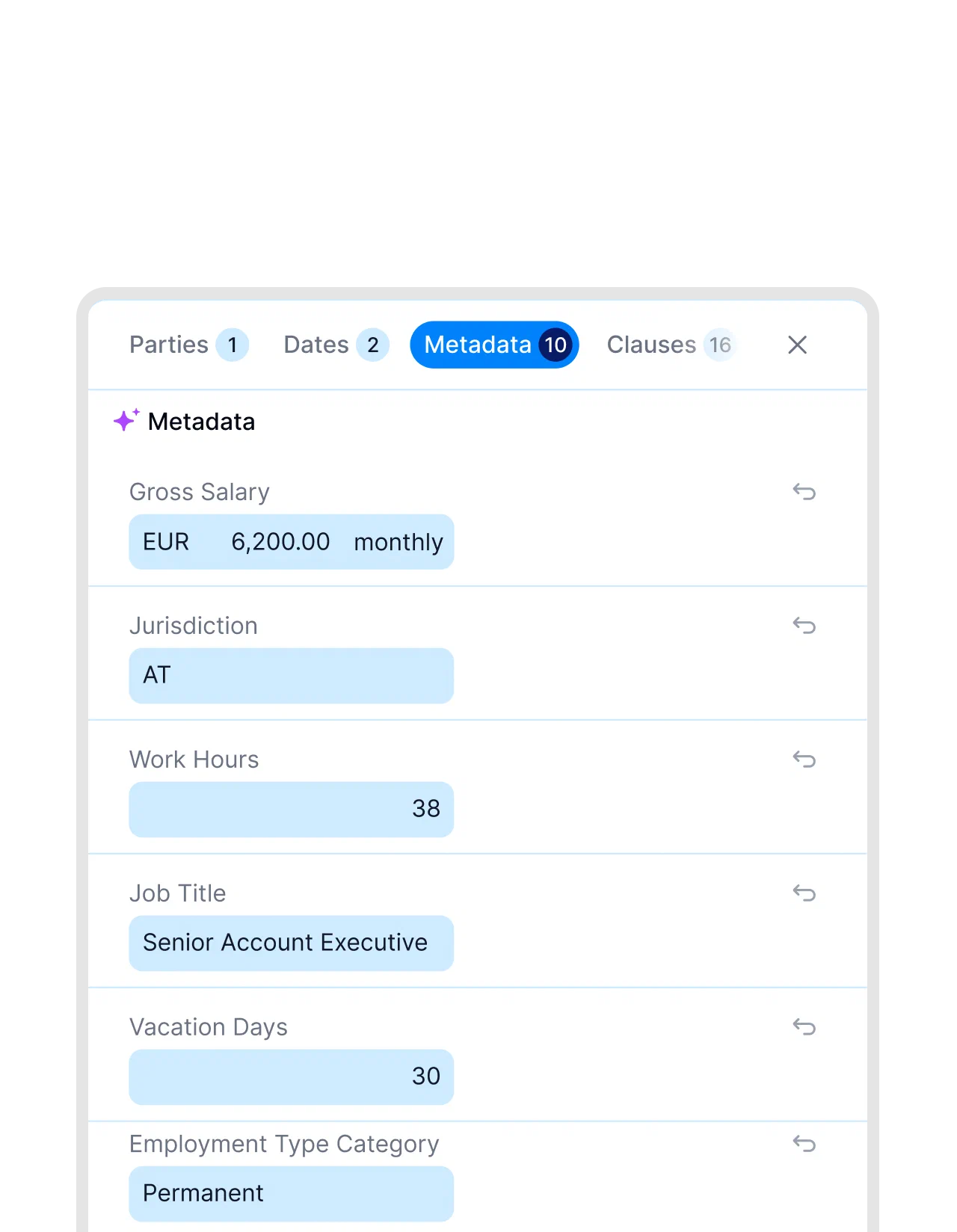
Track reference requests and responses with contract metadata - tag by employee, date issued, and recipient type (employer, financial institution, visa) for easy retrieval.
Reference letters tagged by employee, recipient type, and issue date.
FAQs
An employment reference letter is a formal letter from a current or former employer confirming an employee's job title, dates of employment, role, and - at the employer's discretion - an assessment of their performance, skills, and conduct. It is used by the employee to support job applications, mortgage or loan requests, tenancy applications, and visa processes.
In most jurisdictions, employers are not legally obligated to provide a reference - except in certain regulated industries (such as financial services in the UK, where firms are required to provide references for regulated employees). However, an employer who has agreed in a settlement agreement or contract to provide a reference may be contractually obligated to do so.
An employer can give an honest negative reference, but it must be factually accurate and not motivated by malice or discrimination. A negative reference that contains false statements, or that is given in a discriminatory or retaliatory manner, can expose the employer to defamation or discrimination claims. Many employers limit references to factual confirmation precisely to avoid this risk.
A factual reference confirms only the basic employment facts: job title, dates of employment, and sometimes salary. It does not include any opinion about the employee's performance or suitability. A character or professional reference goes further, providing an assessment of the employee's skills, strengths, reliability, and fit for future roles. Many large employers now provide factual references only as a matter of policy.
A reference letter is not itself a contract - it is a statement of fact and, optionally, opinion. However, a prospective employer who relies on inaccurate statements in a reference letter to make a hiring decision may have a claim for negligent misrepresentation against the issuing employer. This is one reason why accuracy and consistency in reference letters is so important.
Searching for a contract management solution?
Find out how fynk can help you close deals faster and simplify your eSigning process – request a demo to see it in action.