Contract proposal template for software and IT services
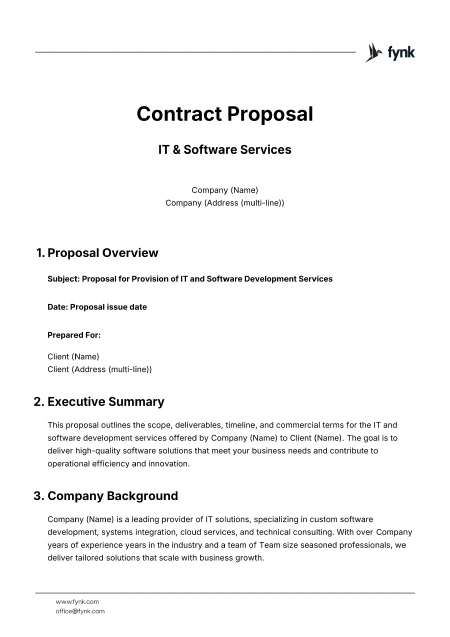
Contract Proposal
IT & Software Services
Company (Name) Company (Address (multi-line))
Proposal Overview
Subject: Proposal for Provision of IT and Software Development Services
Date: Proposal issue date
Prepared For:
Client (Name) Client (Address (multi-line))
Executive Summary
This proposal outlines the scope, deliverables, timeline, and commercial terms for the IT and software development services offered by Company (Name) to Client (Name). The goal is to deliver high-quality software solutions that meet your business needs and contribute to operational efficiency and innovation.
Company Background
Company (Name) is a leading provider of IT solutions, specializing in custom software development, systems integration, cloud services, and technical consulting. With over Company years of experience years in the industry and a team of Team size seasoned professionals, we deliver tailored solutions that scale with business growth.
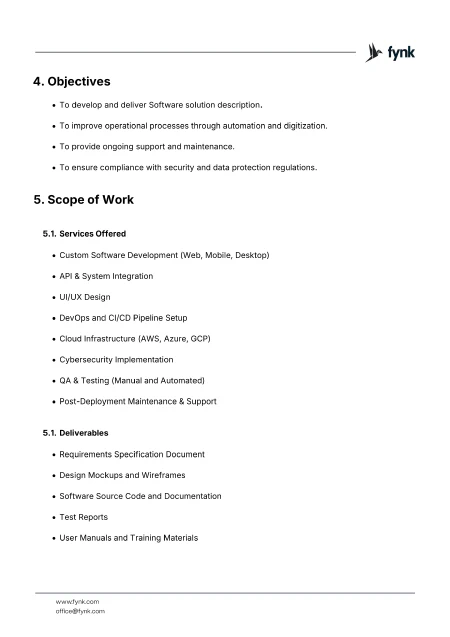
Objectives
To develop and deliver Software solution description.
To improve operational processes through automation and digitization.
To provide ongoing support and maintenance.
To ensure compliance with security and data protection regulations.
Scope of Work
Services Offered
Custom Software Development (Web, Mobile, Desktop)
API & System Integration
UI/UX Design
DevOps and CI/CD Pipeline Setup
Cloud Infrastructure (AWS, Azure, GCP)
Cybersecurity Implementation
QA & Testing (Manual and Automated)
Post-Deployment Maintenance & Support
Deliverables
Requirements Specification Document
Design Mockups and Wireframes
Software Source Code and Documentation
Test Reports
User Manuals and Training Materials
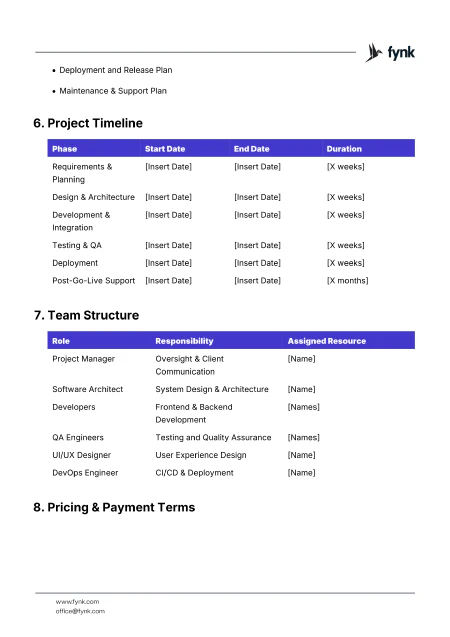
Deployment and Release Plan
Maintenance & Support Plan
Project Timeline
Phase
Start Date
End Date
Duration
Requirements & Planning
[Insert Date]
[Insert Date]
[X weeks]
Design & Architecture
[Insert Date]
[Insert Date]
[X weeks]
Development & Integration
[Insert Date]
[Insert Date]
[X weeks]
Testing & QA
[Insert Date]
[Insert Date]
[X weeks]
Deployment
[Insert Date]
[Insert Date]
[X weeks]
Post-Go-Live Support
[Insert Date]
[Insert Date]
[X months]
Team Structure
Role
Responsibility
Assigned Resource
Project Manager
Oversight & Client Communication
[Name]
Software Architect
System Design & Architecture
[Name]
Developers
Frontend & Backend Development
[Names]
QA Engineers
Testing and Quality Assurance
[Names]
UI/UX Designer
User Experience Design
[Name]
DevOps Engineer
CI/CD & Deployment
[Name]
Pricing & Payment Terms
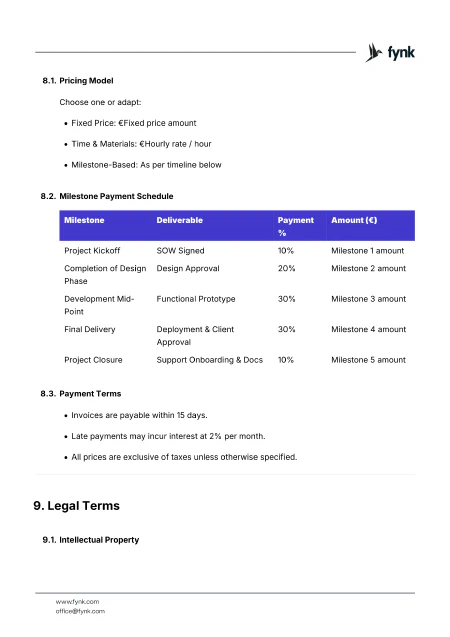
Pricing Model
Choose one or adapt:
Fixed Price: €Fixed price amount
Time & Materials: €Hourly rate / hour
Milestone-Based: As per timeline below
Milestone Payment Schedule
Milestone
Deliverable
Payment %
Amount (€)
Project Kickoff
SOW Signed
10%
Milestone 1 amount
Completion of Design Phase
Design Approval
20%
Milestone 2 amount
Development Mid-Point
Functional Prototype
30%
Milestone 3 amount
Final Delivery
Deployment & Client Approval
30%
Milestone 4 amount
Project Closure
Support Onboarding & Docs
10%
Milestone 5 amount
Payment Terms
Invoices are payable within 15 days.
Late payments may incur interest at 2% per month.
All prices are exclusive of taxes unless otherwise specified.
Legal Terms
Intellectual Property
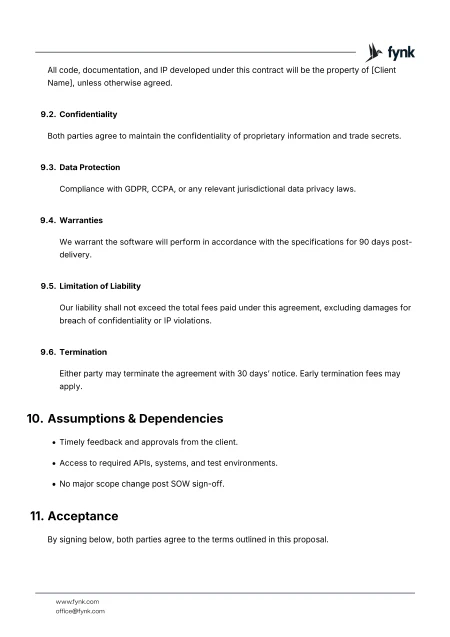
All code, documentation, and IP developed under this contract will be the property of [Client Name], unless otherwise agreed.
Confidentiality
Both parties agree to maintain the confidentiality of proprietary information and trade secrets.
Data Protection
Compliance with GDPR, CCPA, or any relevant jurisdictional data privacy laws.
Warranties
We warrant the software will perform in accordance with the specifications for 90 days post-delivery.
Limitation of Liability
Our liability shall not exceed the total fees paid under this agreement, excluding damages for breach of confidentiality or IP violations.
Termination
Either party may terminate the agreement with 30 days’ notice. Early termination fees may apply.
Assumptions & Dependencies
Timely feedback and approvals from the client.
Access to required APIs, systems, and test environments.
No major scope change post SOW sign-off.
Acceptance
By signing below, both parties agree to the terms outlined in this proposal.
Pending
Pending
Appendix A
Project Schedule Gantt Chart
[Upload files using “Attachments” tab on top of the editor]
Appendix B
Functional Requirement Specification (FRS)
[List detailed functional requirements that the software or system must meet, organized by module or feature.]
Appendix C
Non-Disclosure Agreement (NDA)
[Attach a mutual NDA that outlines confidentiality obligations and restrictions on sharing proprietary information.]
Appendix D
Change Request Template
[Provide a standard form for clients to request scope changes, including fields for description, impact, and approval.]
Appendix E
Support & SLA Terms
[Define the support process, response times, service level commitments, and escalation paths post-deployment.]
Disclaimer: The original creator, the author of this template, and fynk GmbH are not responsible for any damages or liabilities that may result from using this template. This template should not be considered a substitute for legal advice, and consulting with a legal professional is recommended before use. fynk GmbH, the original creator, and the author do not provide legal advice and will not be held accountable for any legal consequences arising from its use.
More than3.000 teamschose fynk to outgrow legal chaos.
Contract proposal for software and IT services explained in simple terms
Learn everything there is about Executive Contract proposal for software and IT services. What they are, when to use them for and what they should contain.
What is a contract proposal for software & IT services?
A Contract Proposal for Software & IT Services is a formal document that outlines the scope, pricing, timeline, and terms of a potential project or engagement between a service provider and a client. Unlike a typical service agreement that comes into play after a deal is sealed, a contract proposal is more of a pitch with structure—it’s designed to win work and set clear expectations from the get-go.
It walks the line between lawyer-approved clarity and sales-savvy persuasion. Basically, it helps your future client see the full picture—what they’re getting, what it’ll cost, when it’ll happen, and how you’ll make tech magic happen. It’s your chance to say, “Here’s what we bring to the table—and why it’s worth every penny.”
Whether you’re diving into SaaS development, managing IT infrastructure, beefing up cybersecurity, or wearing multiple digital hats, this proposal is a wining strategy for you. Write a great contract proposal
, and you’ll cut down on endless email chains, get everyone aligned from day one, and start building trust before a single line of code hits the repo.
Key elements of a software & IT services proposal
Creating a solid IT and software services proposal is your chance to lay down the law (in a friendly, “we’ve got this” kind of way). Let’s break it down, piece by piece.
1. Executive Summary
Think of this as your red-carpet intro. The executive summary gives a bird’s-eye view of the project: what’s being done, who’s involved, and what success looks like. In one quick read, your client should walk away thinking, “Okay, this makes sense—and it sounds like exactly what we need.”
2. Scope of Services
Here’s where the rubber meets the (tech) road. This section spells out the specifics—custom app development, cloud infrastructure, cybersecurity, API wizardry—you name it. Scope of service
also outlines what’s not included, which is just as important. This isn’t just about transparency; it’s your built-in insurance against scope creep.
3. Project Timeline and Milestones
Deadlines don’t have to be scary. A well-laid-out timeline gives your client the full play-by-play—from kickoff to QA and final handoff. Tack on clear milestones, and now you’ve got progress checkpoints that keep everyone honest and everything on track.
4. Pricing and Payment Terms
Let’s talk money—clearly and confidently. Whether it’s a flat fee, upfront payment
, hourly billing, or milestone-based payments
, the payment for service section
should lay out the numbers in a way that aligns with both your cash flow and your client’s comfort zone. Bonus points for breaking it down into bite-sized chunks that show value at every step.
5. Terms and Conditions
Ah, the fine print—less flashy, but make no mistake, it’s the backbone of your proposal. Cover everything from IP ownership to confidentiality
and performance warranties
. The terms and conditions clause
the rulebook that keeps your project (and your relationship) running smoothly, even if things get a little bumpy.
6. Deliverables and Acceptance Criteria
No surprises, no confusion. This section lists every item the client will receive—source code, training docs, UI mockups, the works. Then it adds acceptance criteria, so everyone agrees on what “done” actually looks like. Less room for misinterpretation, more room for happy clients.
7. Confidentiality and Data Protection
This one’s a biggie in the IT world. Reassure your clients that their data is safe with you. Whether it’s GDPR, CCPA, or some other acronym soup, show them you’re serious about compliance and security. Trust starts here—and builds fast when handled right.
8. Termination Clauses
A termination clause
sets the exit ground rules: how much notice is needed, who owes what, and what happens to work in progress. It’s not the most exciting part of the proposal, but it’s the one that saves a ton of headaches down the road.
Tailoring the template to your business
Whether you’re a solo code-slinger or running a fully staffed dev agency, your contract proposal needs to feel custom-fit, not off-the-rack. The goal? Show clients that you get them—and that you’re ready to deliver exactly what they need, how they need it.
For Freelancers vs. Agencies
Freelancers:
If your flying solo, your proposal should spotlight you—your skills, your smarts, your hands-on approach.
🗣️ Tone: Keep it warm and personal, but still polished. You’re not a corporation—you’re the one they’ll be working with.
🧍♂️ Team Structure: Feel free to strip this out or keep it simple. No need to invent a team you don’t have.
💳 Payment Terms: Stick to clear, straightforward setups—hourly rates or milestone payments tend to work best.
🛠️ Maintenance: Offering support after launch? Spell out exactly what’s included (and what’s gonna cost extra).
Agencies
Got a squad? Clients love knowing there’s depth and backup behind the scenes.
👥 Team Structure: Introduce key roles—project manager, lead dev, QA. It shows strength and coverage.
🗓️ Timeline & QA: More moving parts means more room for details. Lay out timelines and quality assurance processes.
➕ Optional Add-ons: Mention extras like DevOps, cloud migration, or AI integration to sweeten the deal.
🔁 Collaborative Deliverables: Think design sprints, iteration reviews, and feedback loops—then put those in writing.
Customizing for Different Service Types
SaaS Development
SaaS projects are marathons, not sprints—your proposal should reflect the long game.
Talk up agile cycles, versioning, and your plan for scalability.
Get specific on backend tech, cloud setup, and multi-user architecture.
Post-launch support? Absolutely. Outline your SLAs and customer success approach.
App Development (Mobile/Web/Desktop)
It’s all about sleek design and seamless performance—make sure that shines through.
Emphasize UI/UX, speed, and cross-platform consistency.
Define your development phases: MVP, beta, full release.
Deliverables should include wireframes, clickable prototypes, and usability testing summaries.
IT Support or Managed Services
Here, dependability is king. Clients want to know you’ll pick up the phone when things go sideways.
Highlight response time guarantees, on-call support, and coverage hours.
Include a separate SLA appendix—clients love their metrics.
Be ultra-clear about what’s included in “support.” Break it down line by line if needed.
When your proposal speaks directly to your business type and your client’s needs, you’re not just pitching—you’re connecting. And that’s how you win deals.
Free contract proposal template
Our contract proposal templatefor Software & IT Services is a great choice that help you setting clear expectations, and building long-term client relationships. Designed to be practical, professional, and flexible, this template gives you a ready-made framework to present your services with confidence.
To get started, simply open the template in the fynk. Begin by replacing all placeholders with your project-specific information—client names, deliverables, pricing details, and timelines. Then, choose a pricing model that fits your workflow, whether it’s fixed-fee, hourly, or milestone-based, and adjust the payment schedule accordingly.
Clearly define the deliverables and outline the acceptance criteria to avoid any misunderstandings down the line. Then, review the legal terms, making adjustments as needed to align with your business model or regional regulations, such as GDPR. Once everything is finalized, both parties can sign the proposal directly in fynk using secure electronic signature blocks
, making the entire process smooth, professional, and legally compliant.
Searching for a contract management solution?
Find out how fynk can help you close deals faster and simplify your eSigning process – request a demo to see it in action.
While both outline what you plan to do for a client, a contract proposal includes legally binding terms (like payment, IP, and liability), whereas a project proposal is often used earlier in the sales process and may be more conceptual.
There’s no set length, but aim for 5–15 pages. The key is clarity, not length. Cover all critical aspects (scope, terms, deliverables) without overwhelming the client with legal jargon or unnecessary filler.
Yes—but always customize it. At a minimum, update the scope of work, pricing, client details, and timelines. A generic proposal can come off as lazy or irrelevant and may create legal risks.
Negotiation is common. Be open to it, but know your non-negotiables (e.g., IP ownership, payment terms). A contract management platform with commenting or redlining features can make this process smoother.
Yes—this is a smart move. You can offer a “core package” and list add-ons (e.g., extended support, performance audits). It gives clients flexibility and can boost your deal size.
Ideally within 24–72 hours. The faster you follow up, the more momentum you retain. Using a customizable template can speed this up without sacrificing quality.
Look for tools that offer template management, version control, e-signatures, and analytics. A contract lifecycle management (CLM) platform like fynk can handle all of these—and more.
If you’re sharing sensitive technical plans, yes. Many providers include an NDA appendix or attach a separate agreement to protect IP and business insights during the proposal stage.