
professional services
The professional services clause outlines the scope, responsibilities, and standards by which a provider delivers specialized or skilled services to a client, ensuring both parties clearly understand their commitments. It often specifies deliverables, timelines, and quality expectations to safeguard the interests of both the service provider and the client.
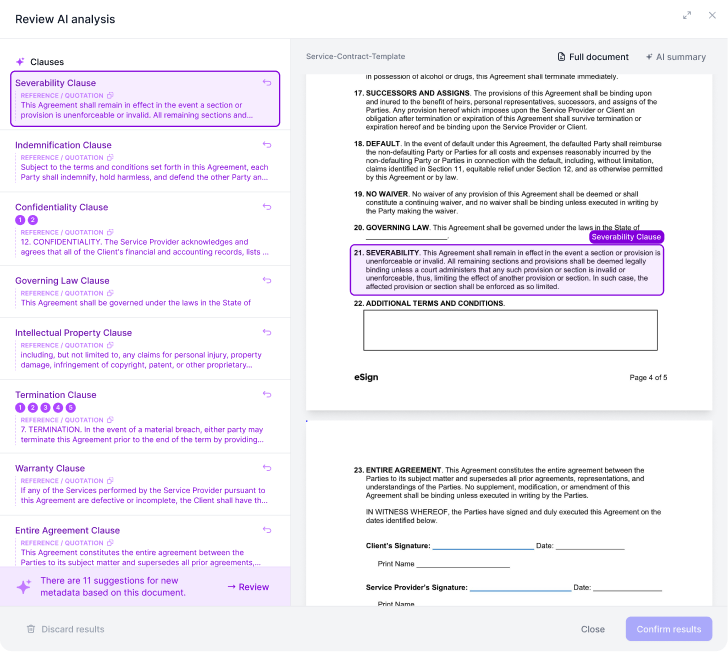
Analyze your contracts. Extract important clauses.
Try our AI contract analysis and extract important clauses and information from existing contracts.
Save your favourite clauses
Insert directly with a single click
Upload preferred precedents
Sample professional services clauses
Source
Micropolis Holding CoSISW will perform services (“Professional Services”) and produce the deliverables described in one or more statements of work (“SOW”).
…the Professional Services shall take place on such dates, times, and at such locations as mutually agreed to in writing and in advance by the parties. Professional consents to Company or its designee creating a videotape and/or audio-recording (collectively, the “Recording”) of the Professional Services, in whole or in part, which Company shall use for internal purposes only. Professional acknowledges that Company shall own all right, title, and interest in and to the intellectual property fixed in the Recording. Professional waives and transfers any so-call “moral” rights or rights of attribution or integrity Professional may have in the Recording.
Source
IronNet, Inc.We sell professional services, including development of national cyber security strategies, cyber operations monitoring, security, training, red team, incident response and tailored maturity assessments. Revenue derived from these services is recognized as the services are delivered.
Professional services revenue is derived primarily from fees for enabling services, including solution consulting and solution deployment. These services are often sold in conjunction with the sale of [Company’s] solutions. [Company] provides professional services primarily on a time and materials basis, but also on a fixed fee basis. Customers are invoiced for professional services either monthly in arrears or, as with fixed fee arrangements, in advance and upon reaching project milestones. Professional services revenue is recognized over time.
What is professional services?
Professional services refer to specialized services provided by professionals using their expertise and experience in specific areas. These services often require advanced education and training and are usually provided by licensed or certified individuals or firms. Common categories include accounting, legal, consulting, engineering, architecture, and marketing services. Professionals in these fields offer strategic advice and solutions tailored to the client’s specific needs.
When should I use professional services?
You should consider using professional services when:
- You require specialized expertise that you or your team do not possess.
- There is a need for unbiased, professional advice on complex issues.
- Legal, financial, or environmental compliance needs to be assured.
- Strategic planning and execution for projects or business operations are necessary.
- Efficiency and effectiveness in achieving business objectives need enhancement.
For example, a company might hire an accounting firm to ensure compliance with tax laws or a legal firm to manage complex contracts.
How do I write professional services contracts?
Writing professional services contracts involves several key steps and considerations:
- Define the scope of work: Clearly outline the services to be provided, including deliverables and deadlines.
- Payment terms: Specify how and when payments will be made, including rates, billing frequency, and payment methods.
- Responsibilities and obligations: Detail the responsibilities of both parties, including necessary support from the client.
- Confidentiality and data protection: Include clauses that protect sensitive information.
- Termination conditions: Describe circumstances under which the contract may be terminated by either party.
- Dispute resolution: Specify how disputes will be handled, such as through mediated negotiation or arbitration.
A well-drafted professional services contract mitigates potential disputes and provides legal protection for both parties.
Which contracts typically contain professional services?
Professional services are typically delivered under various types of contracts, such as:
- Service Agreements: Detailing the nature of services, payment terms, and responsibilities.
- Consulting Agreements: Focused on advice and strategic planning support.
- Engagement Letters: Often used by accounting or audit firms to outline terms of service.
- Management Service Agreements: Involving ongoing management and advisory roles.
- Freelancer Contracts: Protects both freelancer and client when engaging independent professionals.
These contracts ensure that both parties have clear expectations, legal protection, and agreed-upon terms for the duration of the services provided.
Templates referencing “professional services”
These templates contain the clause you just read about.
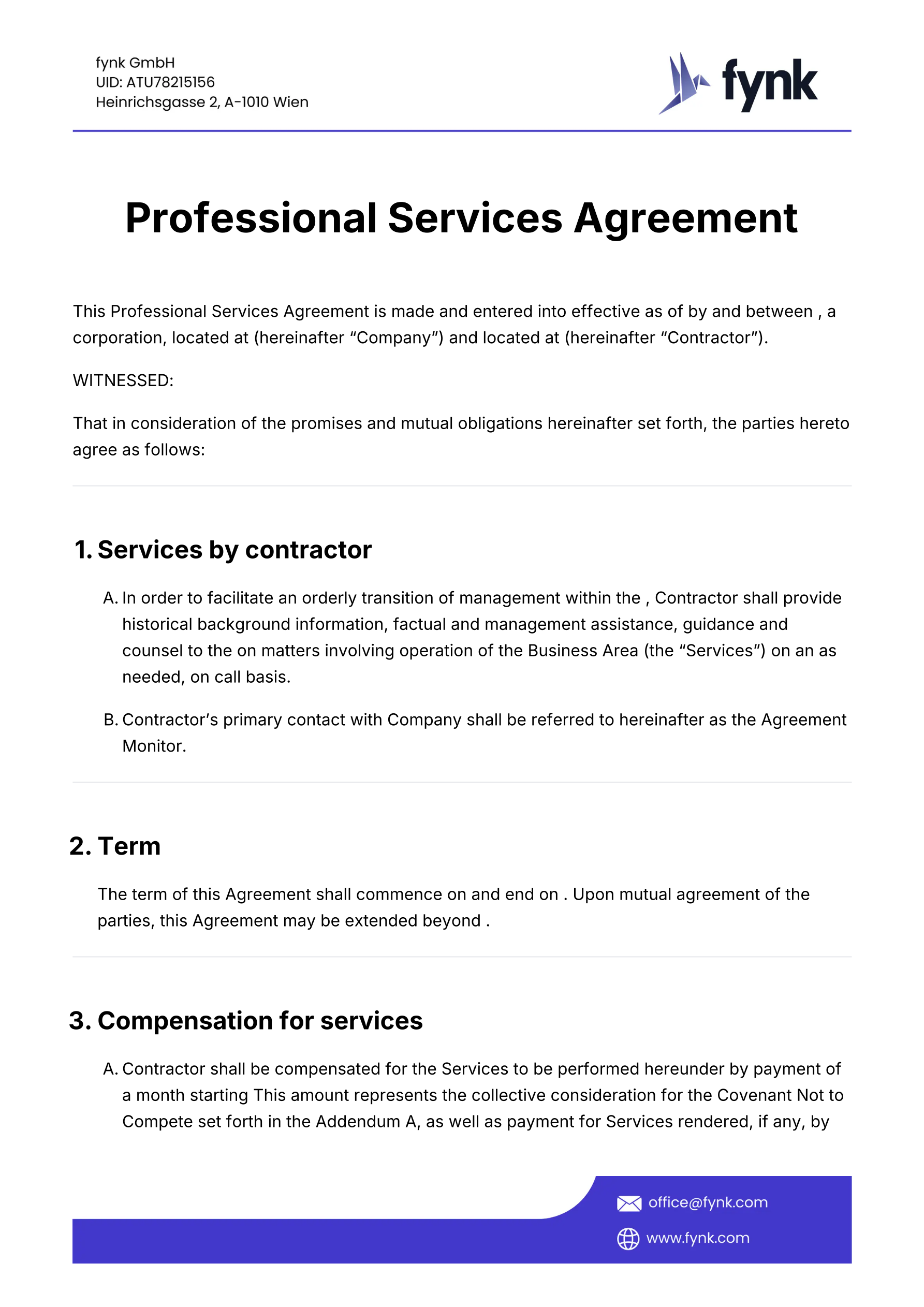
Professional services agreement template
A professional services agreement template that establishes terms for consulting, advisory, or transition support services.
More clauses from the library
See allPromise to pay
A "Promise to Pay" clause is a contractual agreement where one party commits to making a specified payment to another party under outlined conditions. This clause serves as a legal assurance of payment, detailing the amount, payment method, and deadline to ensure clarity and accountability between the parties involved.
17 example clauses
Proper cause
The "proper cause" clause specifies that any action or decision by a party, such as termination of a contract, must be based on a legitimate and justifiable reason that is aligned with the terms agreed upon in the contract. This clause is intended to prevent arbitrary or unfair actions and ensure that both parties adhere to agreed standards and expectations.
5 example clauses
Proprietary information and confidentiality
The "Proprietary Information and Confidentiality" clause ensures that any proprietary or confidential information shared between parties remains protected and is not disclosed to unauthorized individuals or entities. It restricts the use of such information solely for the purposes defined in the contract, safeguarding the interests of the party that owns the information.
12 example clauses
Analyze your contracts. Extract important clauses.
Try our AI contract analysis and extract important clauses and information from existing contracts.
Save your favourite clauses
Insert directly with a single click
Upload preferred precedents