
interpretation
The interpretation clause in a contract provides guidance on how the terms and definitions within the agreement should be understood and applied. It helps prevent ambiguities by clarifying the meanings of specific words or phrases, ensuring that all parties have a consistent understanding of the contractual terms.
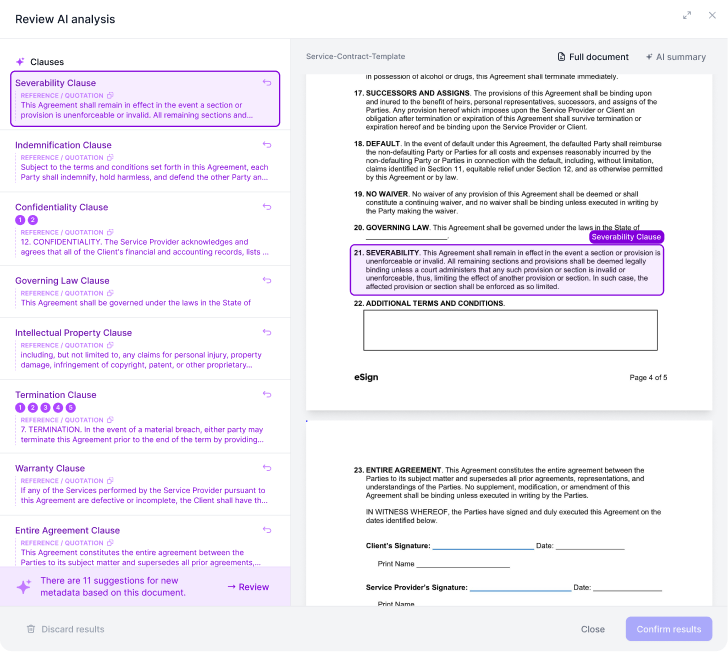
Analyze your contracts. Extract important clauses.
Try our AI contract analysis and extract important clauses and information from existing contracts.
Save your favourite clauses
Insert directly with a single click
Upload preferred precedents
Sample interpretation clauses
Source
TuanChe Ltd (TC)The conclusion, validity, interpretation, performance, modification and termination hereof and the settlement of disputes arising from this Consent Letter shall all be governed by the Chinese laws. Any dispute arising from the interpretation and performance hereof shall first of all be settled by the signatories hereto through friendly negotiation. Where the dispute is still not settled within thirty (30) days upon written notification by a Party to the other Parties requesting for the settlement of the dispute through negotiation, any Party may submit the dispute to China International Economic and Trade Arbitration Commission for settlement in accordance with its arbitration rules. The arbitration shall be held in Beijing, and the language of the arbitration shall be Chinese. The arbitration award shall be final and binding upon the Parties.
- Arkansas, New York. If Employee’s primary place of employment with the Company is located in either of these states, the following term shall apply to the interpretation of this Agreement and supersede any conflicting terms…
Source
TuanChe Ltd (TC)The conclusion, validity, interpretation, performance, modification and termination hereof and the settlement of disputes arising from this Consent Letter shall all be governed by the Chinese laws. Any dispute arising from the interpretation and performance hereof shall first of all be settled by the signatories hereto through friendly negotiation. Where the dispute is still not settled within thirty (30) days upon written notification by a Party to the other Parties requesting for the settlement of the dispute through negotiation, any Party may submit the dispute to China International Economic and Trade Arbitration Commission for settlement in accordance with its arbitration rules. The arbitration shall be held in Beijing, and the language of the arbitration shall be Chinese. The arbitration award shall be final and binding upon the Parties.
This Opinion is rendered only with respect to the PRC Laws. We have made no investigation of, and do not express or imply any views on, the laws and regulations of any other jurisdiction. This Opinion relates only to the PRC Laws in effect on the date hereof and there is no guarantee that any of such PRC Laws, or the interpretation thereof or enforcement therefor, will not be changed, amended or revoked in the immediate future or in the longer term with or without retroactive effect. This Opinion is subject to the discretion of any competent Governmental Agencies in exercising their authority in the PRC in connection with the interpretation, implementation and application of relevant PRC Laws. We make no prediction as to any revision, adjustment or new interpretation of PRC Law or related government policy, nor is this opinion intended to contain any advice or suggestion in respect of any such prediction. There is no guarantee that any PRC Law, or the interpretation or enforcement thereof, will not be changed, amended or revoked in the future with or without retrospective effect.
1.7 Effect of Headings The headings in this First Supplemental Indenture are for convenience only and shall not affect the construction or interpretation of this First Supplemental Indenture. Unless otherwise expressly specified, references in this First Supplemental Indenture to specific Article numbers or Section numbers refer to Articles and Sections contained in this First Supplemental Indenture, and not the Indenture or any other document.
Section 5. Headings. All headings in this Third Amendment are included only for convenience and ease of reference and shall not be considered in the construction and interpretation of any provision hereof.
Source
Cool Holdings, Inc.SECTION THIRTEEN: The validity and interpretation of the Offer and the Agreement shall be governed and construed exclusively by the laws of the Argentine Republic. Any dispute that may arise regarding the interpretation, compliance, scope or validity of the Offer and the Agreement, the Parties shall submit exclusively to the jurisdiction of the federal civil and commercial national courts of the City of Buenos Aires, waiving expressly any other jurisdiction that may apply.
In the case of any conflict of interpretation or definition between this Agreement and the Existing Syndicated RCF, the Bank’s interpretation shall prevail (acting reasonably and in good faith at all times).
Interpretation In this agreement the following rules of interpretation apply unless the contrary intention appears: (a) headings are for convenience only and do not affect the interpretation of this agreement…
What is Interpretation?
Interpretation is the process of explaining or presenting the meaning of something. It involves clarifying and making sense of a subject, text, or concept to enhance understanding. Interpretation can refer to a wide range of contexts, including legal documents, literary works, artworks, and more. In essence, it is about providing insight and meaning beyond the literal understanding.
When Should I Use Interpretation?
You should use interpretation when you need to explain or provide a deeper understanding of something that may not be immediately clear or is open to multiple meanings. Key scenarios include:
- Legal Contracts: To clarify terms and conditions that might be ambiguous.
- Literature: To unpack the themes, symbols, and messages within a text.
- Art: To explain or find meaning in artistic expressions and motifs.
- Conversations: To understand the underlying intentions or subtleties in spoken communication.
How Do I Write Interpretation?
Writing an interpretation involves several steps:
- Identify the Subject: Clearly specify what you’re interpreting.
- Gather Contextual Information: Understanding the background and context is crucial.
- Analyze the Content: Break down the material into parts and examine them.
- Provide Insight: Offer an explanation that uncovers deeper meaning or significance.
- Support with Evidence: Use examples, quotes, or data to back up your interpretation.
Example: When interpreting a Shakespearean play, highlight themes such as ambition or fate, using specific dialogues or scenes as evidence.
Which Contracts Typically Contain Interpretation?
Contracts that often contain interpretation clauses include:
- Employment Contracts: Terms regarding job roles, responsibilities, and termination conditions may require interpretation.
- Service Agreements: The scope of services provided can be subject to interpretation.
- Lease Agreements: Terms related to maintenance and usage might need clarification.
- Partnership Agreements: Clauses about profit sharing or decision-making authority require clear interpretation to avoid disputes.
Example: In an employment contract, the phrase “reasonable efforts” in the context of job performance could be interpreted differently by the employer and the employee.
More clauses from the library
See allInterruption of services
The "Interruption of Services" clause outlines the conditions and responsibilities associated with temporary or permanent disruptions in the provision of services outlined in a contract. It typically includes information on notification requirements, potential remedies, and liability limitations for the parties involved when service interruptions occur.
9 example clauses
Intuitu personae
The "intuitu personae" clause emphasizes the personal nature of a contractual relationship, indicating that the contract has been entered into specifically because of the individual qualities or characteristics of the parties involved. Such a clause often restricts the ability to transfer or assign rights and obligations to third parties without consent, as the identity and personal attributes of the involved parties are crucial to the contract's intent.
7 example clauses
Irrevocable power of attorney
An "irrevocable power of attorney" clause grants an agent the enduring authority to act on behalf of the principal, with the power remaining effective even if the principal becomes incapacitated or decides to revoke it. This provision is typically used in situations where continuity of decision-making is critical, such as in financial transactions or business operations.
20 example clauses
Analyze your contracts. Extract important clauses.
Try our AI contract analysis and extract important clauses and information from existing contracts.
Save your favourite clauses
Insert directly with a single click
Upload preferred precedents