
Golden Parachute
The Golden Parachute clause is a provision in an executive's employment contract that provides substantial financial benefits if the executive's employment is terminated, typically due to a merger or takeover. These benefits may include severance pay, bonuses, and accelerated stock options, offering a safety net that mitigates the impact of sudden job loss.
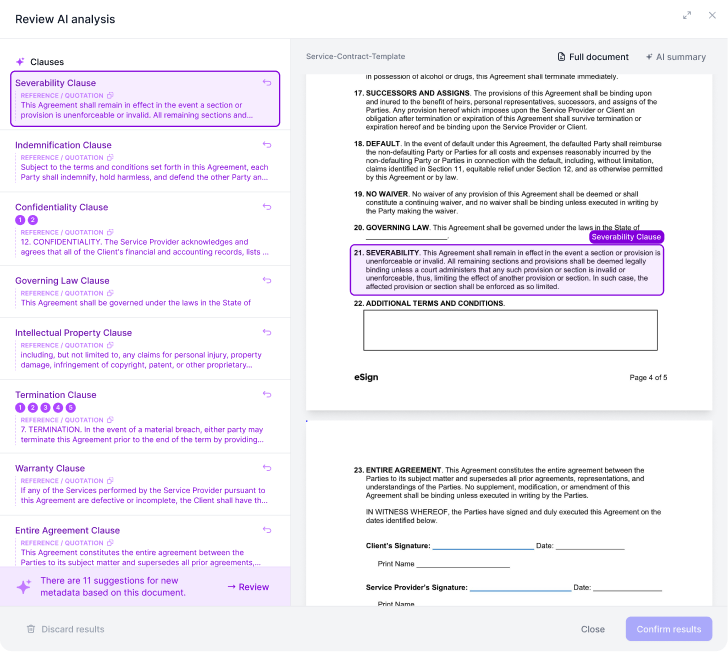
Analyze your contracts. Extract important clauses.
Try our AI contract analysis and extract important clauses and information from existing contracts.
Save your favourite clauses
Insert directly with a single click
Upload preferred precedents
Sample Golden Parachute clauses
In this section, the term “golden parachute” describes the Merger-related compensation that will or may be payable to the Company’s named executive officers. The table below sets forth, for the purposes of this golden parachute disclosure, the amount of payments and benefits (on a pre-tax basis) that each of the Company’s named executive officers would receive…
No Employment or Golden Parachute Agreements: The Firm does not provide golden parachute agreements. There are no employment agreements and Named Executive Officers (“NEOs”) are not entitled to special severance benefits.
With respect to “golden parachute” compensation in particular, the Company notes that any future “golden parachute” compensation primarily consists of certain employment termination payments and benefits that would only be payable in the event that certain future actions are taken, and certain conditions are satisfied…
Under the Severance Plan, severance benefits to any executive cannot exceed the amount permitted under the Company’s Golden Parachute Policy unless approved by a vote of the Company’s stockholders. Further, if any of the executive’s payments under the Severance Plan or otherwise would be subject to “golden parachute” excise taxes under the Internal Revenue Code, the payments to the executive will be reduced in order to limit or avoid the “golden parachute” excise tax if and to the extent such reduction would produce an expected better after-tax result for the executive.
Source
CENTENE CORP (CNC)[We] and you will cooperate in good faith to modify the treatment of your outstanding…severance and equity awards to provide for treatment that minimizes or eliminates the imposition of a Section 280G golden parachute excise tax on you while maintaining as closely as possible the intended treatment of such equity awards as set forth in this Agreement. Notwithstanding the foregoing, you acknowledge that you will be solely responsible for any taxes you incur under Sections 280G or 4999 of the Internal Revenue Code of 1986, as amended (the “Golden Parachute Provisions”).
This section sets forth the information required by Item 402(t) of Regulation S-K regarding the compensation for each of the Company’s named executive officers that is based on or otherwise relates to the Merger. This compensation is referred to as “golden parachute” compensation by the applicable SEC disclosure rules. The amounts set forth in the table are estimates based on multiple assumptions that may or may not actually occur, including assumptions described in this Schedule 14D-9 and in the footnotes to the table. As a result, the actual amounts, if any, that a named executive officer receives may materially differ from the amounts set forth in the table.
[We] will not make any payment to you following a termination of your employment, to the extent such payments are deemed by [us], in [our] reasonable discretion, to be “golden parachute payments”, prohibited by applicable regulations. Notwithstanding anything herein to the contrary, any payments contemplated by this letter are subject to and conditioned on their compliance with applicable laws and regulations, including without limitation the FDIC’s regulations governing “golden parachute payments”.
9.7 Golden Parachute Payment. If the payment or provision of any amounts or any benefits, including Severance Benefits, hereunder would be a Golden Parachute Payment that is prohibited by applicable law, then such payment, provision or benefit will be reduced to the Golden Parachute Limit. For purposes of this Section 9.7, “Golden Parachute Payment” means a golden parachute payment within the meaning of Section 18(k) of the Federal Deposit Insurance Act and “Golden Parachute Limit” means the greatest amount of payment, provision or benefit under this Plan that could be made to the Participant without having any portion of such payment, provision or benefit be a Golden Parachute Payment.
- Golden Parachute Limitation: The payments and benefits payable to the Executive under this Agreement and all other contracts, arrangements, or programs with the Company shall not, in the aggregate exceed the maximum amount that may be paid to the Executive without triggering golden parachute penalties under Section 280G of the Internal Revenue Code of 1986, as amended (the “Code”), as determined in good faith by the Company’s independent auditors.
Golden Parachute Compensation. This section sets forth the information required by Item 402(t) of Regulation S-K regarding the compensation that is based on or otherwise related to the Offer and the Merger for each of the Company’s “named executive officers” included in the Definitive Proxy Statement on Schedule 14A, filed by the Company on April 23, 2020, which is filed as Exhibit (e)(3) to this Schedule 14D-9, and is incorporated herein by reference. This compensation is referred to as “golden parachute” compensation by the applicable SEC disclosure rules. In this section, the term “golden parachute” describes the Merger-related compensation that will or may be payable to the Company’s named executive officers.
What is a Golden Parachute?
A “Golden Parachute” refers to a substantial financial package awarded to executives in the event that they are terminated or demoted, often due to a merger or acquisition. These packages typically include generous severance pay, stock options, and other benefits. The term invokes the image of an executive softly landing after being ejected from their role, cushioned by financial security.
When should I use a Golden Parachute?
Golden Parachutes are generally used in corporate settings where high-level executives need to be protected or incentivized during potentially tumultuous times like mergers and acquisitions. Companies might implement these to:
- Attract Talent: Assure incoming executives that they will be protected financially.
- Encourage Objectivity: Allow executives to make decisions in the best interest of the company without fear of losing their livelihood.
- Retain Executive Stability: Ensure continuity in leadership by reducing the risk of key executives leaving abruptly.
How do I write a Golden Parachute?
Writing a Golden Parachute involves detailing specific conditions and benefits that apply upon the termination of an executive. Key components often include:
- Triggering Events: Define the specific circumstances under which the parachute will be activated (e.g., change of control, merger).
- Compensation Details: Clearly outline the severance package, which may include salary continuation, bonuses, stock options, and benefits.
- Timing and Duration: Specify the timeframe for payouts and how long benefits will continue.
It’s advisable to consult with a legal expert to ensure compliance with corporate laws and regulations.
Which contracts typically contain a Golden Parachute?
Golden Parachutes are typically found in employment contracts or executive compensation agreements for C-suite executives. These may include specific terms embedded in:
- Employment Agreements: Contracts outlining the terms of employment for executives.
- Merger and Acquisition Agreements: Documents where conditions are set for transitions in corporate control.
- Executive Compensation Plans: Comprehensive packages detailing payment and bonuses for high-ranking officials.
These contracts are designed to protect both the organization and the individual, ensuring clarity and financial security during corporate changes.
More clauses from the library
See allGood faith deposit
A good faith deposit is an initial sum paid by a buyer to demonstrate their genuine intent to complete a transaction and secure the terms of a contract. This deposit is typically credited towards the total purchase price upon successful completion of the agreement or may be forfeited if the buyer fails to fulfill their obligations.
16 example clauses
Good faith negotiation
The "Good Faith Negotiation" clause mandates that all parties involved in a contract engage in sincere and honest discussions to resolve any disputes or issues that arise, endeavoring to reach a mutually acceptable agreement without resorting to litigation. This clause ensures that parties commit to cooperative problem-solving and maintain transparent communication throughout the negotiation process.
7 example clauses
Governing law and jurisdiction
The "Governing Law and Jurisdiction" clause specifies which region's legal framework will be applied in interpreting and enforcing the terms of a contract and designates the location where any legal disputes will be resolved. This clause is crucial for determining procedural and substantive legal matters, ensuring both parties are aware of the legal standards and courts that will have authority in case of conflicts.
14 example clauses
Analyze your contracts. Extract important clauses.
Try our AI contract analysis and extract important clauses and information from existing contracts.
Save your favourite clauses
Insert directly with a single click
Upload preferred precedents